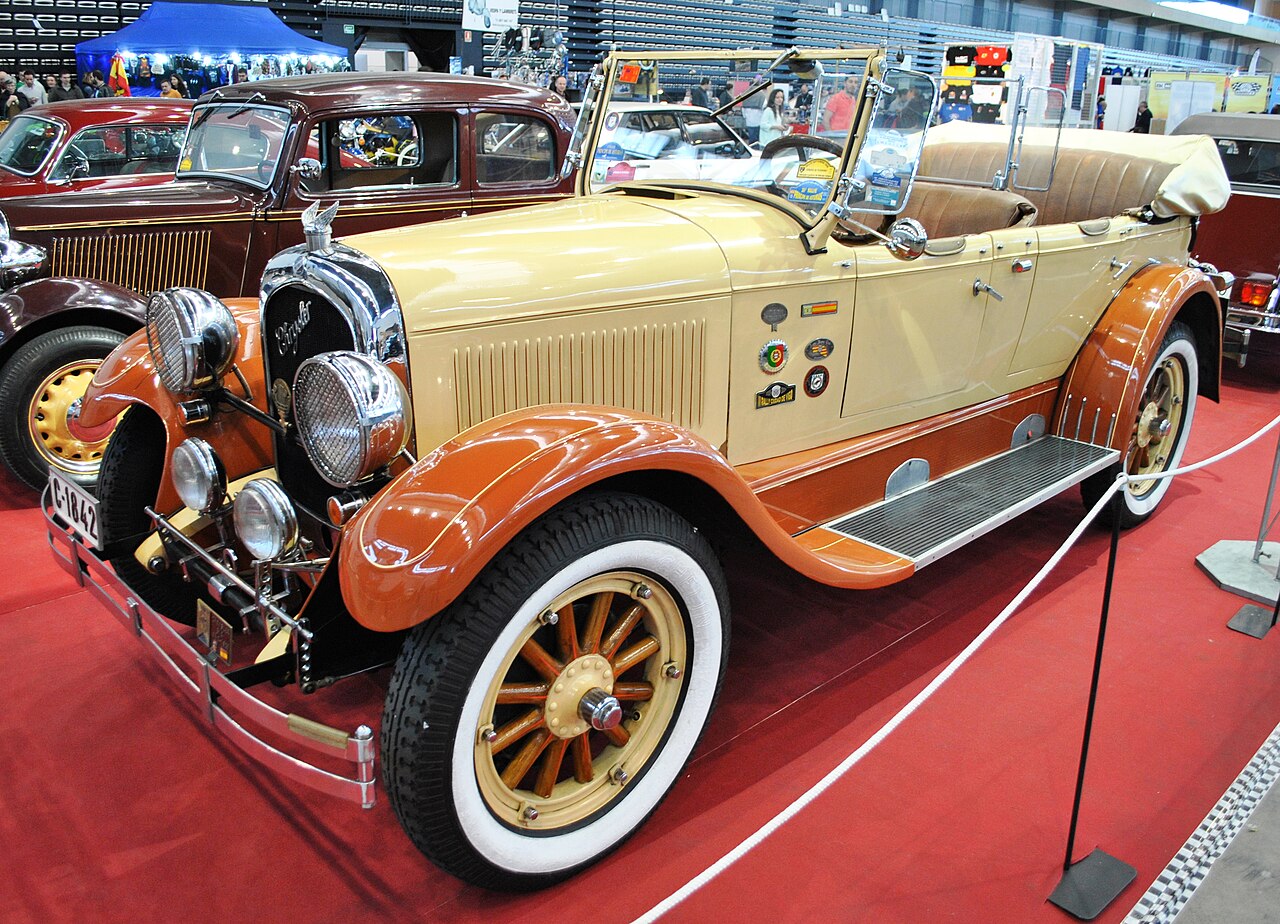
This car's own model number was a promise: Chrysler's Series badges in the 1920s stated the top speed the car could actually sustain, so a Series 70 meant 70 mph, continuously.
Median 47 hp across 40 similar cars
Lead trim: Six 180.2 cu in I6 (1927–1929)
Chrysler Six Series 60/70, 62/72, 65/75Series 60/70/62/72/65/75 · 1927–1929
- 0spots by members
- Unclaimednobody has spotted one yet
- 0sets it belongs to
Nobody in Burbles has spotted a Chrysler Six Series 60/70, 62/72, 65/75 yet. See one on the street, point the app at it, and the first card is yours — with your @handle permanently credited on this page.
FactThis car's own model number was a promise: Chrysler's Series badges in the 1920s stated the top speed the car could actually sustain, so a Series 70 meant 70 mph, continuously.
The Series 60 was the shorter-wheelbase version of the Model G-70 in 1927, while the Series 70 remained on the longer wheelbase (the page gives two Series 70 wheelbases, 112.75 in and 120 in, so none is entered). The Series 60 was developed from the previous Series 50, which had only a four-cylinder engine and was changed into the Plymouth Model Q; it had the upgraded interior and the six-cylinder engine, and was offered in six two-door body styles (including roadsters) and open or closed four-door styles, while the Series 70 offered seven two-door and five four-door body styles, with "sport" or "custom sport" names for phaetons, rumbleseat coupes, convertibles and a landau brougham. Standard equipment included hydraulic brakes, one-piece glass windshields, a Delco-Remy ignition system and a coincidental lock on the manual transmission; both series had 30-inch wheels, wooden-spoke or pressed steel discs. The Dodge Six of 1927 was based on the Series 60, and in 1928 the entry-level Series 50 was rebranded Plymouth. For 1928 the Series 62 and Series 72 offered appearance changes and engineering improvements at unchanged retail prices, with a taller radiator, headlight posts attached directly to the chassis, a tubular front axle, rubber shock insulators on the leaf springs, throttle and headlight controls on the steering wheel hub, an electric gas gauge and an exterior sun visor; the Series 62 four-door Landau Sedan was listed at US$1,235 on a 109 in wheelbase and the Series 72 Imperial Town Cabriolet by LeBaron at US$3,595 on a 120.5 in wheelbase. Four Series 72 roadsters ran the 1928 24 Hours of Le Mans, two finishing third and fourth in their class; the Series 62 was badge-engineered as the DeSoto Six in 1929. For 1929 the Series 65 had a 112.75 in wheelbase and the Series 75 a 121 in wheelbase, both with narrow-profile radiators, a higher cowl, a keyhole ignition switch and built-in adjustable radiator shutters (silver and black dashboards for the 65, gold and black for the 75); a Series 75 and a Series 77 roadster ran the 1929 Le Mans, finishing sixth and seventh in class. The engines listed for the period were a 180.2 cu in (3.0 L) Chrysler I6 (1927–1929) and a 248.9 cu in (4.1 L) Chrysler I6 (1928–1929).
Collectors Spotted in the Chrysler Six Lineage
No member has published a public street spot of the Chrysler Six yet — the First · Worldwide stamp is wide open.
Trims & Figures
7 published trims in the catalogue. A blank is a figure not recorded, not zero.
| Trim | Years | Engine | Power | Torque | 0–60 | Drive | Gearbox | MSRP |
|---|---|---|---|---|---|---|---|---|
| Six 180.2 cu in I6 (1927–1929) | 1927–1929 | 3.0 L Inline-6 | 54 hp | — | — | — | — | — |
| Six 248.9 cu in I6 (1928–1929) | 1928–1929 | 4.1 L Inline-6 | — | — | — | — | — | — |
| Six Series 60 (1927) | 1927–1927 | — | — | — | — | — | — | — |
| Six Series 62 (1928) | 1928–1928 | — | — | — | — | — | — | — |
| Six Series 65 (1929) | 1929–1929 | — | — | — | — | — | — | — |
| Six Series 72 Imperial Town Cabriolet (1928) | 1928–1928 | — | — | — | — | — | — | — |
| Six Series 75 (1929) | 1929–1929 | — | — | — | — | — | — | — |
Owning one
We don’t estimate running costs for a car like this. What it costs depends on its condition, its specialist and how it is driven, and an average would mislead.
Owners’ builds
Nobody has claimed one yet.
Photographs
In 1934 Chrysler's radical new Airflow couldn't be sold as a bare chassis — its unibody construction ruled that out — but the old-fashioned Six Series CA and CB still could, for coachbuilders who wanted to build their own bodies.
The 1930 Chrysler Series CJ dropped the old high stance for hydraulic brakes, a fuel pump and hydraulic shocks — real engineering upgrades rushed out just as the Depression hit.
This car's own model number was a promise: Chrysler's Series badges in the 1920s stated the top speed the car could actually sustain, so a Series 70 meant 70 mph, continuously.
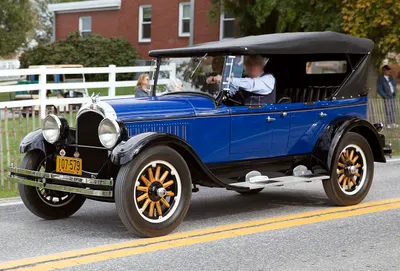
Two trim packages introduced on the 1926 Chrysler Six, Royal Coupe and Crown Sedan, were popular enough that Chrysler later spun each one off into its own standalone model.
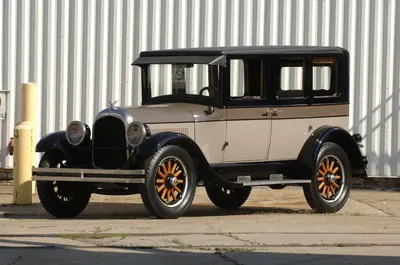
Chrysler's very first car, the B-70, sold 32,000 units in its debut year alone — a record for any new model's introduction at the time.
Rivals
Same body, same money, other badges — tap any card to flip.

It briefly served as senior sibling to Marquette, a GM companion brand cancelled after just one year.

Nissan hired former BMW engineers to help develop the 510's suspension, which is why period reviewers frequently compared its handling to the BMW 1600/2002.

A Trabant 601 won its class at the 1970 Monte Carlo Rally, with a second 601 right behind it in second.

The 600 was a stopgap: the P50's body over the 601's mechanicals, and for a while its estate was built alongside the new 601 saloon.

The G80 Sport brought a 370 PS twin-turbo 3.3 V6, a mesh grille and copper-tinted chrome with copper stitching to match.

The Vigor was sold only with a five-cylinder engine, an unusual configuration Honda used to fit a longer engine transversely under a short hood.

The GS/E coupe earned the nickname "German Charger" for its long hood, short deck stance borrowed from Detroit muscle cars.

This DeVille/Fleetwood was the first production car anywhere to mount its V8 sideways, Cadillac's front-drive gamble on the new C-body.