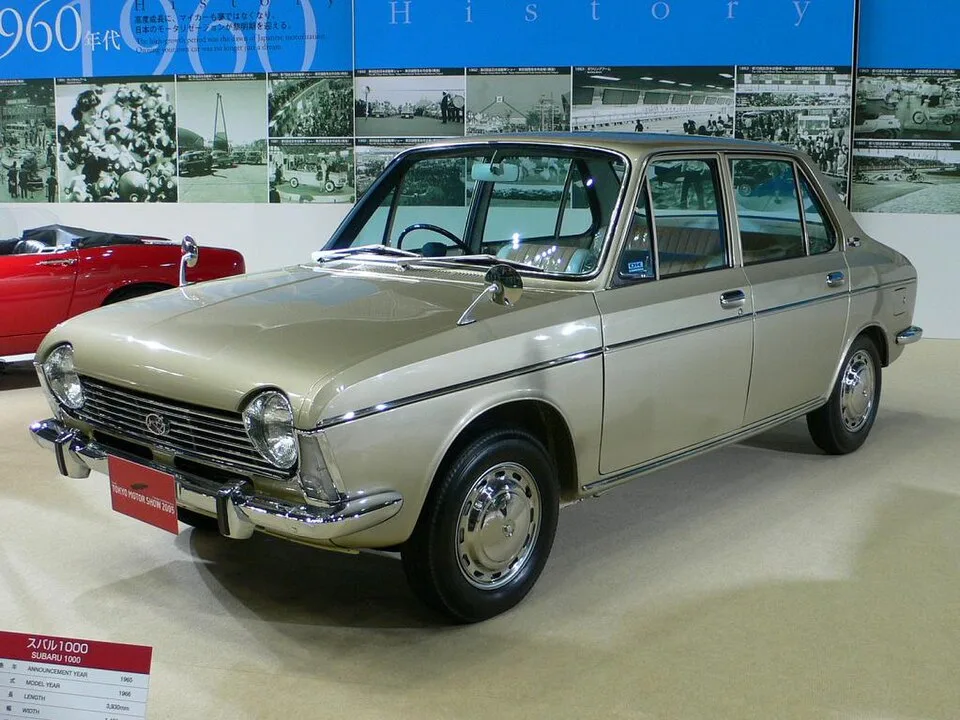
Subaru's first car didn't bother with a heater core — cabin heat came straight off the radiator, no separate component needed.
Lead trim: 1000 977 cc EA52 flat-four (55 PS)
Subaru 1000 A121966–1969
- 0spots by members
- Unclaimednobody has spotted one yet
- 0sets it belongs to
Nobody in Burbles has spotted a Subaru 1000 A12 yet. See one on the street, point the app at it, and the first card is yours — with your @handle permanently credited on this page.
FactSubaru's first car didn't bother with a heater core — cabin heat came straight off the radiator, no separate component needed.
The Subaru 1000, built by Fuji Heavy Industries from 1966 to 1969, was the first front-engine, front-wheel-drive Subaru, the first to use a boxer engine and the first in the Japanese "compact car" class (after the rear-engined 360 and Sambar kei cars), and one of Japan's first front-wheel-drive cars. It grew out of a 1962 air-cooled prototype (A-5, the 980 cc EA51X) and a 1963 project A-4 (923 cc) that became the water-cooled A-63 (977 cc EA52 — 72 × 60 mm, pushrod overhead valves, 55 PS at 6,000 rpm and 9:1 compression), to offer four people room without a central driveshaft against the Corolla, Sunny, Familia, Contessa, Bellett and Colt 1000, with a bench seat, column shifter, inboard front drum brakes, torsion bars combined with coil springs and a "double offset joint" devised with Toyo Bearing to cope with driveshaft vibration. It was introduced on 21 October 1965 at the Hilton Hotel Tokyo, shown at the 12th Tokyo Motor Show that month and on sale from 14 May 1966; the two-door sedan came in February 1967, a five-door light van (a station wagon with folding rear seat for tax reasons) in September 1967 and a three-door van in January 1968, with a Super Deluxe added in November 1968. Monthly production reached over 4,000 by March 1969, when it was superseded by the FF-1 (1100).
Collectors Spotted in the Subaru 1000 Lineage
No member has published a public street spot of the Subaru 1000 yet — the First · Worldwide stamp is wide open.
Trims & Figures
One published trim in the catalogue. A blank is a figure not recorded, not zero.
| Trim | Years | Engine | Power | Torque | 0–60 | Drive | Gearbox | MSRP |
|---|---|---|---|---|---|---|---|---|
| 1000 977 cc EA52 flat-four (55 PS) | 1966–1969 | 1.0 L Flat-4 | 54 hp | 56 lb-ft | — | FWD | — | — |
Owning one
We don’t estimate running costs for a car like this. What it costs depends on its condition, its specialist and how it is driven, and an average would mislead.
Owners’ builds
Nobody has claimed one yet.
Photographs
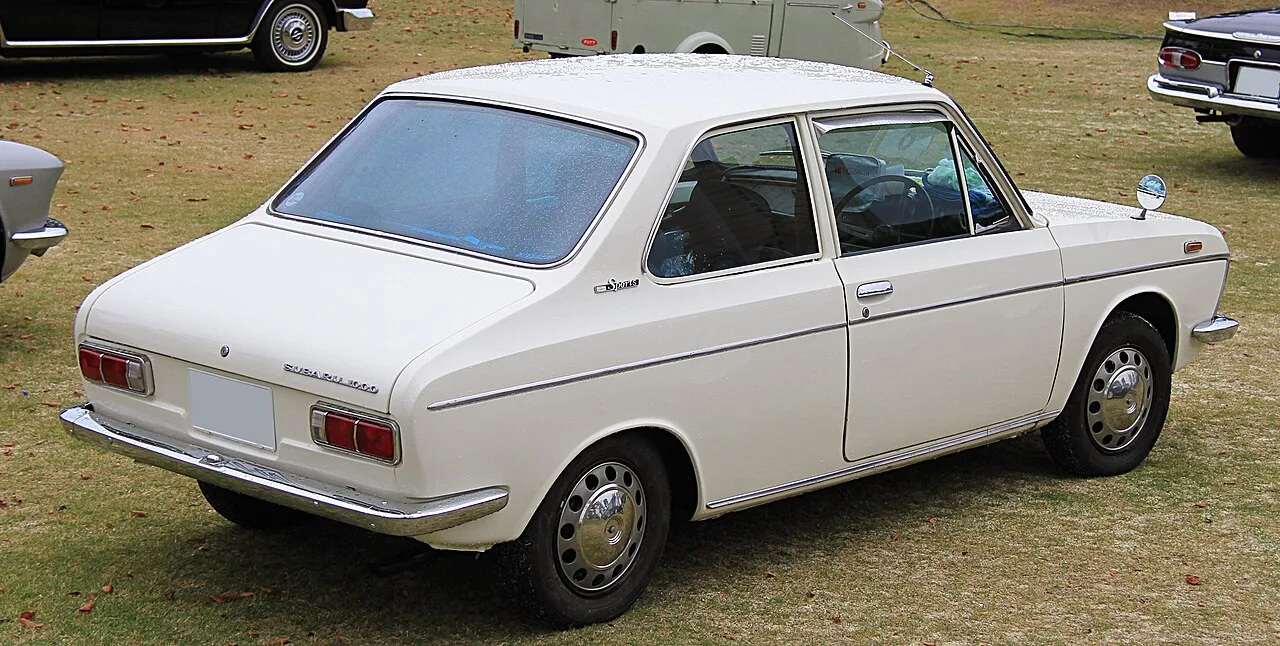
The 1968 Subaru 1000 SS got its extra power from twin SU carburettors and a 10:1 compression ratio, and Subaru backed it up with front discs, quicker steering and radials, a full chassis upgrade, not just a tune.
Subaru's first car didn't bother with a heater core — cabin heat came straight off the radiator, no separate component needed.
Rivals
Same body, same money, other badges — tap any card to flip.

It briefly served as senior sibling to Marquette, a GM companion brand cancelled after just one year.

Nissan hired former BMW engineers to help develop the 510's suspension, which is why period reviewers frequently compared its handling to the BMW 1600/2002.

A Trabant 601 won its class at the 1970 Monte Carlo Rally, with a second 601 right behind it in second.

The 600 was a stopgap: the P50's body over the 601's mechanicals, and for a while its estate was built alongside the new 601 saloon.

The G80 Sport brought a 370 PS twin-turbo 3.3 V6, a mesh grille and copper-tinted chrome with copper stitching to match.

The Vigor was sold only with a five-cylinder engine, an unusual configuration Honda used to fit a longer engine transversely under a short hood.

The GS/E coupe earned the nickname "German Charger" for its long hood, short deck stance borrowed from Detroit muscle cars.

This DeVille/Fleetwood was the first production car anywhere to mount its V8 sideways, Cadillac's front-drive gamble on the new C-body.