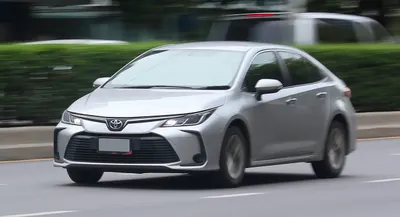
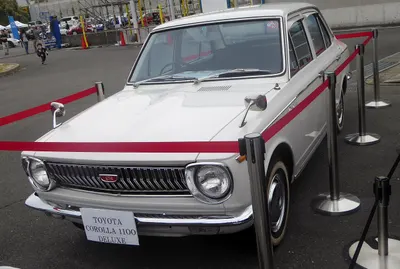
VerifiedFIRST PRINTSince 1997 the Corolla has been the best-selling car nameplate in history, overtaking the VW Beetle -- Toyota passed 54 million sold by early 2026.

Twin-cam Levin coupes of this generation skipped brake servos entirely, just to make the pedal feel sportier.
Median 98 hp across 250 similar cars
Lead trim: 3K-C 1.2 L OHV (US, 65 hp net) · up to 113 hp
Nobody in Burbles has spotted a Toyota Corolla E20 second generation yet. See one on the street, point the app at it, and the first card is yours — with your @handle permanently credited on this page.
FactTwin-cam Levin coupes of this generation skipped brake servos entirely, just to make the pedal feel sportier.
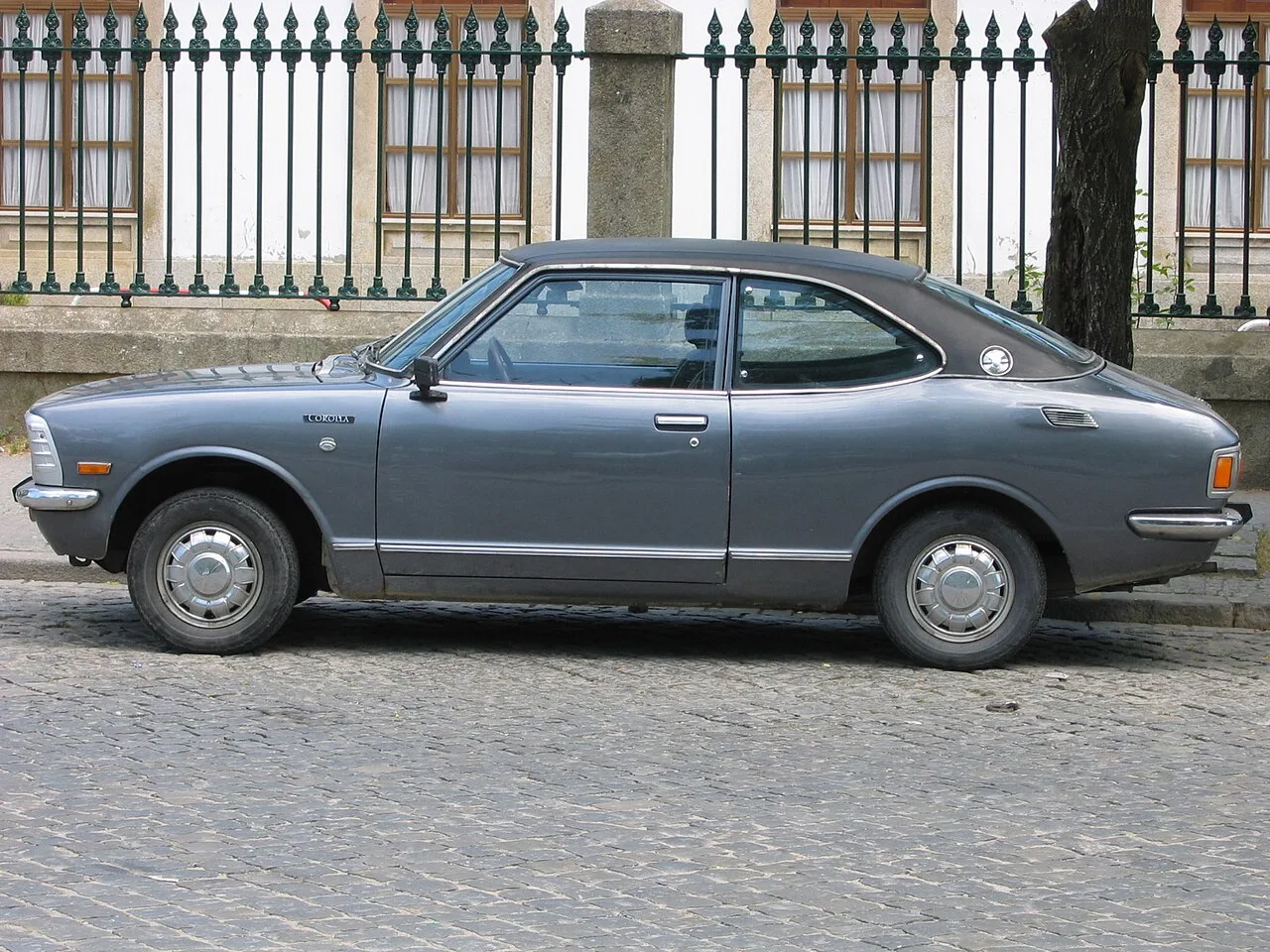
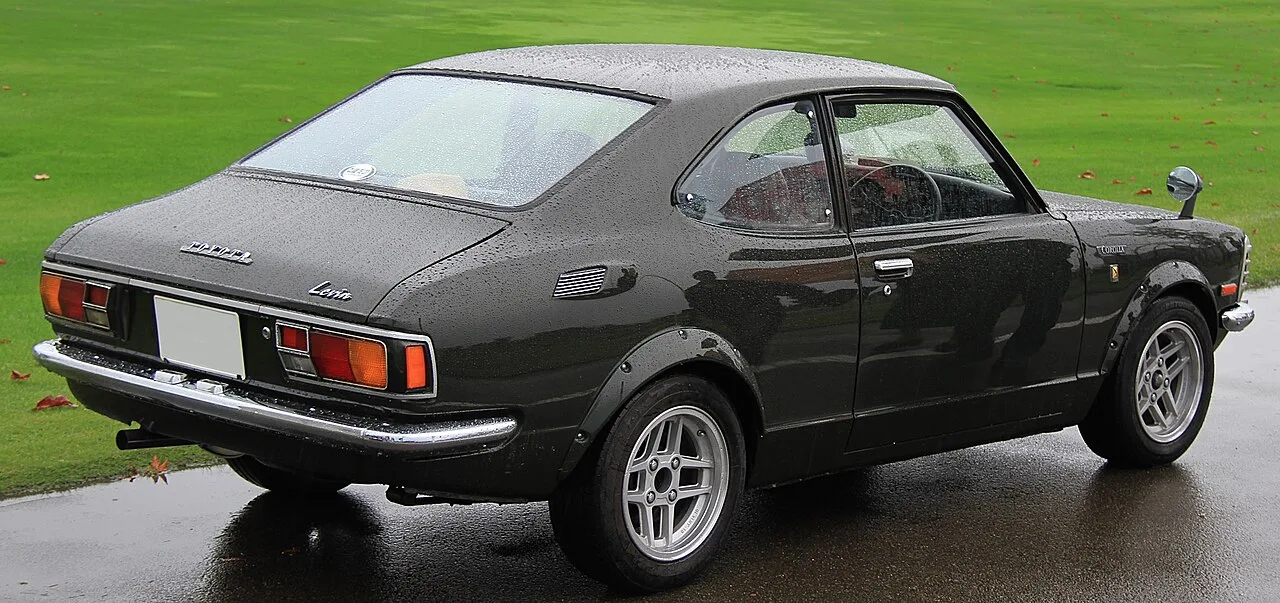
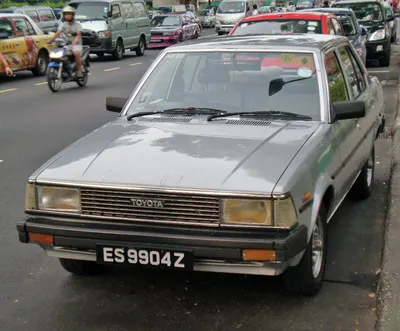
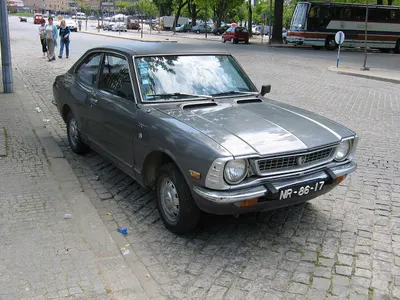
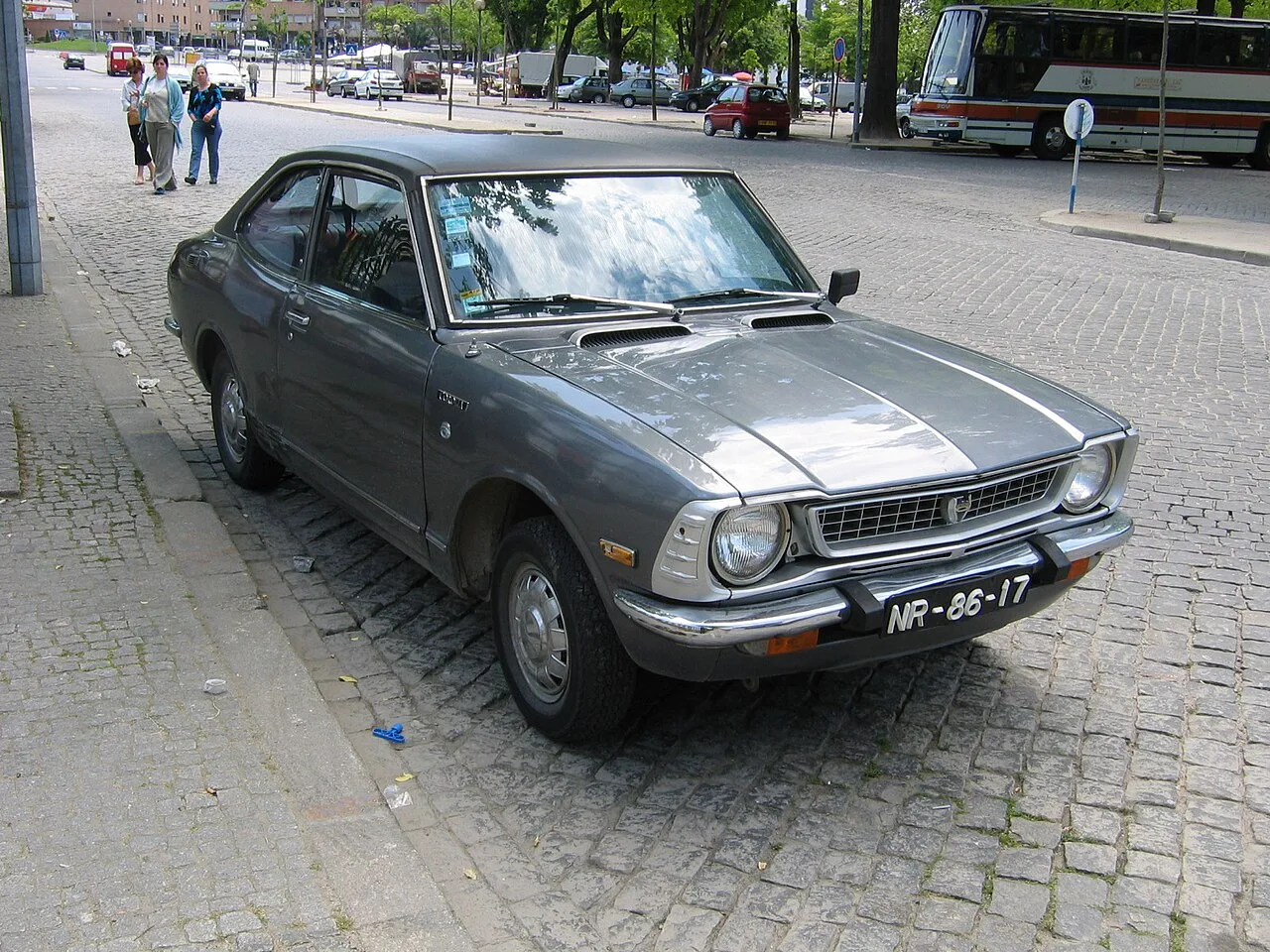
Launched in May 1970 with "coke bottle styling" and a longer 2,335 mm wheelbase, designed by Shiro Sasaki (1967), with an improved front suspension using a swaybar; that year the Corolla became the second-best-selling car in the world. Sedans came in Standard, Deluxe and Hi-Deluxe grades, and the coupé in Deluxe, SL, SR and Levin trims. The Levin ("levin" being Old English for lightning) was originally offered only with the twin-cam engine, had fender extensions and a quicker steering rack, and its twin-cam versions lacked servo brakes to feel sportier; production ran around 5,000 a year. Minor changes came in September 1971 and a facelift in August 1972, and the car was the basis of the 1974 Daihatsu Charmant. Most models ended in July 1974, but the KE26 wagon and van lasted in Japan until May 1978. In the US the 1.4 L and twin-cam engines were never offered; a 1,588 cc engine was added in September 1970 and the five-speed S-5 and SR-5 coupés in 1972. It was the first Corolla sold in Indonesia (1971–1975) and was assembled in Nova Scotia by CMI and, from February 1973, in Ireland.
Real Toyota Corolla cards spotted on the street by Burbles collectors. Tap any card to flip it over, inspect the collector’s binder, or follow them.
VerifiedFIRST PRINTSince 1997 the Corolla has been the best-selling car nameplate in history, overtaking the VW Beetle -- Toyota passed 54 million sold by early 2026.
VerifiedFIRST PRINTPROA humble Corolla Axio went racing in Japan's Super GT GT300 class with its engine moved to the middle of the car and a 3.5-litre V6 making over 300 PS in place of its usual four-cylinder.
9 published trims in the catalogue. A blank is a figure not recorded, not zero.
| Trim | Years | Engine | Power | Torque | 0–60 | Drive | Gearbox | MSRP |
|---|---|---|---|---|---|---|---|---|
| 2T-B 1.6 L twin-carb OHV (Japan, 105 PS) | 1970–1974 | 1.6 L Inline-4 | 104 hp | 101 lb-ft | — | RWD | — | — |
| 2T-C 1.6 L OHV (US, 88 hp net) | 1970–1974 | 1.6 L Inline-4 | 88 hp | 91 lb-ft | — | RWD | — | — |
| 2T-G 1.6 L twin-cam Levin (Japan, 115 PS) | 1970–1974 | 1.6 L Inline-4 | 113 hp | 105 lb-ft | — | RWD | — | — |
| 2T-GR 1.6 L twin-cam (Japan, 110 PS) | 1970–1974 | 1.6 L Inline-4 | 108 hp | 101 lb-ft | — | RWD | — | — |
| 3K 1.2 L OHV (Japan, 68 PS) | 1970–1974 | 1.2 L Inline-4 | 67 hp | 69 lb-ft | — | RWD | — | — |
| 3K-B 1.2 L twin-carb OHV (Japan, 77 PS) | 1970–1974 | 1.2 L Inline-4 | 76 hp | 69 lb-ft | — | RWD | — | — |
| 3K-C 1.2 L OHV (US, 65 hp net) | 1970–1974 | 1.2 L Inline-4 | 65 hp | — | — | RWD | — | — |
| T 1.4 L OHV (Japan, 86 PS) | 1970–1974 | 1.4 L Inline-4 | 85 hp | 85 lb-ft | — | RWD | — | — |
| T-B 1.4 L twin-carb OHV (Japan, 95 PS) | 1970–1974 | 1.4 L Inline-4 | 94 hp | 89 lb-ft | — | RWD | — | — |
We don’t estimate running costs for a car like this. What it costs depends on its condition, its specialist and how it is driven, and an average would mislead.
Nobody has claimed one yet.

Since 1997 the Corolla has been the best-selling car nameplate in history, overtaking the VW Beetle -- Toyota passed 54 million sold by early 2026.

This is the last Corolla India ever got — Toyota never bothered re-engineering it for the country's 2020 emissions rules, so the model line simply ended there.

A humble Corolla Axio went racing in Japan's Super GT GT300 class with its engine moved to the middle of the car and a 3.5-litre V6 making over 300 PS in place of its usual four-cylinder.

The XRS version of this Corolla borrowed its high-revving 2ZZ-GE engine straight from the Celica GT-S and the Lotus Elise — a Yamaha co-developed, 8,200-rpm-redline motor hiding in an economy sedan.

A cost-cutting fix backfired: Toyota's attempt to curb oil burn on the non-VVT-i engines instead gave this Corolla generation a flawed piston ring design across the board.

The E100 Corolla was built with fewer body panels than its predecessor -- stronger, cheaper, and with tighter panel gaps for a cleaner shape.

The AE92 Corolla Levin and Trueno could be had with a Roots-type supercharger bolted to the usual 4A-GE engine — good for 50% more torque than the naturally aspirated version.

The Corolla FX hatchback almost never happened — it was just a sketch by chief designer Fumio Agetsuma until Toyota Australia’s marketing director saw it and demanded it be built.

The one millionth Corolla ever built was one of these, rolling off the line in February 1983.

Australia kept building this Corolla for years after Toyota replaced it everywhere else in August 1979.

Twin-cam Levin coupes of this generation skipped brake servos entirely, just to make the pedal feel sportier.

Toyota enlarged the first Corolla's engine late in development to 1,077cc purely to beat the Datsun 1000 by 100cc.
Same body, same money, other badges — tap any card to flip.

It briefly served as senior sibling to Marquette, a GM companion brand cancelled after just one year.

Nissan hired former BMW engineers to help develop the 510's suspension, which is why period reviewers frequently compared its handling to the BMW 1600/2002.

A Trabant 601 won its class at the 1970 Monte Carlo Rally, with a second 601 right behind it in second.

The 600 was a stopgap: the P50's body over the 601's mechanicals, and for a while its estate was built alongside the new 601 saloon.

The G80 Sport brought a 370 PS twin-turbo 3.3 V6, a mesh grille and copper-tinted chrome with copper stitching to match.

The Vigor was sold only with a five-cylinder engine, an unusual configuration Honda used to fit a longer engine transversely under a short hood.

The GS/E coupe earned the nickname "German Charger" for its long hood, short deck stance borrowed from Detroit muscle cars.

This DeVille/Fleetwood was the first production car anywhere to mount its V8 sideways, Cadillac's front-drive gamble on the new C-body.