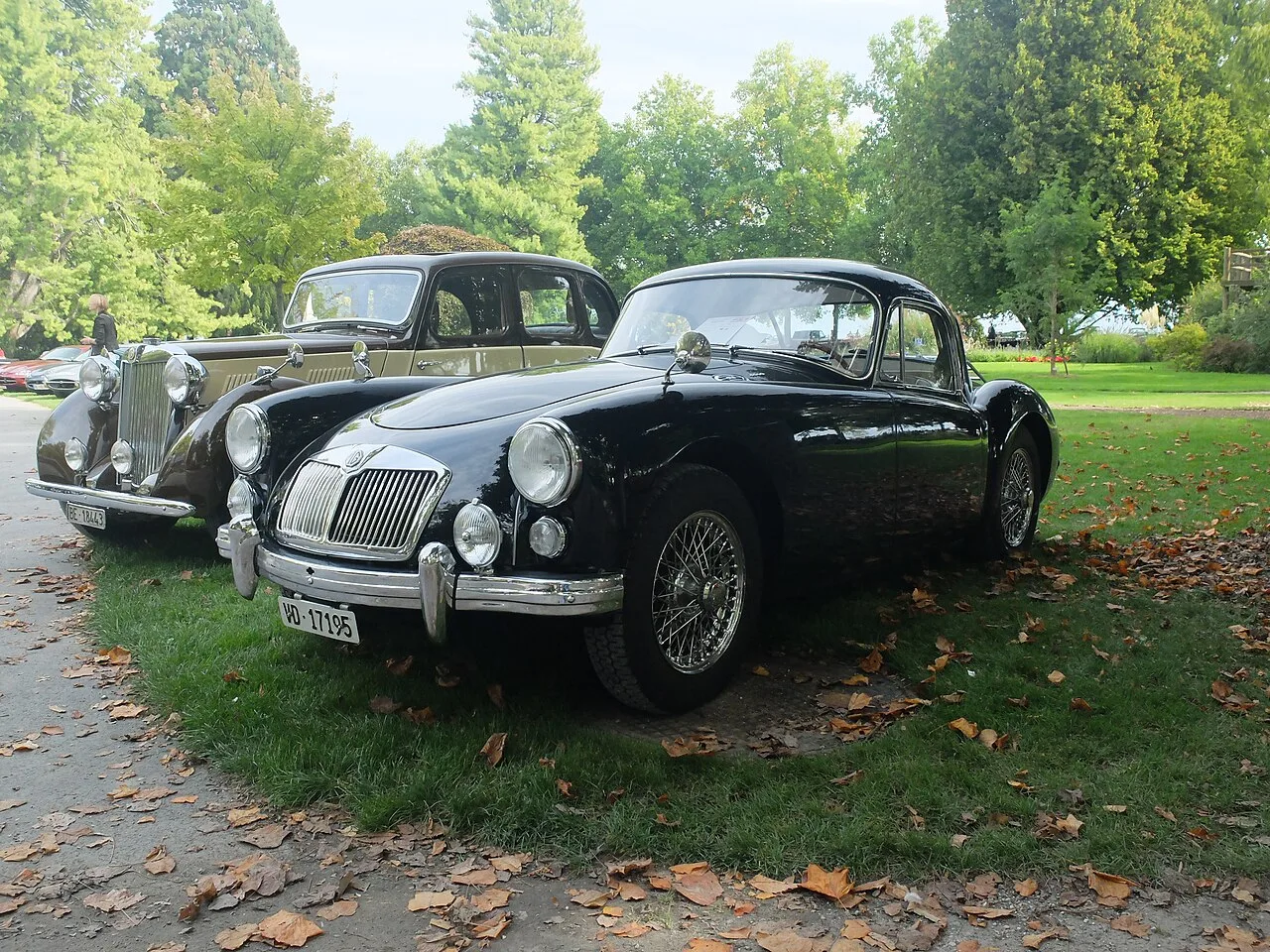
The 1947 MG Y-Type built its own jack into the chassis: a hydraulic 'Jackall System' with four rams could lift any corner, or the whole car, for a roadside wheel change.
Lead trim: YA 1250 XPAG four, single SU (46 bhp at 4,800 rpm)
MG Y-Type YAYA · 1947–1951
- 0spots by members
- Unclaimednobody has spotted one yet
- 0sets it belongs to
Nobody in Burbles has spotted a MG Y-Type YA yet. See one on the street, point the app at it, and the first card is yours — with your @handle permanently credited on this page.
FactThe 1947 MG Y-Type built its own jack into the chassis: a hydraulic 'Jackall System' with four rams could lift any corner, or the whole car, for a roadside wheel change.
The MG Y-type is an automobile built by MG in England from 1947 to 1953, designed by Gerald Palmer, as a four-door saloon and a limited-production open four-seat tourer, 8,336 in all (the original production records were lost when the Abingdon works closed in 1981). MG had added three saloons (the S, V and W models: SA, VA, WA) to its Midget sports cars before the war; the Y-type came from Morris's Ten-Four Series M and the smaller Series E Eight, its prototype built in 1939 (EX.166) but launch delayed eight years by the war. Palmer took a Morris Eight Series E four-door pressed-steel bodyshell, added a swept tail and rear wings and the upright MG grille, kept separate headlights and a separate chassis (with the Jackall system of four hydraulic rams), and fitted an independent front suspension he designed with Jack Daniels, making it the first Nuffield product and one of the first British production cars with independent front suspension. The YA (1947–1951) had a single-carburettor version of the 1,250 cc XPAG engine of the TB (later in the TC and TD), developing 46 bhp at 4,800 rpm and 58.5 lb ft at 2,400 rpm, more than any similar-size British saloon bar the Rover Ten; the interior had leather seats and burr-walnut window frames and a bookmatched veneer instrument panel behind octagonal chrome frames. It cost £525 plus purchase tax of £146 11s 8d. The Motor's 1951 test recorded 69.6 mph and 0–60 mph in 29.9 seconds (29.5 mpg), the 7.2:1 compression ratio being problematic on 72-octane "Pool petrol". Wheelbase 99 in, length 164 in, width 59 in, height 57 in.
Collectors Spotted in the MG Y-Type Lineage
No member has published a public street spot of the MG Y-Type yet — the First · Worldwide stamp is wide open.
Trims & Figures
One published trim in the catalogue. A blank is a figure not recorded, not zero.
| Trim | Years | Engine | Power | Torque | 0–60 | Drive | Gearbox | MSRP |
|---|---|---|---|---|---|---|---|---|
| YA 1250 XPAG four, single SU (46 bhp at 4,800 rpm) | 1947–1951 | 1.3 L Inline-4 | 46 hp | 58.5 lb-ft | 29.9 s | — | — | — |
Owning one
We don’t estimate running costs for a car like this. What it costs depends on its condition, its specialist and how it is driven, and an average would mislead.
Owners’ builds
Nobody has claimed one yet.
Photographs
The YB's brakes and rear axle were genuinely modern for 1952 — new twin-leading-shoe Lockheed brakes and a hypoid back axle, bolted to a body that already looked old-fashioned.
Before the real YT Tourer existed, nine stray YA chassis were shipped to Switzerland and bodied as cabriolets by coachbuilders like Reinbolt & Christé — prototypes for a car not yet built.
The 1947 MG Y-Type built its own jack into the chassis: a hydraulic 'Jackall System' with four rams could lift any corner, or the whole car, for a roadside wheel change.
Rivals
Same body, same money, other badges — tap any card to flip.

It briefly served as senior sibling to Marquette, a GM companion brand cancelled after just one year.

Nissan hired former BMW engineers to help develop the 510's suspension, which is why period reviewers frequently compared its handling to the BMW 1600/2002.

A Trabant 601 won its class at the 1970 Monte Carlo Rally, with a second 601 right behind it in second.

The 600 was a stopgap: the P50's body over the 601's mechanicals, and for a while its estate was built alongside the new 601 saloon.

The G80 Sport brought a 370 PS twin-turbo 3.3 V6, a mesh grille and copper-tinted chrome with copper stitching to match.

The Vigor was sold only with a five-cylinder engine, an unusual configuration Honda used to fit a longer engine transversely under a short hood.

The GS/E coupe earned the nickname "German Charger" for its long hood, short deck stance borrowed from Detroit muscle cars.

This DeVille/Fleetwood was the first production car anywhere to mount its V8 sideways, Cadillac's front-drive gamble on the new C-body.