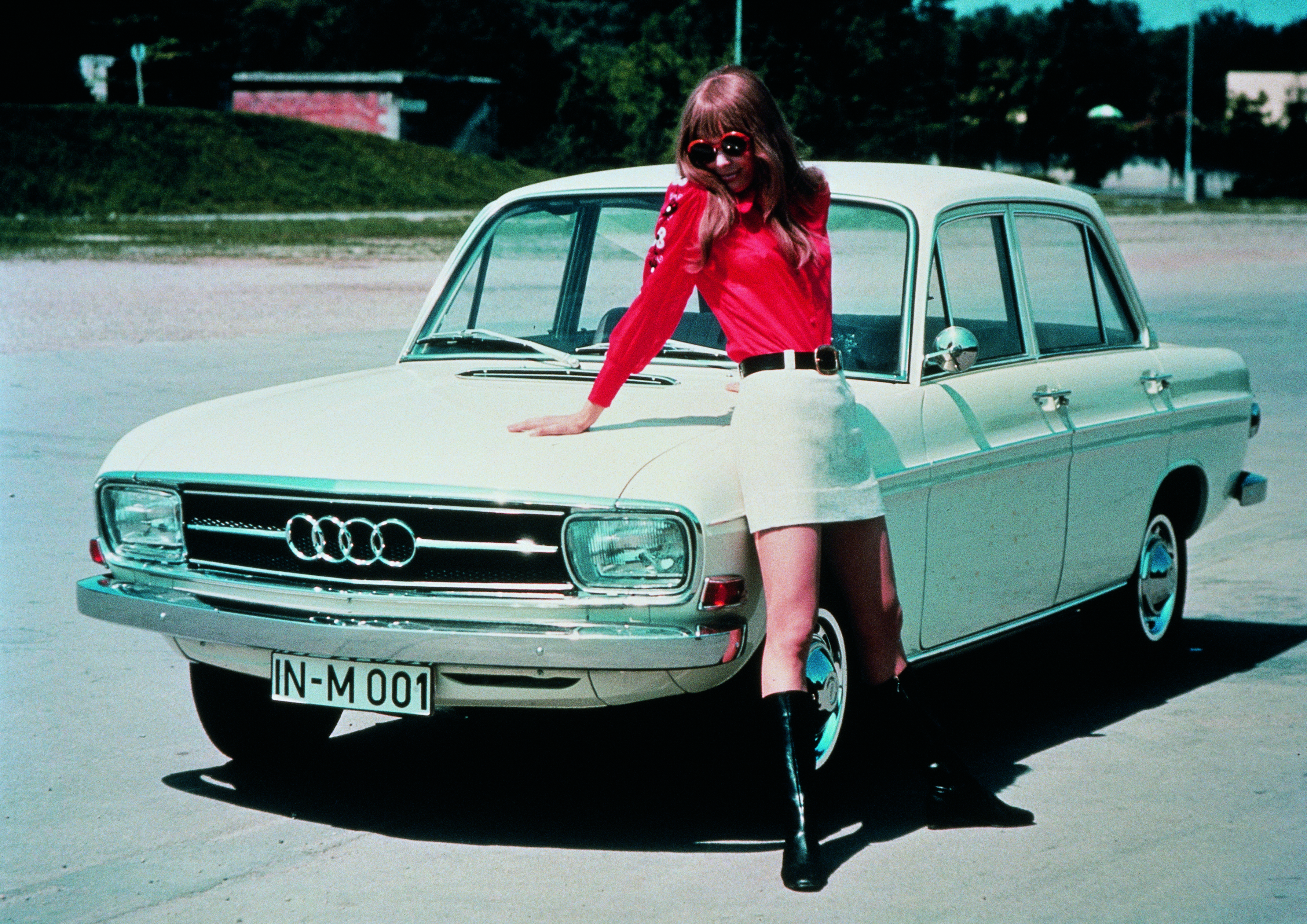
The engines in these early Audis started life as a Daimler-Benz military project that was never built. Mercedes handed the design to Auto Union instead, and it ended up here, under an Audi hood.
Median 101 hp across 350 similar cars
Lead trim: Audi 60 (M118 1.5 I4, 55 PS) · up to 74 hp
Audi F103 (60 / 72 / 75 / 80 / Super 90)F103 · 1965–1972
- 0spots by members
- Unclaimednobody has spotted one yet
- 0sets it belongs to
Nobody in Burbles has spotted a Audi F103 (60 / 72 / 75 / 80 / Super 90) yet. See one on the street, point the app at it, and the first card is yours — with your @handle permanently credited on this page.
FactThe engines in these early Audis started life as a Daimler-Benz military project that was never built. Mercedes handed the design to Auto Union instead, and it ended up here, under an Audi hood.
F103 is the internal designation for a series of car models produced by Auto Union in West Germany from September 1965 to July 1972 (416,853 built), derived from the earlier DKW F102: to signify the change from a two-stroke to a four-stroke engine the DKW marque was dropped in favour of Audi, a name that had been dormant since before the Second World War. The first model was launched simply as the Audi, later renamed the Audi 72 (72 being the nominal power output in PS); the Audi 60 completed the range in 1968 (55 PS, 65 PS for export) and the Audi 75 replaced both the 72 and the 80 from 1969, before the F103 was discontinued in 1972 in favour of the B1 Audi 80. All were equipped exclusively with the longitudinally mounted M118 four-cylinder four-stroke engine, developed by Daimler-Benz as part of a military project that never came to fruition and dubbed the "Mitteldruckmotor" (medium-pressure engine) for its unusually high BMEP, with spiral-formed intake channels and Heron-type combustion chambers; the combination of front-wheel drive and a longitudinal four-cylinder became the basic template for Volkswagen's Passat and the Audi 80 and 100. The car came with a four-speed manual, inboard-mounted front disc brakes and rear drums. The body closely followed the DKW F102's, with the engine compartment extended and a revised front and tail, quasi-rectangular headlamps on European cars, 2- and 4-door saloons (the 2-door not sold in Italy and Britain) and, from March 1966, a three-door estate called the Variant. In September 1967 the compression ratio was reduced from 11.2:1 to 9.1:1 to address teething problems, servo brake assistance became optional and twin brake circuits were fitted; a discreetly modernised rear with larger rear lights and a reshaped bumper arrived in August 1970. By July 1967 100,000 Audis had been completed at almost 40,000 a year. Wheelbase 2,490 mm (98 in), length 4,380 mm (172.4 in), width 1,626 mm (64.0 in), height 1,451 mm (57.1 in). The page's spec table gives three displacements and six speeds across the five models, mapped here in ascending order; the Audi 80 and Super 90 are catalogued as their own generation.
Collectors Spotted in the Audi F103 (60 / 72 / 75 / 80 / Super 90) Lineage
No member has published a public street spot of the Audi F103 (60 / 72 / 75 / 80 / Super 90) yet — the First · Worldwide stamp is wide open.
Trims & Figures
3 published trims in the catalogue. A blank is a figure not recorded, not zero.
| Trim | Years | Engine | Power | Torque | 0–60 | Drive | Gearbox | MSRP |
|---|---|---|---|---|---|---|---|---|
| Audi 60 (M118 1.5 I4, 55 PS) | 1968–1972 | 1.5 L Inline-4 | 54 hp | 87 lb-ft | — | FWD | — | — |
| Audi 72 (M118 1.7 I4, 72 PS) | 1965–1969 | 1.7 L Inline-4 | 71 hp | 94 lb-ft | — | FWD | — | — |
| Audi 75 (M118 1.7 I4, 75 PS) | 1969–1972 | 1.7 L Inline-4 | 74 hp | 94 lb-ft | — | FWD | — | — |
Owning one
We don’t estimate running costs for a car like this. What it costs depends on its condition, its specialist and how it is driven, and an average would mislead.
Owners’ builds
Nobody has claimed one yet.
In the Community
Open CommunityNo notes tagged with the Audi F103 (60 / 72 / 75 / 80 / Super 90) yet.
Photographs
Every Audi F103 (60 / 72 / 75 / 80 / Super 90) Generation
Compare all 2 generations →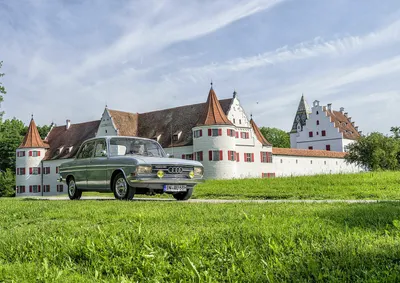
The first Audi 80 and Super 90 were built on a two-stroke DKW chassis, but Audi partnered with none other than Daimler-Benz to give them an all-new four-stroke engine range.
The engines in these early Audis started life as a Daimler-Benz military project that was never built. Mercedes handed the design to Auto Union instead, and it ended up here, under an Audi hood.
Rivals
Same body, same money, other badges — tap any card to flip.

It briefly served as senior sibling to Marquette, a GM companion brand cancelled after just one year.

Nissan hired former BMW engineers to help develop the 510's suspension, which is why period reviewers frequently compared its handling to the BMW 1600/2002.

A Trabant 601 won its class at the 1970 Monte Carlo Rally, with a second 601 right behind it in second.

The 600 was a stopgap: the P50's body over the 601's mechanicals, and for a while its estate was built alongside the new 601 saloon.

The G80 Sport brought a 370 PS twin-turbo 3.3 V6, a mesh grille and copper-tinted chrome with copper stitching to match.

The Vigor was sold only with a five-cylinder engine, an unusual configuration Honda used to fit a longer engine transversely under a short hood.

The GS/E coupe earned the nickname "German Charger" for its long hood, short deck stance borrowed from Detroit muscle cars.

This DeVille/Fleetwood was the first production car anywhere to mount its V8 sideways, Cadillac's front-drive gamble on the new C-body.