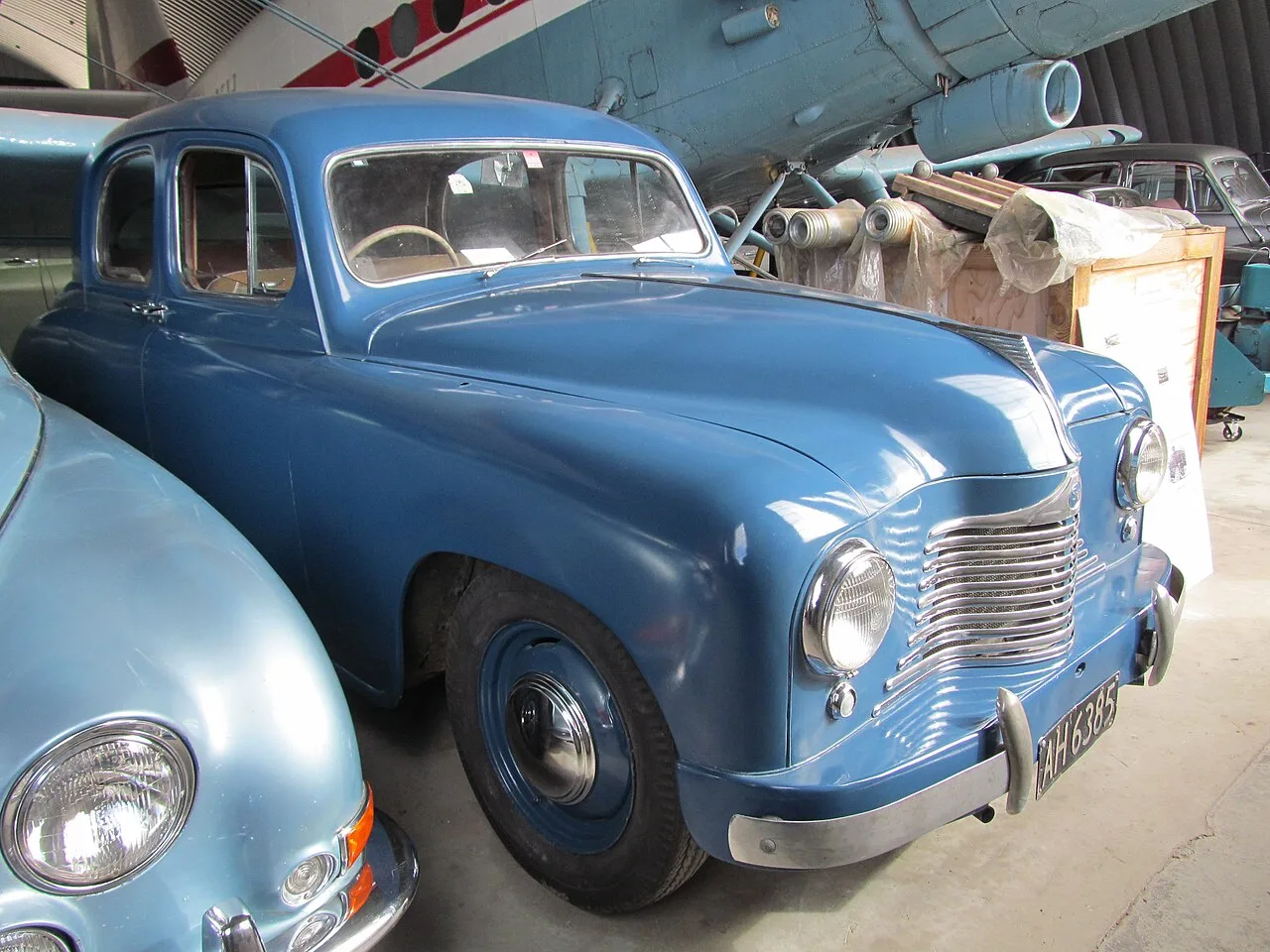
Its body design was inspired directly by Howard Darrin's 1946 Kaiser-Frazer, styled by Leo Shorter.
Lead trim: SM1500 1.5 OHC twin-carb (58 bhp)
Singer SM15001948–1954
- 0spots by members
- Unclaimednobody has spotted one yet
- 0sets it belongs to
Nobody in Burbles has spotted a Singer SM1500 yet. See one on the street, point the app at it, and the first card is yours — with your @handle permanently credited on this page.
FactIts body design was inspired directly by Howard Darrin's 1946 Kaiser-Frazer, styled by Leo Shorter.
The Singer SM1500 is a small family car produced by Singer Motors from 1948 (17,382 made), the first new design produced by Singer after World War II, planned to replace the Super Ten and Super Twelve; a prototype and general description were announced in November 1947, an early production car was shown at Earls Court in October 1948, and production finally commenced just before the end of July 1949. It had a pressed-steel body on a separate chassis with Packard-designed coil-spring independent front suspension built under licence, Lockheed hydraulic brakes with 9 in drums and a four-speed gearbox with a column change that made second and reverse difficult to select, and was almost unique among British volume-produced saloons in having an overhead-camshaft engine: based on the Super 12 unit with larger bore and shorter stroke, 1506 cc, reduced in 1951 by a shorter stroke to 1497 cc to bring it into the sub-1500 class. From 1952 a 58 bhp twin-carburettor version was available for an extra £28. Body styling was by Leo Shorter, inspired by Howard Darrin's 1946 Kaiser-Frazer. A twin-carburettor version tested by The Motor in 1952 had a top speed of 76 mph and reached 0–60 mph in 23.5 seconds (£1168 including taxes); a single-carburettor version tested by The Autocar the same year managed only 71 mph and 27.9 seconds. It sold well at first and was used by some police forces and as a popular provincial taxi; a coupé utility was also produced, and the car was face-lifted in 1952 with a reworked grille and raised headlamps. The infobox gives production years as 1948–1954, while the text says 1948 to 1956 including the Hunter.
Collectors Spotted in the Singer SM1500 Lineage
No member has published a public street spot of the Singer SM1500 yet — the First · Worldwide stamp is wide open.
Trims & Figures
3 published trims in the catalogue. A blank is a figure not recorded, not zero.
| Trim | Years | Engine | Power | Torque | 0–60 | Drive | Gearbox | MSRP |
|---|---|---|---|---|---|---|---|---|
| SM1500 1.5 OHC (1506 cc) | 1948–1951 | 1.5 L | — | — | — | — | — | — |
| SM1500 1.5 OHC single-carb (1497 cc) | 1951–1954 | 1.5 L | — | — | 27.9 s | — | — | — |
| SM1500 1.5 OHC twin-carb (58 bhp) | 1952–1954 | — | 58 hp | — | 23.5 s | — | — | — |
Owning one
We don’t estimate running costs for a car like this. What it costs depends on its condition, its specialist and how it is driven, and an average would mislead.
Owners’ builds
Nobody has claimed one yet.
Photographs
Rivals
Same body, same money, other badges — tap any card to flip.

It briefly served as senior sibling to Marquette, a GM companion brand cancelled after just one year.

Nissan hired former BMW engineers to help develop the 510's suspension, which is why period reviewers frequently compared its handling to the BMW 1600/2002.

A Trabant 601 won its class at the 1970 Monte Carlo Rally, with a second 601 right behind it in second.

The 600 was a stopgap: the P50's body over the 601's mechanicals, and for a while its estate was built alongside the new 601 saloon.

The G80 Sport brought a 370 PS twin-turbo 3.3 V6, a mesh grille and copper-tinted chrome with copper stitching to match.

The Vigor was sold only with a five-cylinder engine, an unusual configuration Honda used to fit a longer engine transversely under a short hood.

The GS/E coupe earned the nickname "German Charger" for its long hood, short deck stance borrowed from Detroit muscle cars.

This DeVille/Fleetwood was the first production car anywhere to mount its V8 sideways, Cadillac's front-drive gamble on the new C-body.