Wartime bombing raids on Coventry destroyed the pre-war Kestrel's die patterns, forcing the RM to be designed from scratch.
Lead trim: RME 1.5 Riley four (1496 cc) · up to 100 hp
Riley RM series1945–1955
- 0spots by members
- Unclaimednobody has spotted one yet
- 0sets it belongs to
Nobody in Burbles has spotted a Riley RM series yet. See one on the street, point the app at it, and the first card is yours — with your @handle permanently credited on this page.
FactWartime bombing raids on Coventry destroyed the pre-war Kestrel's die patterns, forcing the RM to be designed from scratch.
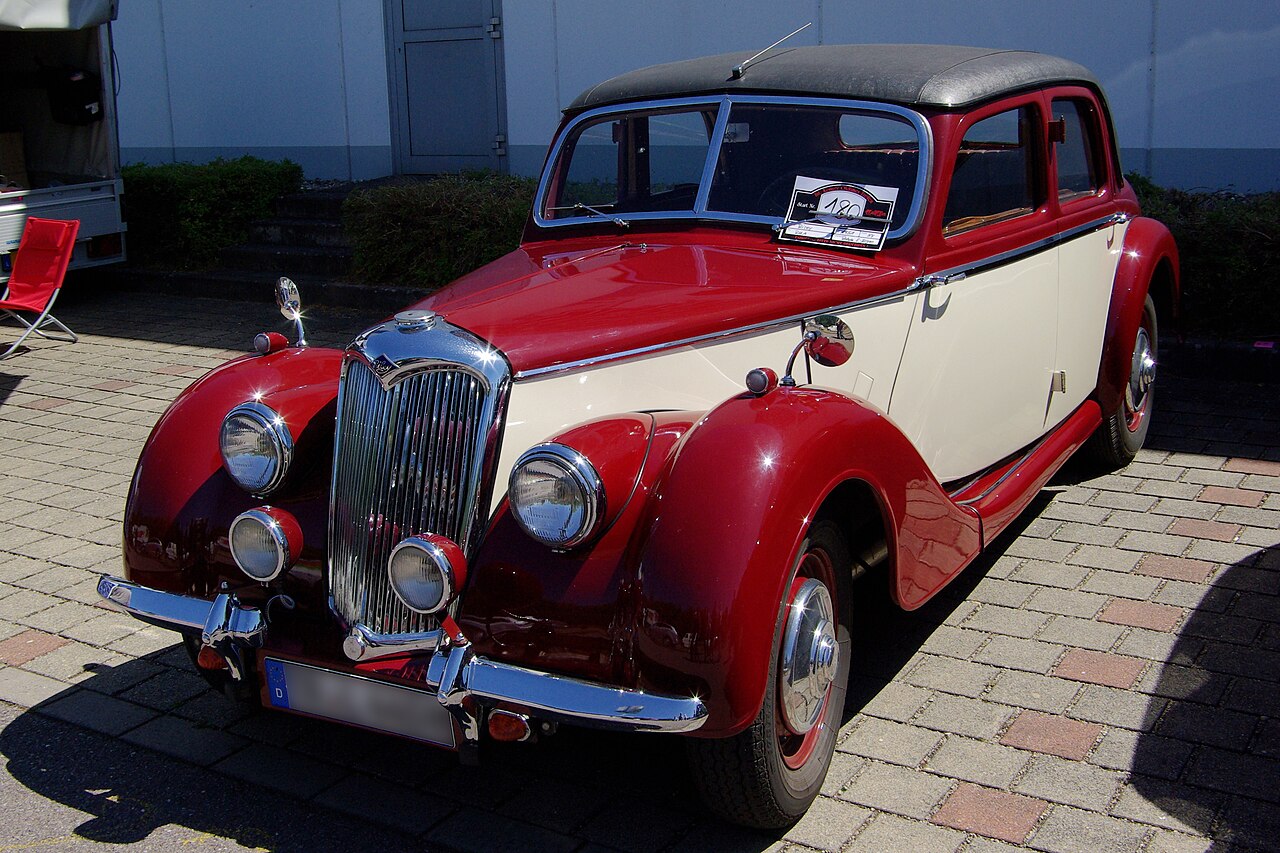
The Riley RM is a series of executive cars and compact executive cars made by Riley Motors from 1945 until 1955, the last models developed independently by Riley before its parent company Nuffield merged with Austin to form BMC. The series was produced in Coventry until 1949, when production moved to the MG works at Abingdon; until 1952 the models were marketed as the Riley 1½ Litre and 2½ Litre, and the term RM has been used retrospectively to encompass those. There were four types: the RMA (replaced by the RME) with the 1.5 L engine, the longer RMB (replaced by the RMF) with the 2.5 L "Big Four", the limited-production RMC open two/three-seater Roadster and the RMD four-seater drophead, plus the Pathfinder (RMH), the last saloon built with the Riley Big Four. All used Riley four-cylinder in-line engines with hemispherical combustion chambers and twin camshafts mounted high at the sides of the cylinder block. The RM was inspired by the successful pre-war 1.5 and 2.5 Litre Kestrel saloons but with a new chassis with Riley "torsionic" independent front suspension; it was a new design because air raids on Coventry had destroyed the die patterns of the pre-war models. The RMA, announced in August 1945, had hydro-mechanical brakes and a wooden body frame in the English tradition, and 10,504 were built to 1952; the RMB, a lengthened RMA (wheelbase 6.5 in and overall length 7 in longer) launched in 1946, used the 2,443 cc engine with twin SU carburettors, starting with 90 hp and increasing to 100 hp for 1948 with a 95 mph top speed, and 6,900 were built; The Motor tested a 1949 RMB at 90 mph and 0–60 mph in 16.8 seconds for £1,224. The RMC roadster (507 built, 1948–1951, mostly left-hand drive for North America, with an enlarged 20-gallon tank and celluloid side curtains) shared the 100 hp engine, and the RMD (502 built) was the last Riley cabriolet. The RME of 1952 was an improved RMA with fully hydraulic brakes, a larger curved rear window and a change of rear axle ratio from 4.89:1 to 5.125:1 (3,446 built to 1955; The Motor tested one in 1952 at 75 mph and 0–60 in 29.5 seconds for £1,339), and the RMF (1,050 built, 1952–1953) replaced the RMB; the RMH Pathfinder replaced the RMF in 1953.
Collectors Spotted in the Riley RM Lineage
No member has published a public street spot of the Riley RM yet — the First · Worldwide stamp is wide open.
Trims & Figures
7 published trims in the catalogue. A blank is a figure not recorded, not zero.
| Trim | Years | Engine | Power | Torque | 0–60 | Drive | Gearbox | MSRP |
|---|---|---|---|---|---|---|---|---|
| RMA 1.5 Riley four (1496 cc, 60 bhp) | 1945–1952 | 1.5 L Inline-4 | 60 hp | — | — | RWD | — | — |
| RMB 2.5 Big Four (2443 cc, 100 hp) | 1948–1952 | 2.4 L Inline-4 | 100 hp | — | — | RWD | — | — |
| RMB 2.5 Big Four (2443 cc, 90 hp) | 1946–1947 | 2.4 L Inline-4 | 90 hp | — | — | RWD | — | — |
| RMC roadster 2.5 Big Four (100 hp) | 1948–1951 | 2.5 L Inline-4 | 100 hp | — | — | RWD | — | — |
| RMD drophead 2.5 Big Four (100 hp) | 1949–1951 | 2.5 L Inline-4 | 100 hp | — | — | RWD | — | — |
| RME 1.5 Riley four (1496 cc) | 1952–1955 | 1.5 L Inline-4 | 60 hp | — | 29.5 s | RWD | — | — |
| RMF 2.5 Big Four (2443 cc) | 1952–1953 | 2.4 L Inline-4 | — | — | — | RWD | — | — |
Owning one
We don’t estimate running costs for a car like this. What it costs depends on its condition, its specialist and how it is driven, and an average would mislead.
Owners’ builds
Nobody has claimed one yet.
Photographs
Rivals
Same body, same money, other badges — tap any card to flip.

It briefly served as senior sibling to Marquette, a GM companion brand cancelled after just one year.

Nissan hired former BMW engineers to help develop the 510's suspension, which is why period reviewers frequently compared its handling to the BMW 1600/2002.

A Trabant 601 won its class at the 1970 Monte Carlo Rally, with a second 601 right behind it in second.

The 600 was a stopgap: the P50's body over the 601's mechanicals, and for a while its estate was built alongside the new 601 saloon.

The G80 Sport brought a 370 PS twin-turbo 3.3 V6, a mesh grille and copper-tinted chrome with copper stitching to match.

The Vigor was sold only with a five-cylinder engine, an unusual configuration Honda used to fit a longer engine transversely under a short hood.

The GS/E coupe earned the nickname "German Charger" for its long hood, short deck stance borrowed from Detroit muscle cars.

This DeVille/Fleetwood was the first production car anywhere to mount its V8 sideways, Cadillac's front-drive gamble on the new C-body.