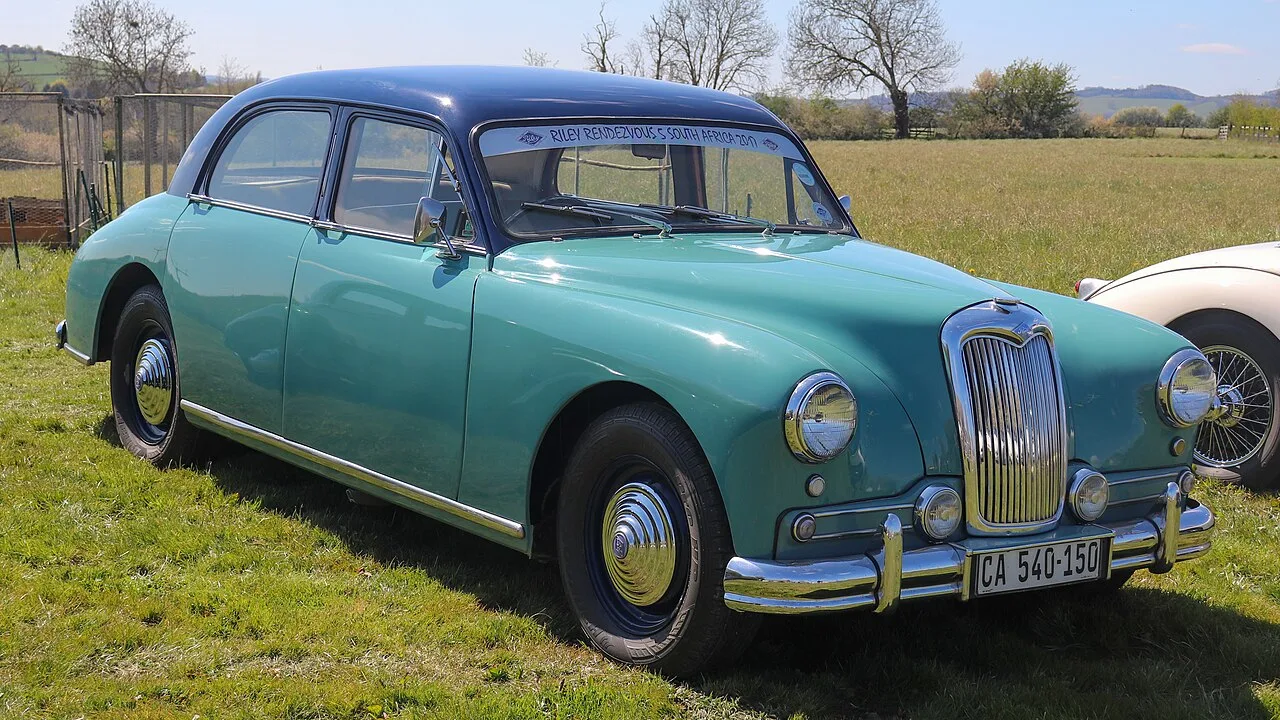
Some early cars' Panhard rods sheared under hard cornering, earning the Pathfinder the nickname "Ditchfinder".
Lead trim: Pathfinder 2.5 Big Four (2443 cc)
Riley Pathfinder1953–1957
- 0spots by members
- Unclaimednobody has spotted one yet
- 0sets it belongs to
Nobody in Burbles has spotted a Riley Pathfinder yet. See one on the street, point the app at it, and the first card is yours — with your @handle permanently credited on this page.
FactSome early cars' Panhard rods sheared under hard cornering, earning the Pathfinder the nickname "Ditchfinder".
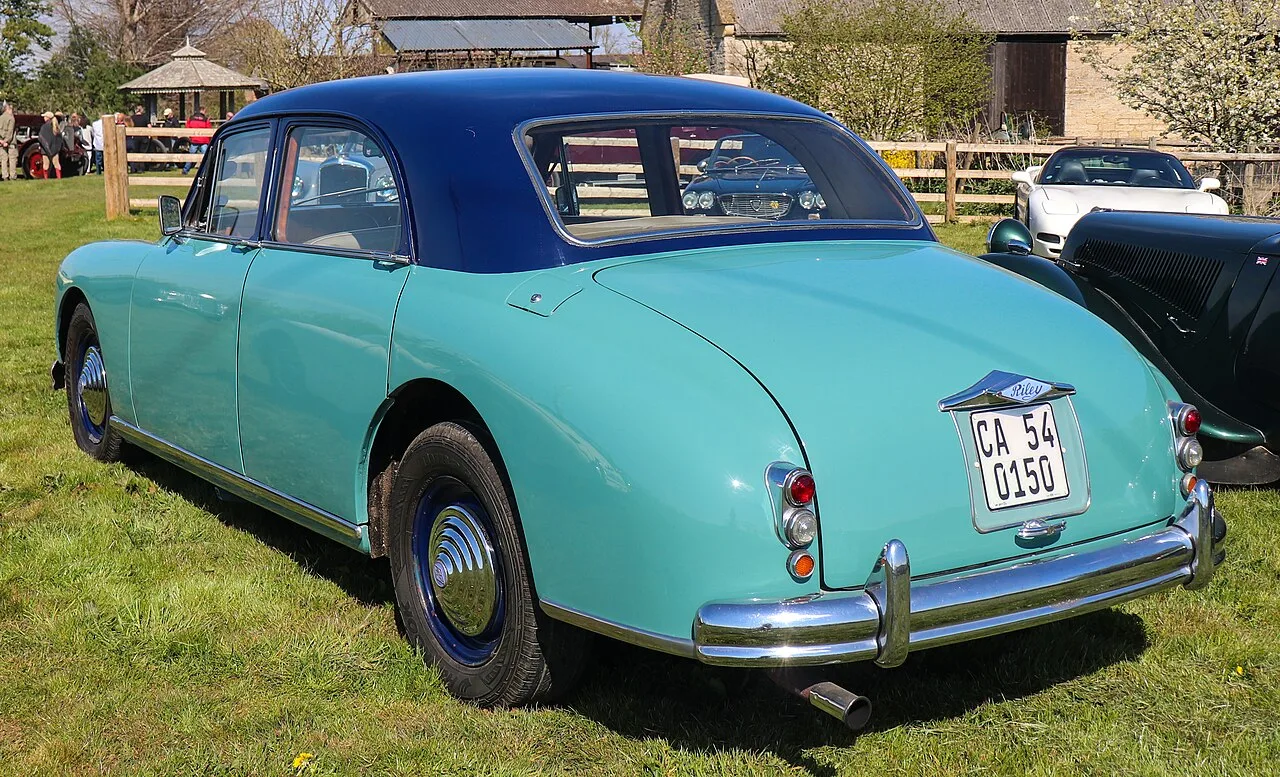
The Riley Pathfinder is an automobile produced by Riley Motors in the United Kingdom from 1953 to 1957 (5,536 made), first presented at the London Motor Show in October 1953, when it replaced the RMF as Riley's top-line model. Designed as the "RMH" by Gerald Palmer just before the 1952 merger of Riley's parent, the Nuffield Organization, with Austin to form BMC, it is seen as the last proper Riley car. It used Riley's 2.5-litre 2,443 cc twin-cam-style "Big Four" straight-four (pushrod-operated, 90-degree angled overhead valves and high-lift camshafts, 6.9:1 compression, twin SU H4 carburettors, a 16hp tax rating, 106 bhp at 4,500 rpm in the engine box) and a separate all-steel chassis with coil-spring rear suspension (changed to leaf springs towards the end of production) and front torsion-bar independent suspension. An overdrive gearbox became optional from 1956 and a 3-speed automatic from 1956; the 12-inch Girling drum brakes had a Clayton Dewandre servo as standard, with a choice of two front single seats or a full-width bench seat allowing seating for three, leather rear covers and a standard heater. The body was similar to the Wolseley 6/90 (launched in 1954, also designed by Palmer) but the Riley's opening bonnet included the radiator grille. A Panhard rod that sheared on hard cornering on some early cars earned the nickname "Ditchfinder". The Motor tested a 1955 car at 99.5 mph and 0–60 mph in 16.8 seconds, costing £1,240, and the Pathfinder was replaced by the short-lived Wolseley 6/90-derived Riley Two-Point-Six in 1957.
Collectors Spotted in the Riley Pathfinder Lineage
No member has published a public street spot of the Riley Pathfinder yet — the First · Worldwide stamp is wide open.
Trims & Figures
One published trim in the catalogue. A blank is a figure not recorded, not zero.
| Trim | Years | Engine | Power | Torque | 0–60 | Drive | Gearbox | MSRP |
|---|---|---|---|---|---|---|---|---|
| Pathfinder 2.5 Big Four (2443 cc) | 1953–1957 | 2.4 L Inline-4 | 110 hp | — | 16.8 s | — | — | — |
Owning one
We don’t estimate running costs for a car like this. What it costs depends on its condition, its specialist and how it is driven, and an average would mislead.
Owners’ builds
Nobody has claimed one yet.
Photographs
Rivals
Same body, same money, other badges — tap any card to flip.

It briefly served as senior sibling to Marquette, a GM companion brand cancelled after just one year.

Nissan hired former BMW engineers to help develop the 510's suspension, which is why period reviewers frequently compared its handling to the BMW 1600/2002.

A Trabant 601 won its class at the 1970 Monte Carlo Rally, with a second 601 right behind it in second.

The 600 was a stopgap: the P50's body over the 601's mechanicals, and for a while its estate was built alongside the new 601 saloon.

The G80 Sport brought a 370 PS twin-turbo 3.3 V6, a mesh grille and copper-tinted chrome with copper stitching to match.

The Vigor was sold only with a five-cylinder engine, an unusual configuration Honda used to fit a longer engine transversely under a short hood.

The GS/E coupe earned the nickname "German Charger" for its long hood, short deck stance borrowed from Detroit muscle cars.

This DeVille/Fleetwood was the first production car anywhere to mount its V8 sideways, Cadillac's front-drive gamble on the new C-body.