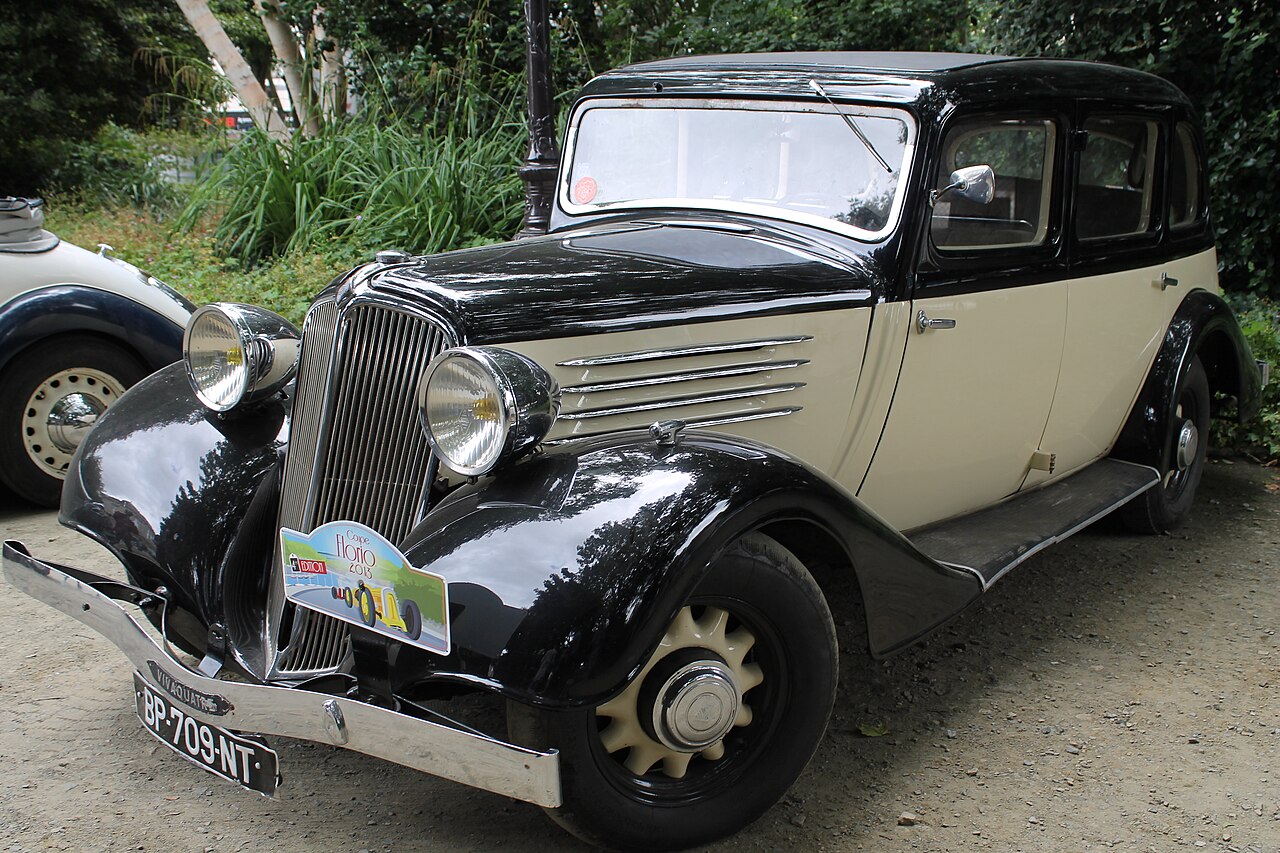
Vivaquatre taxis stayed on the streets into the late 1950s, decades after Renault stopped building the car itself in 1939.
Lead trim: Vivaquatre 2.1 side-valve four (1932–1935; 35 hp) · up to 56 hp
Renault VivaquatreKZ · 1932–1939
- 0spots by members
- Unclaimednobody has spotted one yet
- 0sets it belongs to
Nobody in Burbles has spotted a Renault Vivaquatre yet. See one on the street, point the app at it, and the first card is yours — with your @handle permanently credited on this page.
FactVivaquatre taxis stayed on the streets into the late 1950s, decades after Renault stopped building the car itself in 1939.
The Renault Vivaquatre was built between 1932 and 1939 as the largest of Renault's four-cylinder models, its big four initially putting it in the 10CV tax class (a larger engine later the 11CV), an offshoot of the Primaquatre with a wheelbase 26 cm longer even in "normal" form and the "G7" long-wheelbase six-light version offered for taxi work from April 1933 (Vivaquatre taxis operating to the end of the 1950s). It replaced the robust, unpretentious 10CV with berline bodies only (no cabriolet or coupé), stand-alone headlights and an uncovered rear wheel, black or dark blue on the "Luxe" and four colours on the "Grand Luxe" in 1935. The original 4-cylinder side-valve engine was 2120 cc with a claimed 35 hp, unchanged in size through the KZ13/KZ17 (1934) and KZ23 (1935); from the ADL1 of 1936 it was 2383 cc with a claimed 56 HP at 3,300 rpm, with the ADL2 (1937 model year) getting the wrap-around trapezoidal grille and streamlined bodies (BDH1, BDH3, BDH4 to 1939, the long body reaching 4,700 mm). Three-speed gearbox without synchromesh, rear-wheel drive; an "SA" (Suspendu Amorti) engine mounting option cost 4,000 francs from April 1932. Wheelbase 113.8 in normal and 123.2 in long; length 167.3 in and 176.8 in. The Frégate followed it in 1950.
Collectors Spotted in the Renault Vivaquatre Lineage
No member has published a public street spot of the Renault Vivaquatre yet — the First · Worldwide stamp is wide open.
Trims & Figures
2 published trims in the catalogue. A blank is a figure not recorded, not zero.
| Trim | Years | Engine | Power | Torque | 0–60 | Drive | Gearbox | MSRP |
|---|---|---|---|---|---|---|---|---|
| Vivaquatre 2.1 side-valve four (1932–1935; 35 hp) | 1932–1935 | 2.1 L Inline-4 | 35 hp | — | — | RWD | — | — |
| Vivaquatre 2.4 four (1936–1939; 56 HP at 3,300 rpm) | 1936–1939 | 2.4 L Inline-4 | 56 hp | — | — | RWD | — | — |
Owning one
We don’t estimate running costs for a car like this. What it costs depends on its condition, its specialist and how it is driven, and an average would mislead.
Owners’ builds
Nobody has claimed one yet.
Photographs
Rivals
Same body, same money, other badges — tap any card to flip.

It briefly served as senior sibling to Marquette, a GM companion brand cancelled after just one year.

Nissan hired former BMW engineers to help develop the 510's suspension, which is why period reviewers frequently compared its handling to the BMW 1600/2002.

A Trabant 601 won its class at the 1970 Monte Carlo Rally, with a second 601 right behind it in second.

The 600 was a stopgap: the P50's body over the 601's mechanicals, and for a while its estate was built alongside the new 601 saloon.

The G80 Sport brought a 370 PS twin-turbo 3.3 V6, a mesh grille and copper-tinted chrome with copper stitching to match.

The Vigor was sold only with a five-cylinder engine, an unusual configuration Honda used to fit a longer engine transversely under a short hood.

The GS/E coupe earned the nickname "German Charger" for its long hood, short deck stance borrowed from Detroit muscle cars.

This DeVille/Fleetwood was the first production car anywhere to mount its V8 sideways, Cadillac's front-drive gamble on the new C-body.