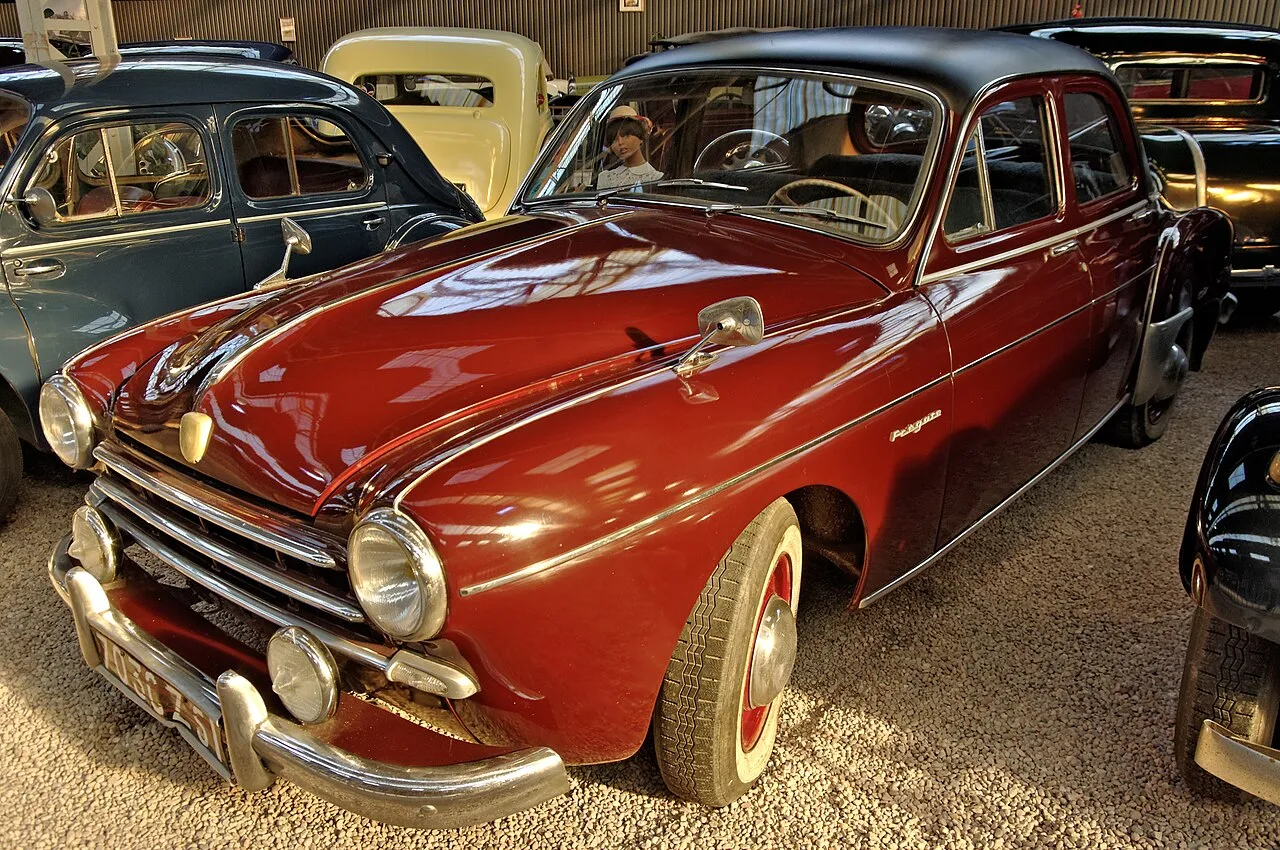
Renault's plant at Flins was later named for Pierre Lefaucheux, the boss who died in a single-car accident driving his own Fregate.
Lead trim: Frégate 2.0 type 668 (58 PS) · up to 79 hp
Renault Frégate1951–1960
- 0spots by members
- Unclaimednobody has spotted one yet
- 0sets it belongs to
Nobody in Burbles has spotted a Renault Frégate yet. See one on the street, point the app at it, and the first card is yours — with your @handle permanently credited on this page.
FactRenault's plant at Flins was later named for Pierre Lefaucheux, the boss who died in a single-car accident driving his own Fregate.
The Renault Frégate is an executive saloon manufactured and marketed by the French automaker Renault from 1951 to 1960, with estate variants, the Domaine and the Manoir, introduced in 1956 and 1958. It was conceived in the years immediately after World War II, when the newly state-controlled Renault needed a modern upmarket model to improve its image and serve the expected middle-class recovery; originally planned with a rear-engined layout like the 4CV ("Project 108"), it switched to a front engine in 1949, so the engineering was rushed. It was presented at the 1950 Paris Motor Show, with the first production model delivered in November 1951 and manufacture at the Flins plant, later named for Pierre Lefaucheux, who died in a single-car accident in a Frégate. From early 1953 it was offered in two trim levels, the "Frégate Affaires" and the "Frégate Amiral". The 2-litre type 668 engine produced 58 PS, raised to 64 PS by a January 1955 compression-ratio increase; complaints about the lack of power were addressed for 1956 by the bored-out 2141 cc Étendard engine with 77 PS, a luxurious Grand Pavois trim package arrived the same year, and in 1957 a three-speed "Transfluide" semi-automatic transmission became an option along with an 80 PS version of the Étendard engine. Sales peaked in 1955 with 37,717 cars, slumping to 9,772 in 1957 as Citroën's DS and ID and Simca competition intensified; the final Frégate was assembled on 18 April 1960 after 163,383 were made at Flins. Renault replaced it with the imported Rambler Classic Six sold as the Rambler Renault.
Collectors Spotted in the Renault Frégate Lineage
No member has published a public street spot of the Renault Frégate yet — the First · Worldwide stamp is wide open.
Trims & Figures
4 published trims in the catalogue. A blank is a figure not recorded, not zero.
| Trim | Years | Engine | Power | Torque | 0–60 | Drive | Gearbox | MSRP |
|---|---|---|---|---|---|---|---|---|
| Frégate 2.0 type 668 (58 PS) | 1951–1954 | 2.0 L Inline-4 | 57 hp | 97 lb-ft | — | RWD | — | — |
| Frégate 2.0 type 668 (64 PS) | 1955–1957 | 2.0 L Inline-4 | 63 hp | — | — | RWD | — | — |
| Frégate 2.1 Étendard (77 PS) | 1955–1957 | 2.1 L Inline-4 | 76 hp | 121 lb-ft | — | RWD | — | — |
| Frégate 2.1 Étendard Transfluide (80 PS) | 1957–1960 | 2.1 L Inline-4 | 79 hp | 125 lb-ft | — | RWD | — | — |
Owning one
We don’t estimate running costs for a car like this. What it costs depends on its condition, its specialist and how it is driven, and an average would mislead.
Owners’ builds
Nobody has claimed one yet.
Photographs
Rivals
Same body, same money, other badges — tap any card to flip.

It briefly served as senior sibling to Marquette, a GM companion brand cancelled after just one year.

Nissan hired former BMW engineers to help develop the 510's suspension, which is why period reviewers frequently compared its handling to the BMW 1600/2002.

A Trabant 601 won its class at the 1970 Monte Carlo Rally, with a second 601 right behind it in second.

The 600 was a stopgap: the P50's body over the 601's mechanicals, and for a while its estate was built alongside the new 601 saloon.

The G80 Sport brought a 370 PS twin-turbo 3.3 V6, a mesh grille and copper-tinted chrome with copper stitching to match.

The Vigor was sold only with a five-cylinder engine, an unusual configuration Honda used to fit a longer engine transversely under a short hood.

The GS/E coupe earned the nickname "German Charger" for its long hood, short deck stance borrowed from Detroit muscle cars.

This DeVille/Fleetwood was the first production car anywhere to mount its V8 sideways, Cadillac's front-drive gamble on the new C-body.