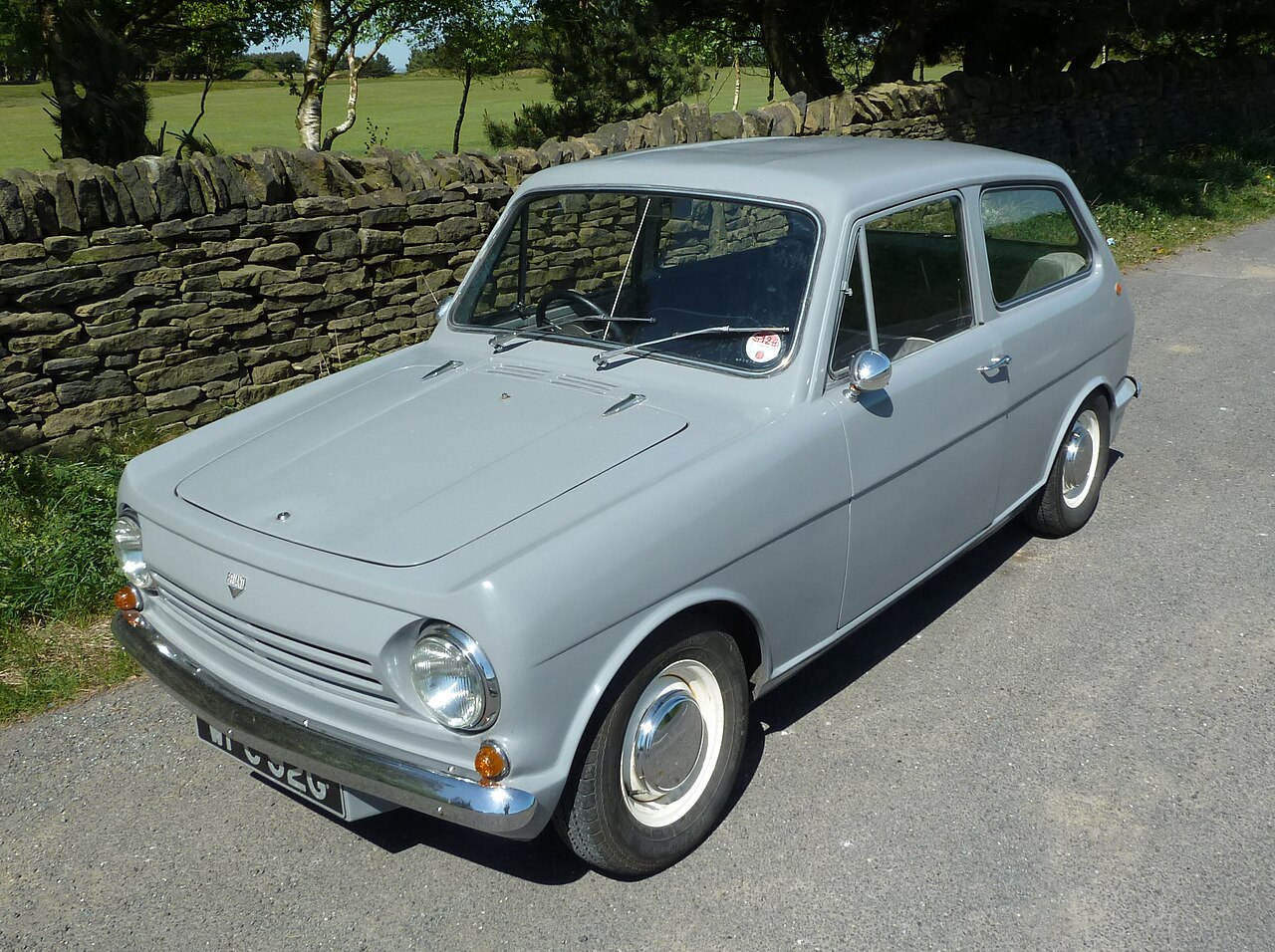
Royal Mail nearly chose the Reliant Rebel van to replace its ageing Morris fleet, running a trial of about ten of them before the idea went no further.
Lead trim: Rebel 0.6 OHV four (598 cc, 28 hp) · up to 35 hp
Reliant Rebel1964–1974
- 0spots by members
- Unclaimednobody has spotted one yet
- 0sets it belongs to
Nobody in Burbles has spotted a Reliant Rebel yet. See one on the street, point the app at it, and the first card is yours — with your @handle permanently credited on this page.
FactRoyal Mail nearly chose the Reliant Rebel van to replace its ageing Morris fleet, running a trial of about ten of them before the idea went no further.
The Reliant Rebel is a small four-wheeled economy car produced by Reliant from 1964 to 1974 (about 2,600 made), designed as a market test to push Reliant beyond three-wheelers; marketed as the smart alternative with a rust-free glass-fibre body, a robust chassis and frugal fuel economy, as a niche rival to the Austin Mini and Hillman Imp, in saloon, estate and van variants. It was the brainchild of managing director Ray Wiggin, who believed people would drive small four-wheeled cars in future and the microcar/three-wheeler segment would die; engineers built a rolling chassis from a cut-and-welded Regal 3/25 chassis, with front suspension from the Triumph Herald, brakes from the Triumph Courier van and the steering box from the Standard 10. It launched in October 1964 as a saloon with the Regal 3/25's 598 cc engine, tuned to 28 horsepower (4 more than the Regal's) by skimming the head and fitting larger valves because the car felt sluggish under its extra weight, in only about 100 originally built in two batches (mostly regarded as pre-production). After the 70 mph motorway limit made anything slower seem slow, Reliant enlarged the engine to 701 cc and 31 hp, first shown as the Rebel 700 at the October 1967 London Motor Show, for a top speed of 70 mph (also fitted to the Regal as the 3/30). The 750, introduced in October 1972 with the new 748 cc engine, Robin-derived rear lights and gearbox and radiator, and 35 hp, was the most popular Rebel with an 80 mph top speed and up to 65 mpg. A Rebel 1600 GT prototype (FW6, an 80 hp Ford Crossflow 1599 cc from the Cortina 1600E) was never put into production because it out-performed the Scimitar GT.
Collectors Spotted in the Reliant Rebel Lineage
No member has published a public street spot of the Reliant Rebel yet — the First · Worldwide stamp is wide open.
Trims & Figures
3 published trims in the catalogue. A blank is a figure not recorded, not zero.
| Trim | Years | Engine | Power | Torque | 0–60 | Drive | Gearbox | MSRP |
|---|---|---|---|---|---|---|---|---|
| Rebel 0.6 OHV four (598 cc, 28 hp) | 1964–1967 | 0.6 L Inline-4 | 28 hp | — | — | — | — | — |
| Rebel 700 (701 cc, 31 hp) | 1967–1972 | 0.7 L Inline-4 | 31 hp | — | — | — | — | — |
| Rebel 750 (748 cc, 35 hp) | 1972–1974 | 0.7 L Inline-4 | 35 hp | — | — | — | — | — |
Owning one
We don’t estimate running costs for a car like this. What it costs depends on its condition, its specialist and how it is driven, and an average would mislead.
Owners’ builds
Nobody has claimed one yet.
Photographs
Rivals
Same body, same money, other badges — tap any card to flip.

It briefly served as senior sibling to Marquette, a GM companion brand cancelled after just one year.

Nissan hired former BMW engineers to help develop the 510's suspension, which is why period reviewers frequently compared its handling to the BMW 1600/2002.

A Trabant 601 won its class at the 1970 Monte Carlo Rally, with a second 601 right behind it in second.

The 600 was a stopgap: the P50's body over the 601's mechanicals, and for a while its estate was built alongside the new 601 saloon.

The G80 Sport brought a 370 PS twin-turbo 3.3 V6, a mesh grille and copper-tinted chrome with copper stitching to match.

The Vigor was sold only with a five-cylinder engine, an unusual configuration Honda used to fit a longer engine transversely under a short hood.

The GS/E coupe earned the nickname "German Charger" for its long hood, short deck stance borrowed from Detroit muscle cars.

This DeVille/Fleetwood was the first production car anywhere to mount its V8 sideways, Cadillac's front-drive gamble on the new C-body.