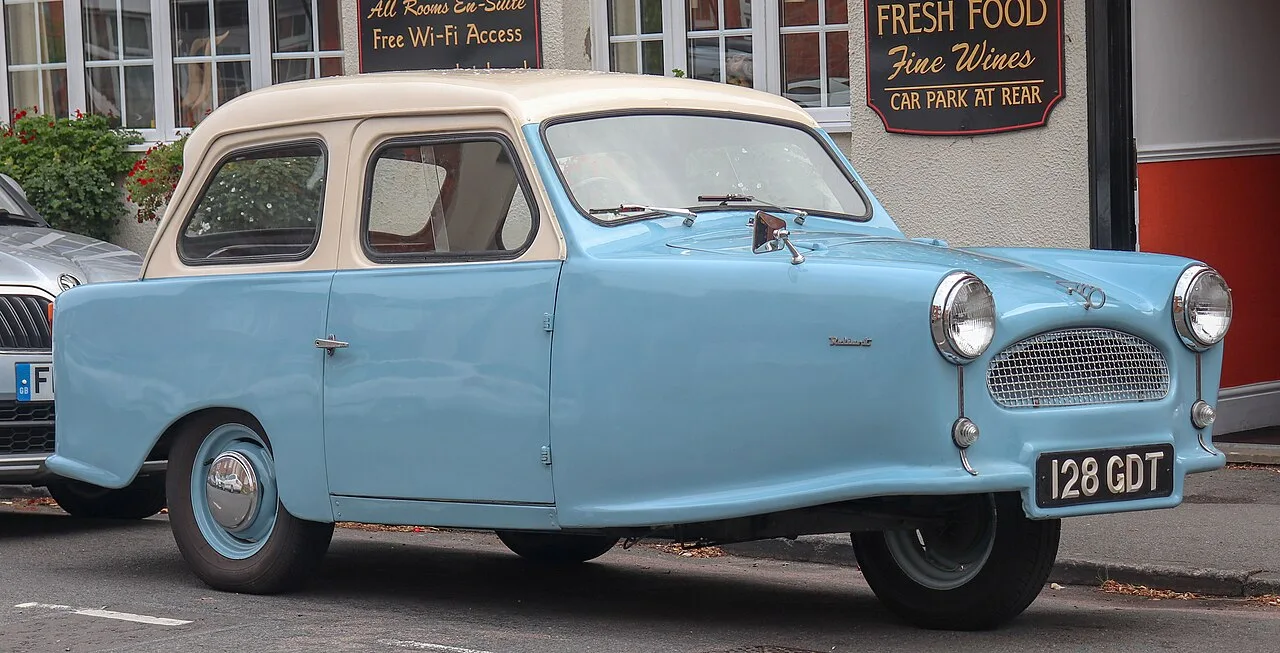
When aluminum prices spiked across Europe in the 1950s, Reliant didn't switch to heavier steel like its rivals — it taught itself fiberglass instead, and the 1956 Mark III Regal became the first with a fully glass-fibre body.
Lead trim: Regal 747 cc side-valve four
Reliant Regal Mk I–VI1952–1962
- 0spots by members
- Unclaimednobody has spotted one yet
- 0sets it belongs to
Nobody in Burbles has spotted a Reliant Regal Mk I–VI yet. See one on the street, point the app at it, and the first card is yours — with your @handle permanently credited on this page.
FactWhen aluminum prices spiked across Europe in the 1950s, Reliant didn't switch to heavier steel like its rivals — it taught itself fiberglass instead, and the 1956 Mark III Regal became the first with a fully glass-fibre body.
The Reliant Regal is a small three-wheeled car and van manufactured from 1952 to 1973 by the Reliant Motor Company in Tamworth, replacing the Reliant Regent three-wheeled cyclecar van (whose origins were a design Reliant bought from the Raleigh Bicycle Company). As a lightweight (under 7 cwt) three-wheeler it is a "tricycle" under UK law and can be driven on a full class A motorcycle licence. Following the launch of the Mk I in 1953 it passed through many revisions in a short time, the "first generation" using the original wooden frame and discrete-panel bodywork through to the 1961 Mk VI: the Mk II of 1954 had an updated windshield, the Mk III of 1956 a heavily updated design and, for the first time, an all-fibreglass body, followed by the Mk IV (1958), Mk V (1959) and Mk VI (1960). Regals Mk I–II had aluminium bodies and 747-cc side-valve engines; as aluminium prices rose across Europe Reliant developed glass-fibre panels that replaced them piece by piece until the 1956 Mark 3 was wholly glass fibre, keeping the light weight (Panhard used heavier steel) and so the ability to use smaller, cheaper, more economical engines. The Mk VI was the last Regal with a side-valve engine.
Collectors Spotted in the Reliant Regal Lineage
No member has published a public street spot of the Reliant Regal yet — the First · Worldwide stamp is wide open.
Trims & Figures
One published trim in the catalogue. A blank is a figure not recorded, not zero.
| Trim | Years | Engine | Power | Torque | 0–60 | Drive | Gearbox | MSRP |
|---|---|---|---|---|---|---|---|---|
| Regal 747 cc side-valve four | 1952–1962 | — | — | — | — | RWD | — | — |
Owning one
We don’t estimate running costs for a car like this. What it costs depends on its condition, its specialist and how it is driven, and an average would mislead.
Owners’ builds
Nobody has claimed one yet.
Photographs
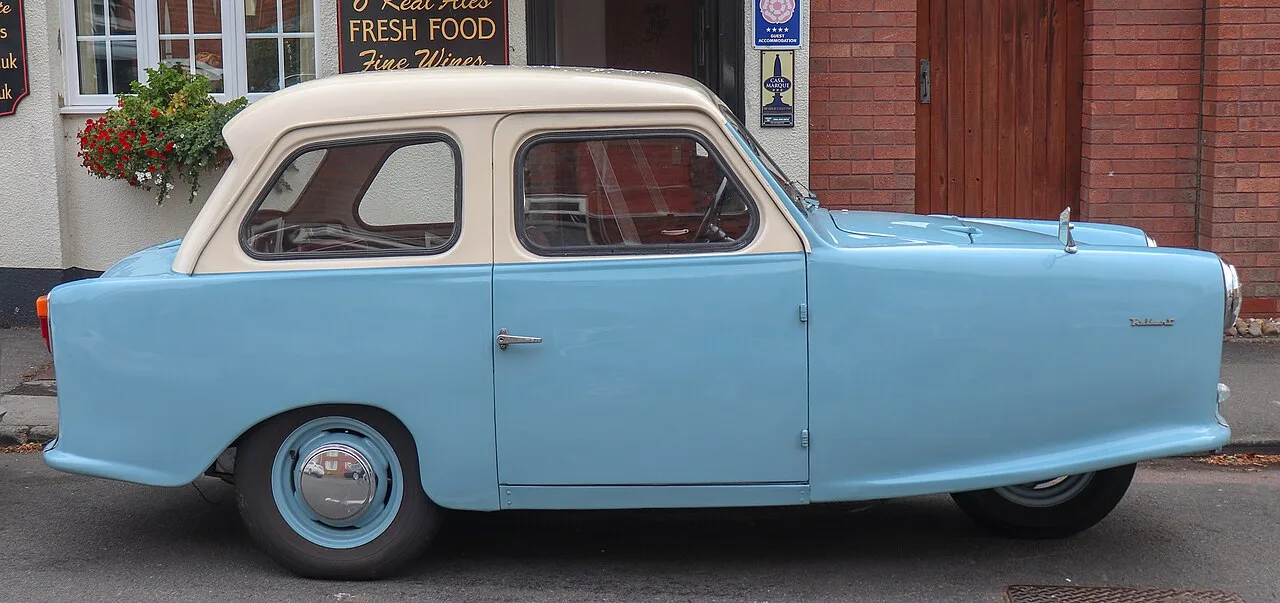
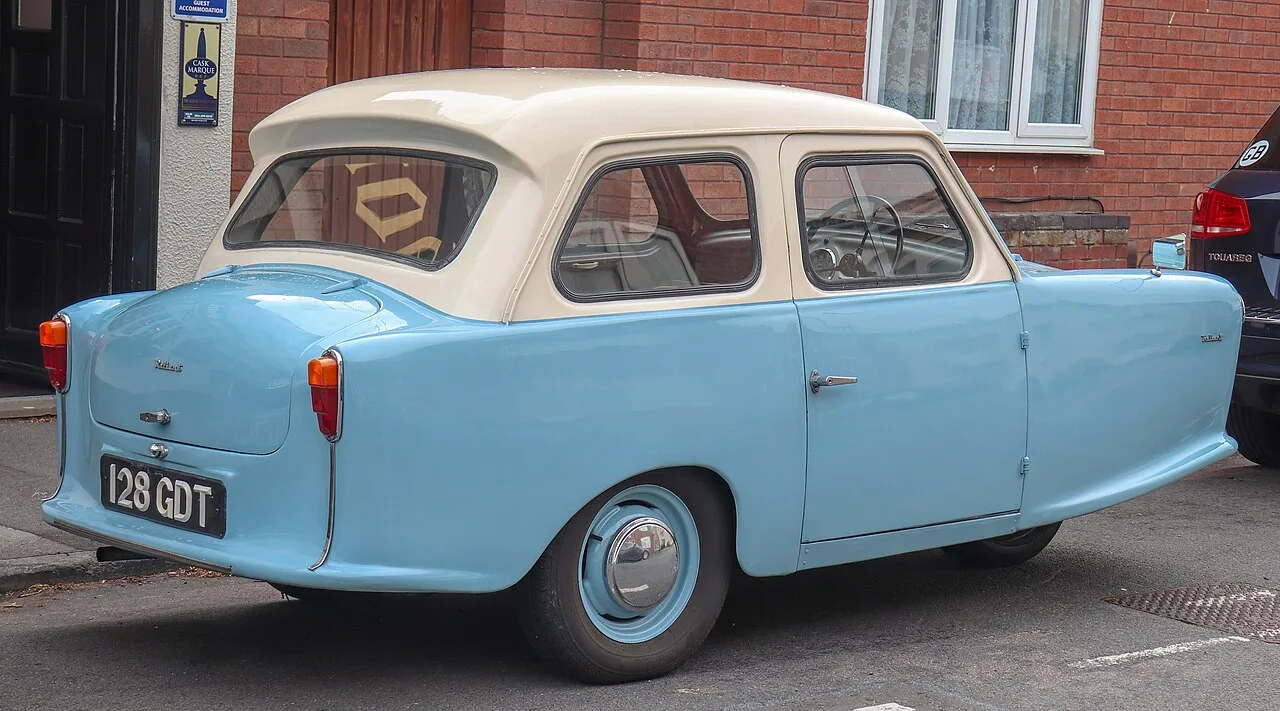
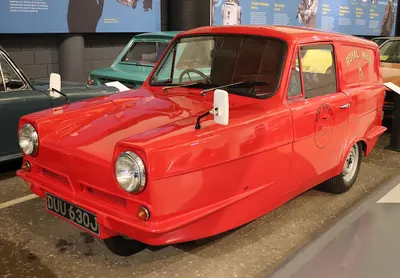
This Regal's engine came secondhand from Reliant's four-wheeled Rebel — but detuned on purpose, its compression ratio dialed back so the 701cc unit made a tamer 29.5 bhp for three-wheeler use instead of the Rebel's 35.
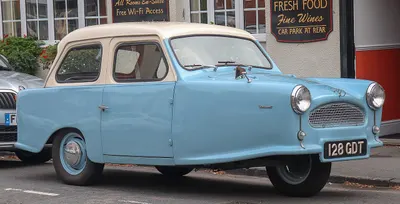
A three-wheeled fibreglass runabout doesn't sound like a sales hit, but Reliant's sales director personally drove the 50,000th Regal 3/25 off the line — a year before BMC hit its own 2,000,000th Mini.
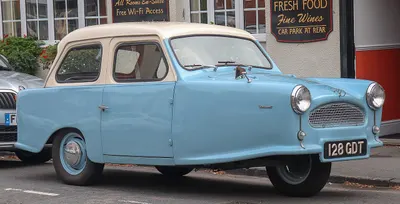
When aluminum prices spiked across Europe in the 1950s, Reliant didn't switch to heavier steel like its rivals — it taught itself fiberglass instead, and the 1956 Mark III Regal became the first with a fully glass-fibre body.
Rivals
Same body, same money, other badges — tap any card to flip.

It briefly served as senior sibling to Marquette, a GM companion brand cancelled after just one year.

Nissan hired former BMW engineers to help develop the 510's suspension, which is why period reviewers frequently compared its handling to the BMW 1600/2002.

A Trabant 601 won its class at the 1970 Monte Carlo Rally, with a second 601 right behind it in second.

The 600 was a stopgap: the P50's body over the 601's mechanicals, and for a while its estate was built alongside the new 601 saloon.

The G80 Sport brought a 370 PS twin-turbo 3.3 V6, a mesh grille and copper-tinted chrome with copper stitching to match.

The Vigor was sold only with a five-cylinder engine, an unusual configuration Honda used to fit a longer engine transversely under a short hood.

The GS/E coupe earned the nickname "German Charger" for its long hood, short deck stance borrowed from Detroit muscle cars.

This DeVille/Fleetwood was the first production car anywhere to mount its V8 sideways, Cadillac's front-drive gamble on the new C-body.