That accent mark in "Volaré" isn't Italian at all — Plymouth invented it and called it an "accent on quality" in the ads.
Median 90 hp across 244 similar cars
Lead trim: Volaré 225 slant-six I6, 1-bbl (1980, 90 hp) · up to 155 hp
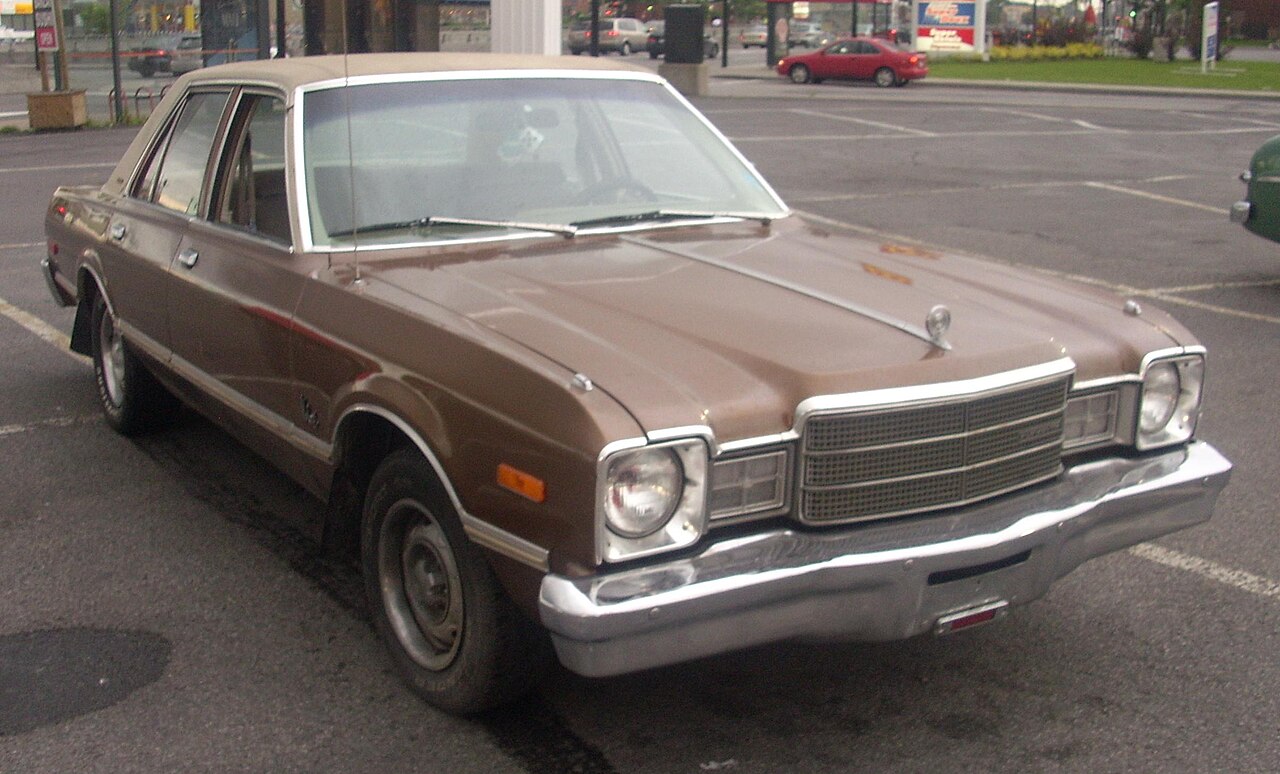
Plymouth VolaréF-1976-PLYMOUTH · 1976–1980
- 0spots by members
- Unclaimednobody has spotted one yet
- 0sets it belongs to
Nobody in Burbles has spotted a Plymouth Volaré yet. See one on the street, point the app at it, and the first card is yours — with your @handle permanently credited on this page.
FactThat accent mark in "Volaré" isn't Italian at all — Plymouth invented it and called it an "accent on quality" in the ads.
Deriving its name from the tree and the ski-resort city, the Dodge Aspen is a compact car marketed by Dodge for the 1976 to 1980 model years as the successor to the 1960–1976 Dodge Dart, sold by Plymouth as the Plymouth Volaré (replacing the Valiant); the model line marked the debut of the all-new Chrysler F platform, the ground-up redesign of the Chrysler compact line since 1960. The two-door coupé lost the hardtop roofline of the Dart/Valiant (a thick "B" pillar was used), and the line was also offered as a four-door sedan and a five-door station wagon, the first Chrysler compact wagon since 1966. Chrysler introduced a new front suspension of crossed torsion bars mounted transversely beneath the engine (the "Isolated Transverse Suspension System") with a K-shaped cross member on four rubber mounts, and rubber-isolated leaf springs at the rear; body engineering used computer-aided design, wind-tunnel testing, thinner glass, lighter door beams and HSLA steel, with 25% (coupé) to 33% (sedan) more glass area. They were named Motor Trend Car of the Year for 1976 but suffered numerous quality problems, frequent recalls (at least eight serious ones for 1976 alone) and early rust, and later received the Center for Auto Safety's Lemon of the Year award. Standard was Chrysler's 225 cu in (3.7 L) slant six with a single-barrel carburetor, with 318 cu in (5.2 L) or 360 cu in (5.9 L) V8s optional, both two-barrel; for 1977 an optional "Super Six" with a two-barrel carburetor arrived; for 1980, at Lee Iacocca's insistence, both were restyled with Dodge Diplomat front sheet metal, the 360 was dropped, the 318 two-barrel went from 140 hp at 4,000 rpm to 120 hp at 3,600, the four-barrel from 140 to 155 hp at 4,000 rpm and the single-barrel slant six produced 90 hp at 3,600 rpm. Production ended in early 1980 with the last car (an R/T) leaving Dodge Main Assembly, which closed the same day; they were replaced by the K-car Dodge Aries and Plymouth Reliant. Coupé wheelbase 108.7 in, sedan and wagon 112.7 in, width 73.3 in. Plymouth Volaré production was 255,008 in 1976, 327,739 in 1977 (Canada's top-selling car that year), 217,795 in 1978, 178,819 in 1979 and 90,063 in 1980; the Volaré came in base, Custom and Premier trims (a 1979 coupé-only "Duster" package, also the "Volaré Duster" in Canada), and its Road Runner and Super Coupe packages are catalogued as their own generations.
Collectors Spotted in the Plymouth Volaré Lineage
No member has published a public street spot of the Plymouth Volaré yet — the First · Worldwide stamp is wide open.
Trims & Figures
7 published trims in the catalogue. A blank is a figure not recorded, not zero.
| Trim | Years | Engine | Power | Torque | 0–60 | Drive | Gearbox | MSRP |
|---|---|---|---|---|---|---|---|---|
| Volaré 225 "Super Six" two-barrel I6 (from 1977) | 1977–1979 | 3.7 L Inline-6 | 110 hp | 180 lb-ft | — | RWD | — | — |
| Volaré 225 slant-six I6, 1-bbl (1976–1979) | 1976–1979 | 3.7 L Inline-6 | 100 hp | 170 lb-ft | — | RWD | — | — |
| Volaré 225 slant-six I6, 1-bbl (1980, 90 hp) | 1980–1980 | 3.7 L Inline-6 | 90 hp | 165 lb-ft | — | RWD | — | — |
| Volaré 318 LA four-barrel V8 (1980, 155 hp) | 1980–1980 | 5.2 L V8 | 155 hp | — | — | RWD | — | — |
| Volaré 318 LA two-barrel V8 (1976–1979, 140 hp) | 1976–1979 | 5.2 L V8 | 140 hp | 245 lb-ft | — | RWD | — | — |
| Volaré 318 LA two-barrel V8 (1980, 120 hp) | 1980–1980 | 5.2 L V8 | 120 hp | 245 lb-ft | — | RWD | — | — |
| Volaré 360 LA V8 (1976–1979) | 1976–1979 | 5.9 L V8 | — | — | — | RWD | — | — |
Owning one
An estimate, for the Volaré 225 "Super Six" two-barrel I6 (from 1977) trim: fuel on its EPA figure and a dated national price, upkeep on a per-mile average for the kind of car it is.
Owners’ builds
Nobody has claimed one yet.
Photographs
Only 494 Volaré Super Coupes were ever built, each slathered in matte black across the hood, fenders, half the roof and both bumpers for a widebody look unlike any other Volaré.
That accent mark in "Volaré" isn't Italian at all — Plymouth invented it and called it an "accent on quality" in the ads.
Chrysler named the Volaré after an Italian pop song, then added an accent mark that exists in neither the song title nor the word itself — marketing called it an 'accent on quality.'
Rivals
Same body, same money, other badges — tap any card to flip.

It briefly served as senior sibling to Marquette, a GM companion brand cancelled after just one year.

Nissan hired former BMW engineers to help develop the 510's suspension, which is why period reviewers frequently compared its handling to the BMW 1600/2002.

A Trabant 601 won its class at the 1970 Monte Carlo Rally, with a second 601 right behind it in second.

The 600 was a stopgap: the P50's body over the 601's mechanicals, and for a while its estate was built alongside the new 601 saloon.

The G80 Sport brought a 370 PS twin-turbo 3.3 V6, a mesh grille and copper-tinted chrome with copper stitching to match.

The Vigor was sold only with a five-cylinder engine, an unusual configuration Honda used to fit a longer engine transversely under a short hood.

The GS/E coupe earned the nickname "German Charger" for its long hood, short deck stance borrowed from Detroit muscle cars.

This DeVille/Fleetwood was the first production car anywhere to mount its V8 sideways, Cadillac's front-drive gamble on the new C-body.