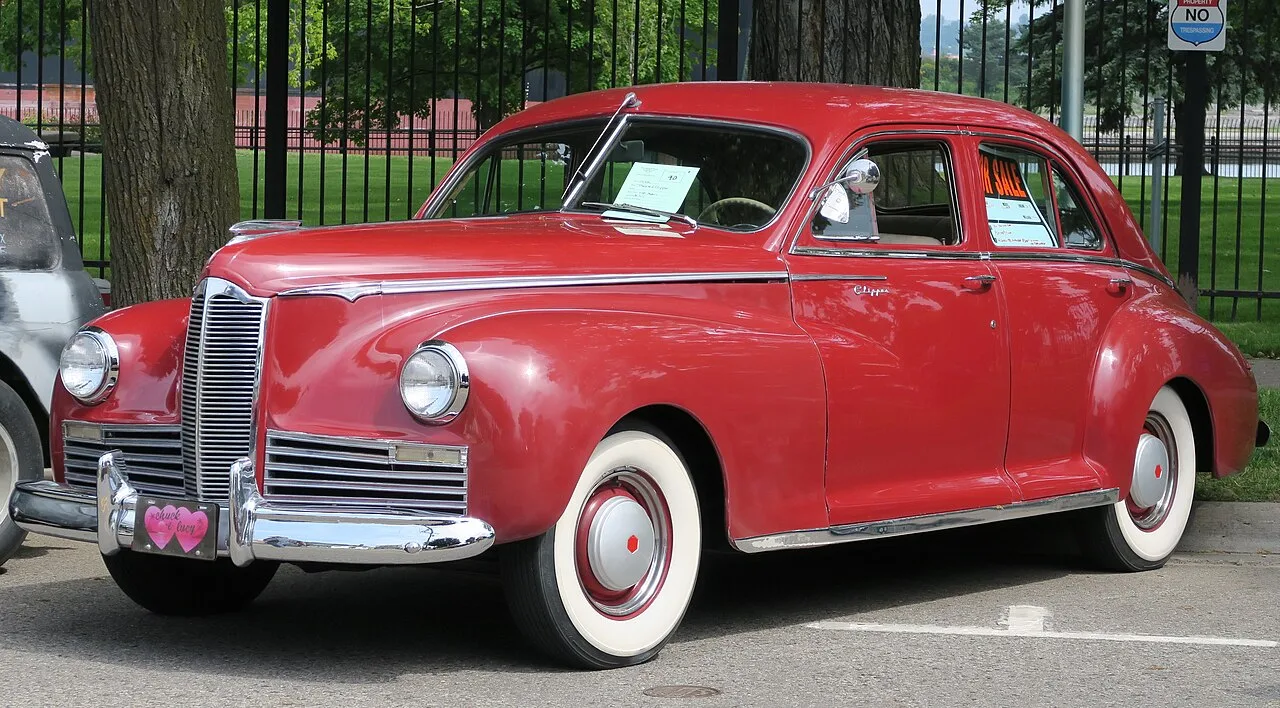
Introduced halfway through the model year, the pricier Clipper still notched 16,600 sales in 1941 — nearly matching the full year's 17,100 units of Packard's cheaper One-Twenty.
Lead trim: Clipper 282 cu in straight eight (125 bhp, 1941) · up to 165 hp
Packard Clipper1941–1947
- 0spots by members
- Unclaimednobody has spotted one yet
- 0sets it belongs to
Nobody in Burbles has spotted a Packard Clipper yet. See one on the street, point the app at it, and the first card is yours — with your @handle permanently credited on this page.
FactIntroduced halfway through the model year, the pricier Clipper still notched 16,600 sales in 1941 — nearly matching the full year's 17,100 units of Packard's cheaper One-Twenty.
The Packard Clipper is an automobile series named for a type of sailing ship, introduced in April 1941 as a mid-model-year, four-door-sedan-only entry aimed at the Buick Roadmaster, Cadillac Model 62, Chrysler New Yorker and Lincoln Zephyr, at around US$1,400 between the One Twenty and One Sixty; only 16,600 of the 1941 models were made before civilian production stopped on February 9, 1942, and it returned in late 1945. The 1941 car rode the 127 in wheelbase of the 120/160/180 and used the One Twenty's 282 cubic inch (4,620 cc) straight eight, but with 125 bhp (five more than the One Twenty), on an entirely new double-drop frame; it was the widest production car in the industry and the first to be wider than it was tall, with a body from cowl to deck of a single piece of steel, and an air conditioning option at $275. For 1942 the Clipper styling spread through the line: the 356 cubic inch (5,830 cc) straight-eight of the One Sixty and One Eighty Clippers, with a nine-main-bearing crankshaft and hydraulic valve lifters, was the most powerful engine in the industry through 1948, while junior Clippers used the 245-ci six (the Clipper Six) and the base 282-ci Clipper Custom cost $1,341. Post-war Clipper Six, Eight, Super and Custom Super versions carried the design through 1947 before the bulbous 1948 upgrade.
Collectors Spotted in the Packard Clipper Lineage
No member has published a public street spot of the Packard Clipper yet — the First · Worldwide stamp is wide open.
Trims & Figures
2 published trims in the catalogue. A blank is a figure not recorded, not zero.
| Trim | Years | Engine | Power | Torque | 0–60 | Drive | Gearbox | MSRP |
|---|---|---|---|---|---|---|---|---|
| Clipper 282 cu in straight eight (125 bhp, 1941) | 1941–1941 | 4.6 L Inline-8 | 125 hp | 260 lb-ft | — | — | — | — |
| One Sixty / One Eighty Clipper 356 cu in straight-eight (1942–1947) | 1942–1947 | 5.8 L Inline-8 | 165 hp | 292 lb-ft | — | — | — | — |
Owning one
We don’t estimate running costs for a car like this. What it costs depends on its condition, its specialist and how it is driven, and an average would mislead.
Owners’ builds
Nobody has claimed one yet.
Photographs
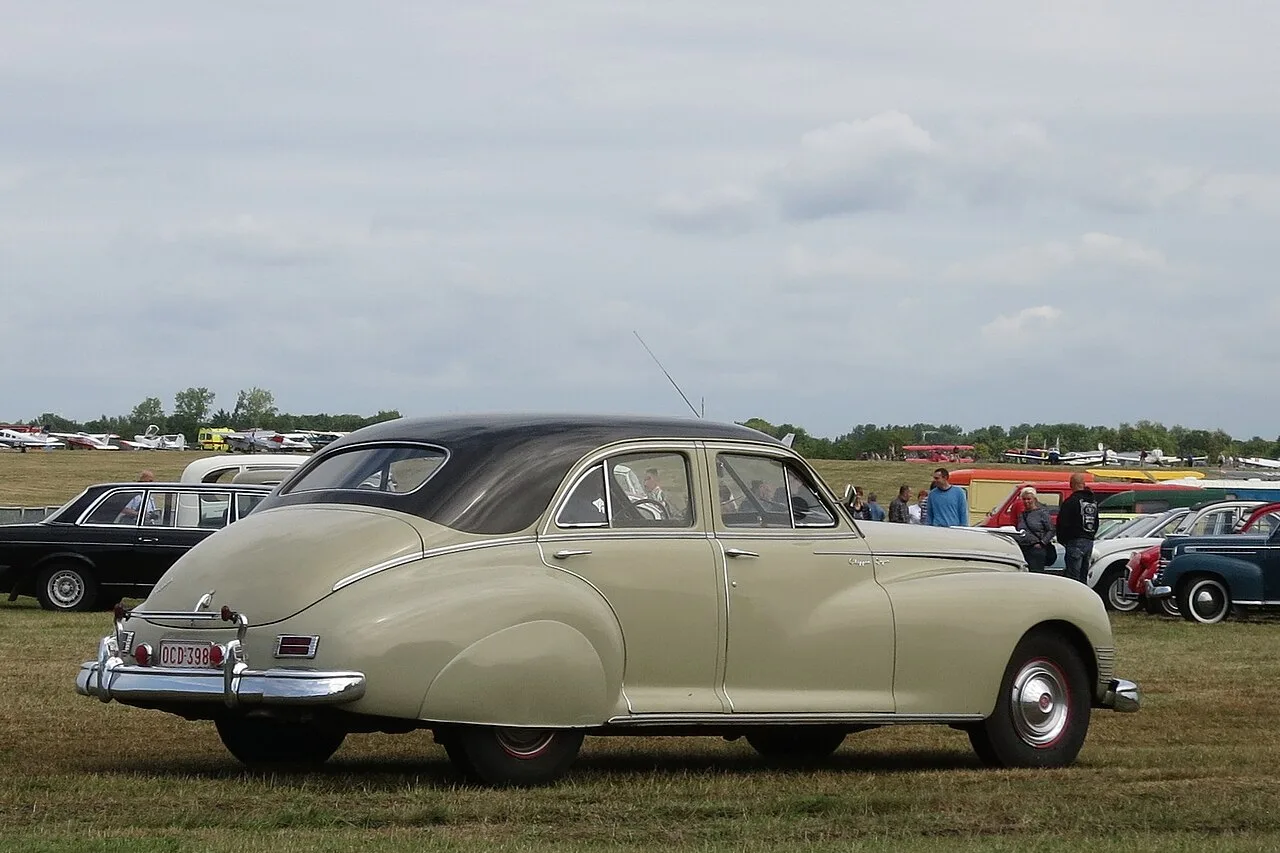
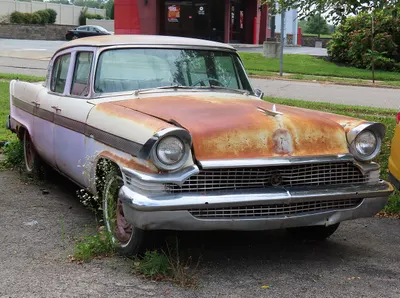
By 1957 there was no Packard engine left in the Packard Clipper at all — every one left the factory with a supercharged Studebaker V8, part of why the public mockingly called these cars "Packardbakers."
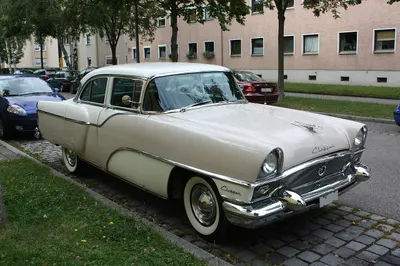
The 1955 Clipper Custom got torsion-bar suspension that no other Packard offered that year — a budget-line car out-engineering its pricier siblings.
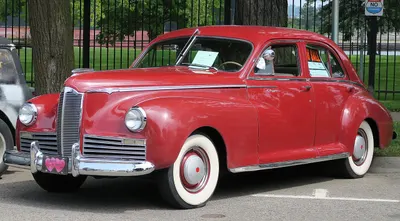
Introduced halfway through the model year, the pricier Clipper still notched 16,600 sales in 1941 — nearly matching the full year's 17,100 units of Packard's cheaper One-Twenty.
Rivals
Same body, same money, other badges — tap any card to flip.

It briefly served as senior sibling to Marquette, a GM companion brand cancelled after just one year.

Nissan hired former BMW engineers to help develop the 510's suspension, which is why period reviewers frequently compared its handling to the BMW 1600/2002.

A Trabant 601 won its class at the 1970 Monte Carlo Rally, with a second 601 right behind it in second.

The 600 was a stopgap: the P50's body over the 601's mechanicals, and for a while its estate was built alongside the new 601 saloon.

The G80 Sport brought a 370 PS twin-turbo 3.3 V6, a mesh grille and copper-tinted chrome with copper stitching to match.

The Vigor was sold only with a five-cylinder engine, an unusual configuration Honda used to fit a longer engine transversely under a short hood.

The GS/E coupe earned the nickname "German Charger" for its long hood, short deck stance borrowed from Detroit muscle cars.

This DeVille/Fleetwood was the first production car anywhere to mount its V8 sideways, Cadillac's front-drive gamble on the new C-body.