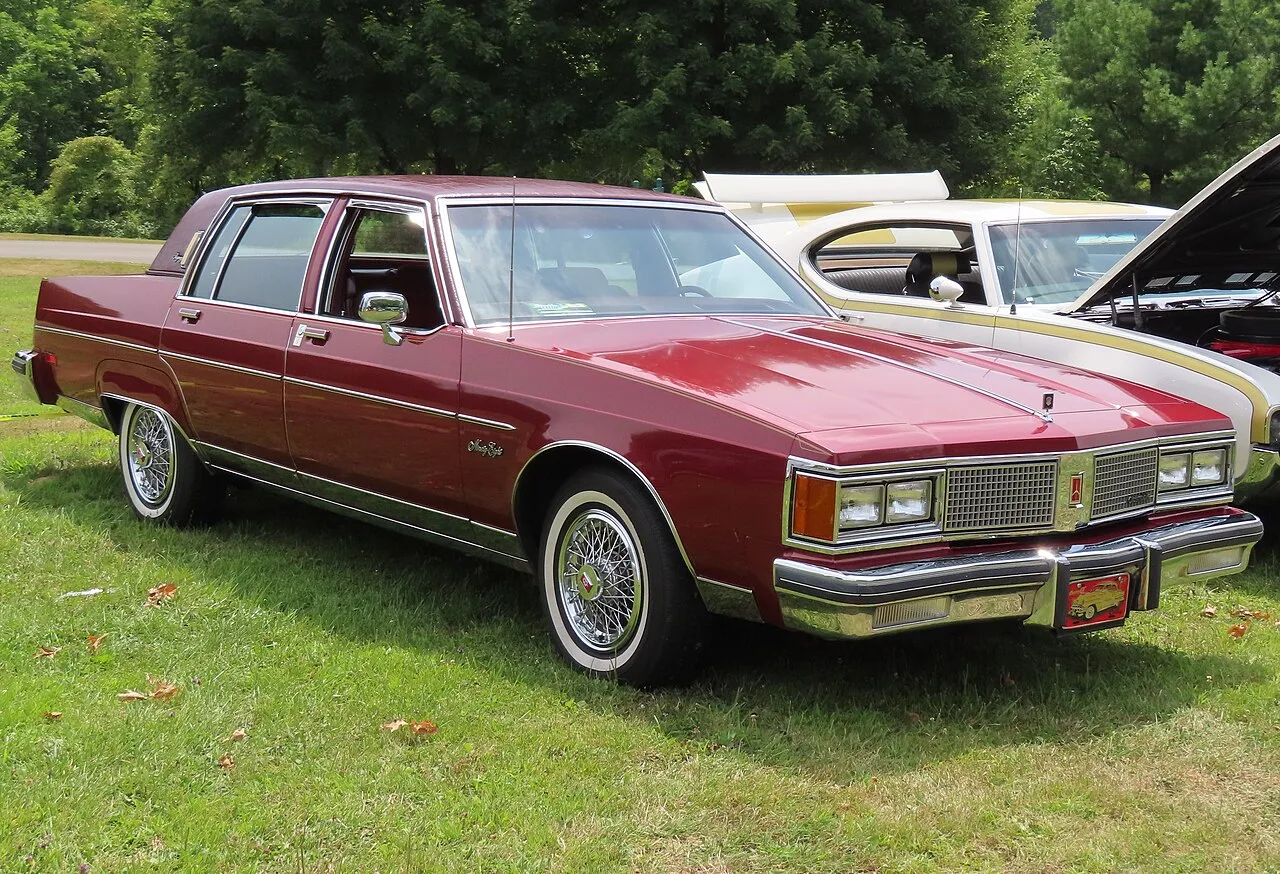
For 1981 this Ninety-Eight switched to a V6 — but Oldsmobile kept the "98" badge anyway, breaking its own decades-old rule that the second digit meant cylinder count.
Median 92 hp across 339 similar cars
Lead trim: Ninety-Eight 252 cu in Buick V6 (standard from 1981) · up to 185 hp
Oldsmobile Ninety-Eight1977–1984
- 0spots by members
- Unclaimednobody has spotted one yet
- 0sets it belongs to
Nobody in Burbles has spotted a Oldsmobile Ninety-Eight yet. See one on the street, point the app at it, and the first card is yours — with your @handle permanently credited on this page.
FactFor 1981 this Ninety-Eight switched to a V6 — but Oldsmobile kept the "98" badge anyway, breaking its own decades-old rule that the second digit meant cylinder count.
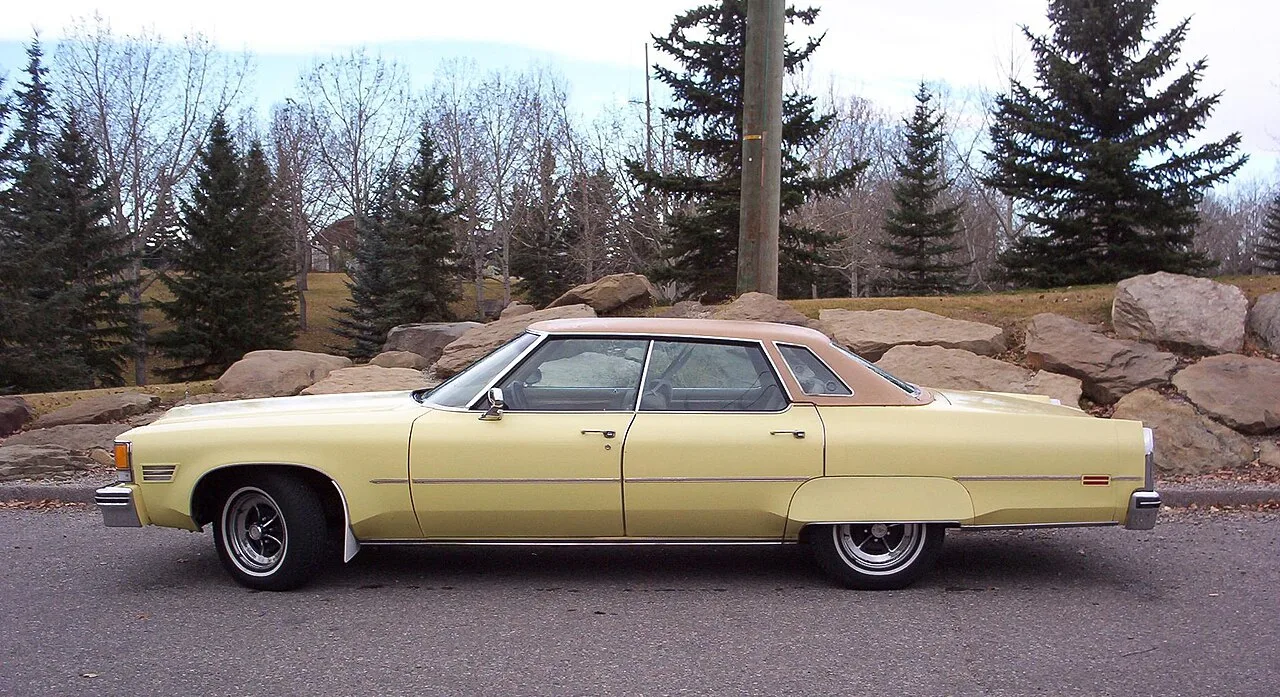
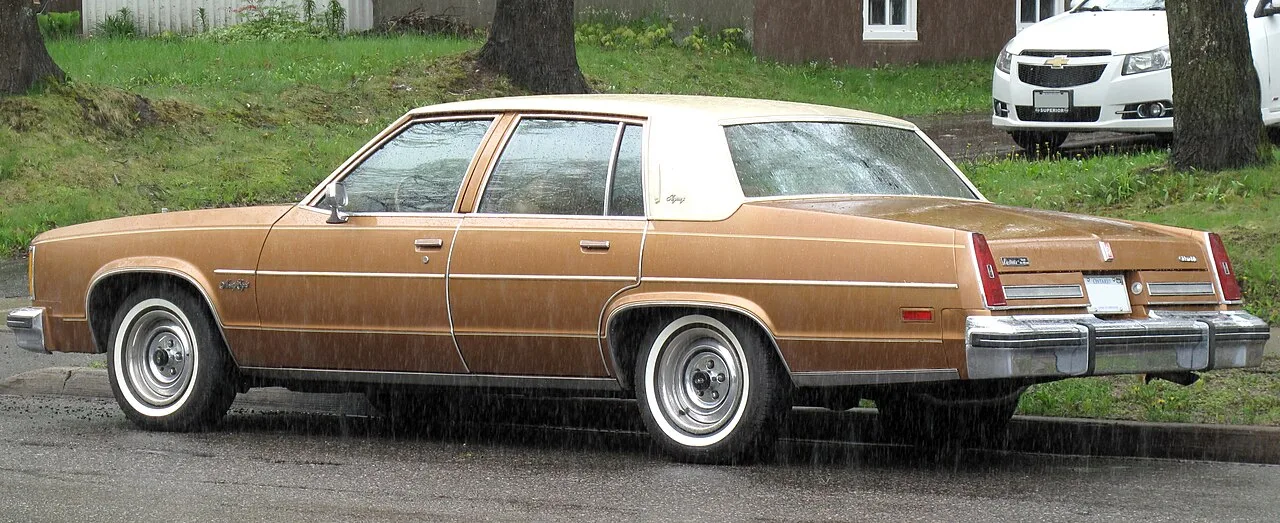
The 1977 Ninety-Eight was redesigned and downsized like the Delta 88: at around 4,000 pounds curb weight it was over 800 pounds lighter, with headroom and rear seat legroom increased, and sold a record 139,423 as a four-door sedan and two-door hardtop coupe. The 455 was replaced by the smaller 403 V8 and the Oldsmobile 350 V8 became the standard engine; a diesel 350 was added in 1978, and from 1979 production was exclusive to Lansing, with base LS sedans and premium Regency coupe or sedan and a limited Regency LX sedan. The 1980 restyle added a 307 cu in (5.0 L) V8 as an option and dropped the 403; the 1981 model year introduced Buick's 252 cu in V6 as standard (and the first standard 4-speed automatic since 1960, the THM200-4R) and dropped the gasoline 350, though the model designation stayed "98"; the Regency Brougham came in 1982. Production ended in March 1984 and these cars were sold concurrently with the new front-wheel-drive 1985 model. Wheelbase 119 in, length 221.4 in, width 76.3 in, height 55.3 in.
Collectors Spotted in the Oldsmobile Ninety-Eight Lineage
No member has published a public street spot of the Oldsmobile Ninety-Eight yet — the First · Worldwide stamp is wide open.
Trims & Figures
4 published trims in the catalogue. A blank is a figure not recorded, not zero.
| Trim | Years | Engine | Power | Torque | 0–60 | Drive | Gearbox | MSRP |
|---|---|---|---|---|---|---|---|---|
| Ninety-Eight 252 cu in Buick V6 (standard from 1981) | 1981–1984 | 4.1 L V6 | 125 hp | 205 lb-ft | — | RWD | — | — |
| Ninety-Eight 307 cu in Oldsmobile V8 (from 1980) | 1980–1984 | 5.0 L V8 | 140 hp | 240 lb-ft | — | RWD | — | — |
| Ninety-Eight 350 cu in Oldsmobile V8 (standard, 1977) | 1977–1977 | 5.7 L V8 | 170 hp | 275 lb-ft | — | RWD | — | — |
| Ninety-Eight 403 cu in Oldsmobile V8 (1977–1979) | 1977–1979 | 6.6 L V8 | 185 hp | 320 lb-ft | — | RWD | — | — |
Owning one
We don’t estimate running costs for a car like this. What it costs depends on its condition, its specialist and how it is driven, and an average would mislead.
Owners’ builds
Nobody has claimed one yet.
Photographs
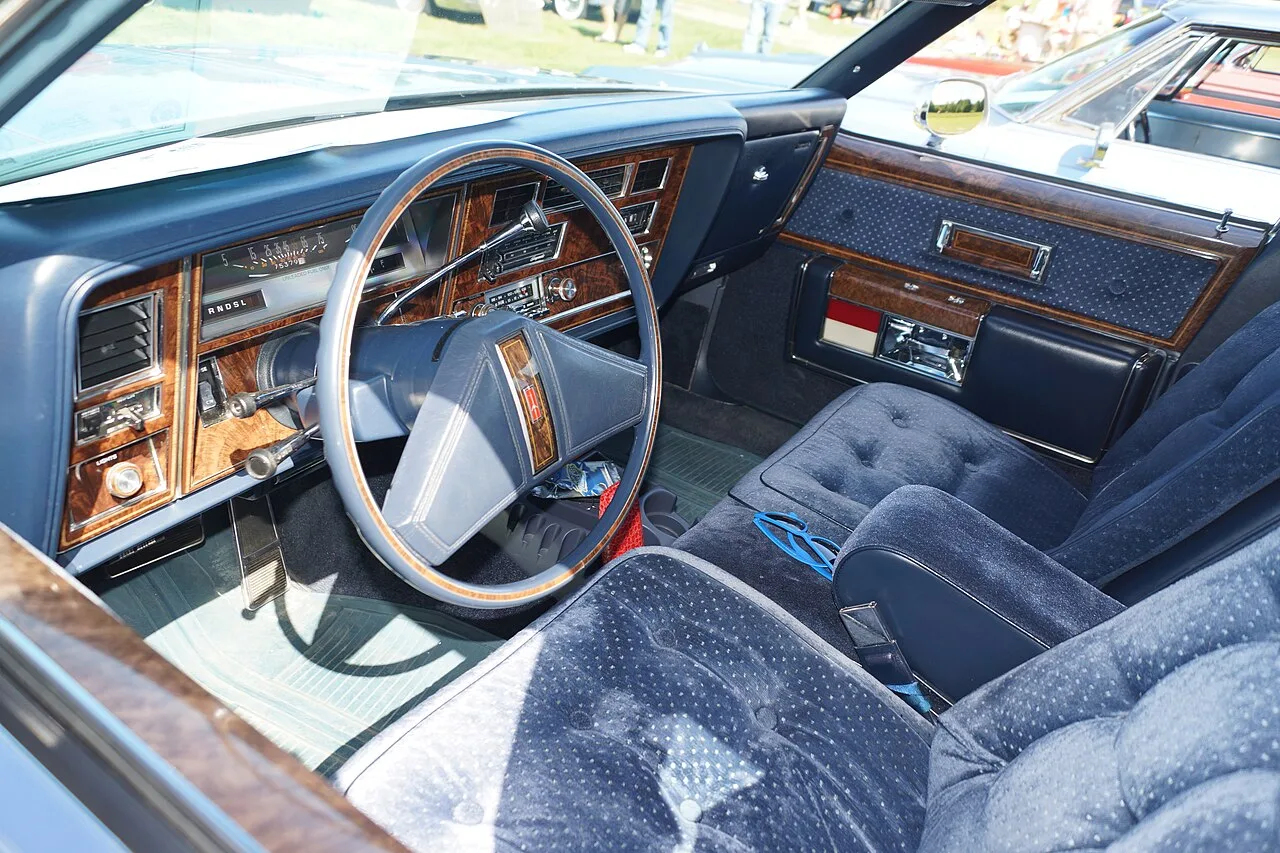
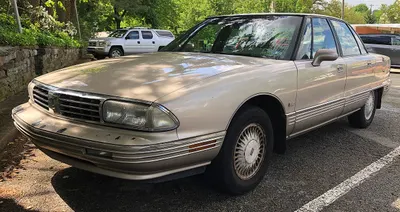
This final Ninety Eight arrived on the nameplate's 50th birthday, and Oldsmobile marked it with a gold-striped anniversary package — cloisonné fender emblems, gold alloy wheels, even gold-flecked burled walnut trim.
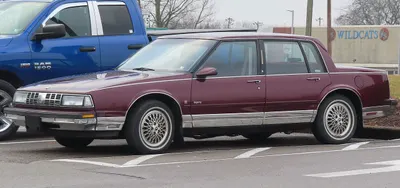
Its Touring Sedan, aimed at Audi and BMW buyers, was finished by ASC of Michigan and cost about 30% more than any other Ninety-Eight.
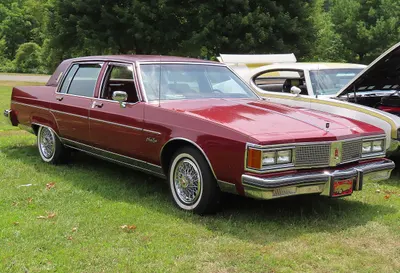
For a few months in 1984, Oldsmobile sold two completely different Ninety-Eights side by side: the outgoing rear-drive car kept rolling off the line even as the all-new front-wheel-drive 1985 model reached showrooms.
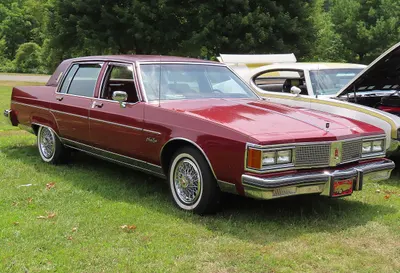
For 1981 this Ninety-Eight switched to a V6 — but Oldsmobile kept the "98" badge anyway, breaking its own decades-old rule that the second digit meant cylinder count.
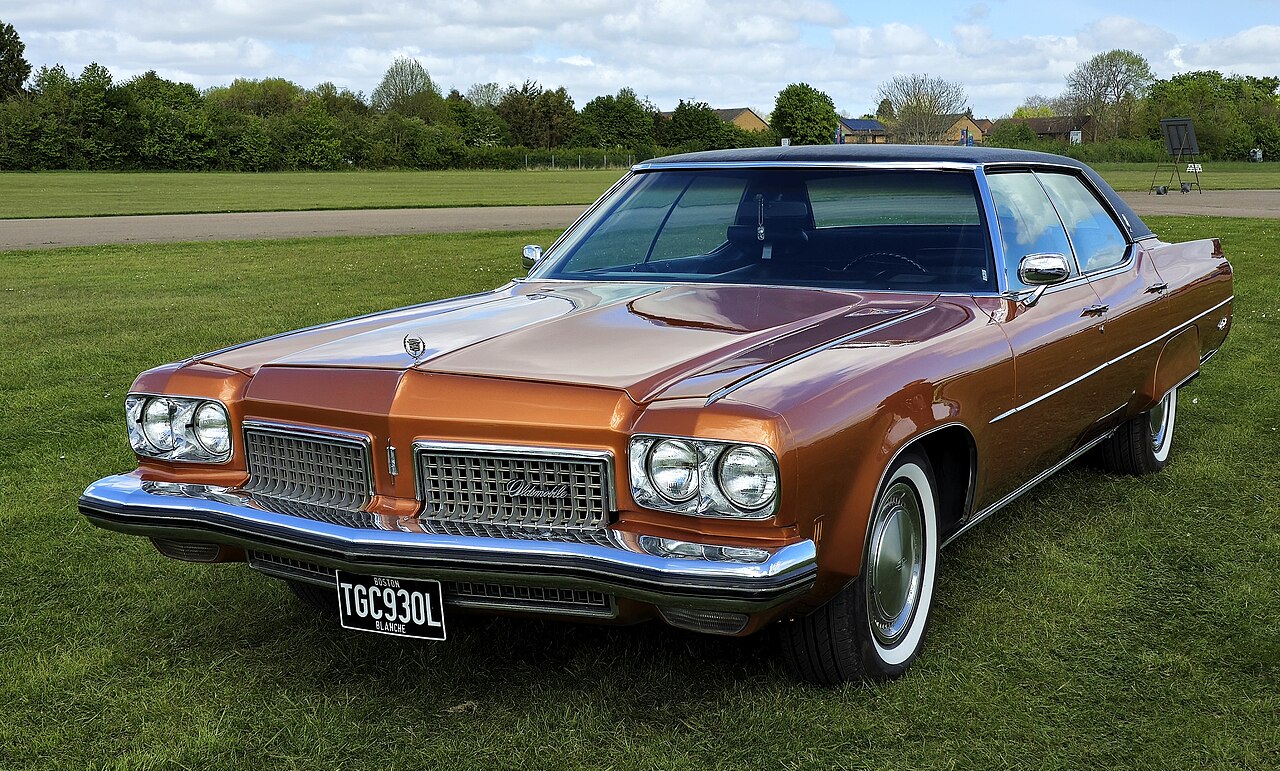
This Ninety-Eight could be ordered with an airbag in 1974 — two decades before they became mandatory. At $700 and facing public doubt about an unproven system, almost nobody actually checked the box.
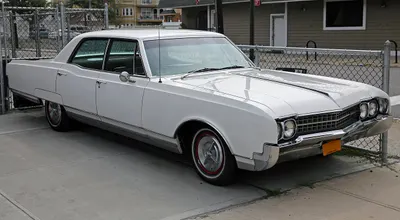
Starting with this generation in 1965, Oldsmobile let coachbuilder Cotner-Bevington turn the big Ninety-Eight chassis into ambulances and hearses.
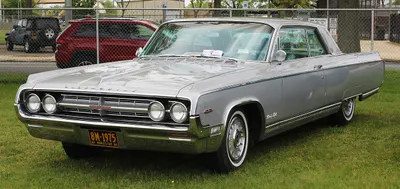
Oldsmobile cheaped out on this Ninety-Eight's transmission, swapping a smooth four-speed for a rough three-speed unit — and so many owners complained that dealers started quietly retrofitting the old gearbox back in.
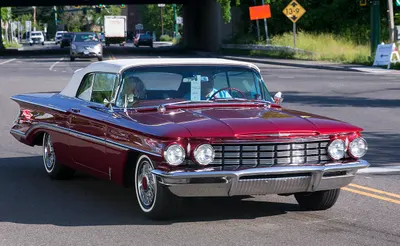
While Chevrolet and Cadillac switched to GM's new X-frame for 1959, Oldsmobile quietly stuck with the older, stronger full perimeter frame for the Ninety-Eight.
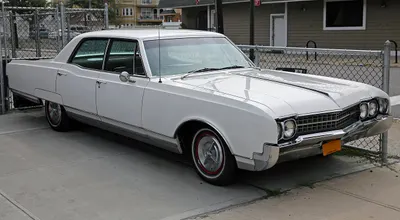
For one year only, Oldsmobile's flagship Ninety-Eight dropped its own name — in 1957 it was sold simply as the Starfire 98, a naming quirk Oldsmobile never repeated.
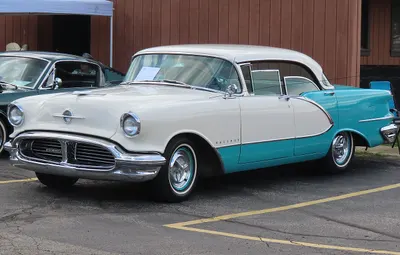
A modified 1954 Ninety-Eight Holiday Coupe worked as a press car at the last-ever Carrera Panamericana, the legendary Mexican road race that was cancelled after that year.
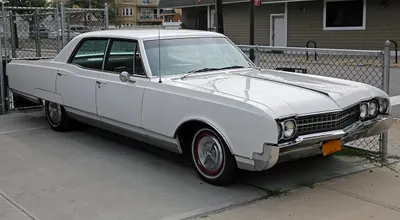
For one single year, the 98 came as a 4-door fastback called the Town Sedan — it sold just 1,778 copies before Oldsmobile dropped the body style for good.
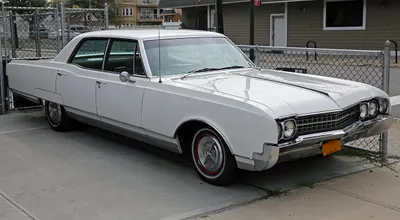
Only 6,659 of these Custom Cruiser 98s were built before World War II shut down production - but when Oldsmobile resumed, demand exploded to a record 37,140 sold in 1947 alone.
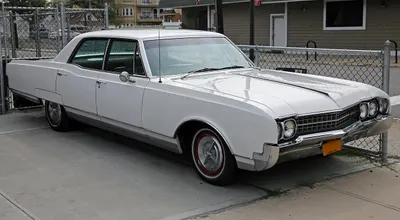
The 1941 Ninety-Eight four-door convertible is a true one-year wonder — only 119 were sold, and Oldsmobile never offered that body style on the 98 again.
Rivals
Same body, same money, other badges — tap any card to flip.

It briefly served as senior sibling to Marquette, a GM companion brand cancelled after just one year.

Nissan hired former BMW engineers to help develop the 510's suspension, which is why period reviewers frequently compared its handling to the BMW 1600/2002.

A Trabant 601 won its class at the 1970 Monte Carlo Rally, with a second 601 right behind it in second.

The 600 was a stopgap: the P50's body over the 601's mechanicals, and for a while its estate was built alongside the new 601 saloon.

The G80 Sport brought a 370 PS twin-turbo 3.3 V6, a mesh grille and copper-tinted chrome with copper stitching to match.

The Vigor was sold only with a five-cylinder engine, an unusual configuration Honda used to fit a longer engine transversely under a short hood.

The GS/E coupe earned the nickname "German Charger" for its long hood, short deck stance borrowed from Detroit muscle cars.

This DeVille/Fleetwood was the first production car anywhere to mount its V8 sideways, Cadillac's front-drive gamble on the new C-body.