Mercury's big engineering news for 1942 was Liquamatic — the brand's first semiautomatic transmission, years before automatics became the norm.
Lead trim: Eight 239 cu in flathead V8 (1941) · up to 100 hp
Mercury Eight19A/29A · 1941–1948
- 0spots by members
- Unclaimednobody has spotted one yet
- 0sets it belongs to
Nobody in Burbles has spotted a Mercury Eight yet. See one on the street, point the app at it, and the first card is yours — with your @handle permanently credited on this page.
FactMercury's big engineering news for 1942 was Liquamatic — the brand's first semiautomatic transmission, years before automatics became the norm.
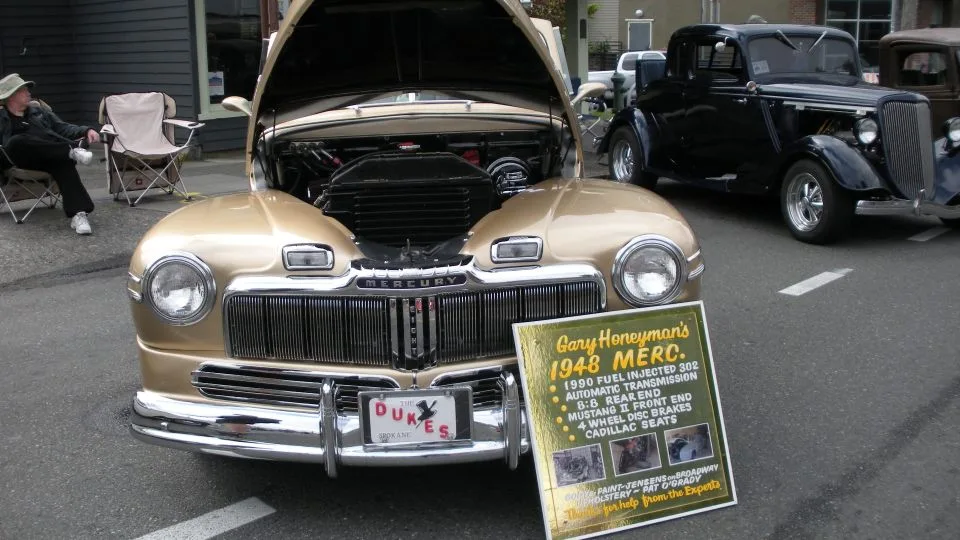
The 1941 Mercury Eight got all-new styling and engineering improvements: it now shared its bodyshell with the Ford Super DeLuxe, the wheelbase was expanded by 2.0 in to 118.0 in, and the door bottoms flared out over the running boards, allowing wider seats and 2.0 in more headroom; the old-fashioned transverse springs were still used. The four-door convertible offered in 1940 was gone but a station wagon was added (the woodie body behind the cowl identical to Ford's, built at the Iron Mountain plant); 90,556 were sold in 1941. In 1942 the horsepower of the 239 cu in flathead V8 was increased to 100 and Ford's first semiautomatic transmission, "Liquamatic", was offered, unsuccessfully; production of the short 1942 model year was only 1,902 before output halted in February 1942 for war production. The 1946 model had a new grille and dropped the Liquimatic option, and the most distinctive new model was the wood-panelled Sportsman convertible (205 built, discontinued the following year); sales totaled 86,603 in 1946, 86,363 in 1947 and 50,268 in 1948 (the 1948 Eights being all practical purposes identical to the 1947s). Dimensions: 118.0 in wheelbase, 201.6 in long (1941–46) or 201.8 in (1947–48), 73.3 in wide and 69.1 in high. A coupe utility variant, the Mercury Club Coupe Utility (Model S9A in 1946 and Model 6M in 1947–48), was built in Australia from 1946 to 1948 on the 118-inch wheelbase, with a panel van also offered.
Collectors Spotted in the Mercury Eight Lineage
No member has published a public street spot of the Mercury Eight yet — the First · Worldwide stamp is wide open.
Trims & Figures
4 published trims in the catalogue. A blank is a figure not recorded, not zero.
| Trim | Years | Engine | Power | Torque | 0–60 | Drive | Gearbox | MSRP |
|---|---|---|---|---|---|---|---|---|
| Eight 239 cu in flathead V8 (100 hp, 1942) | 1942–1942 | 3.9 L V8 | 100 hp | — | — | RWD | — | — |
| Eight 239 cu in flathead V8 (1941) | 1941–1941 | 3.9 L V8 | 95 hp | — | — | RWD | — | — |
| Eight 239 cu in flathead V8 (1946) | 1946–1946 | 3.9 L V8 | 100 hp | 180 lb-ft | — | RWD | — | — |
| Eight 239 cu in flathead V8 (1947–1948) | 1947–1948 | 3.9 L V8 | 100 hp | 180 lb-ft | — | RWD | — | — |
Owning one
We don’t estimate running costs for a car like this. What it costs depends on its condition, its specialist and how it is driven, and an average would mislead.
Owners’ builds
Nobody has claimed one yet.
Photographs
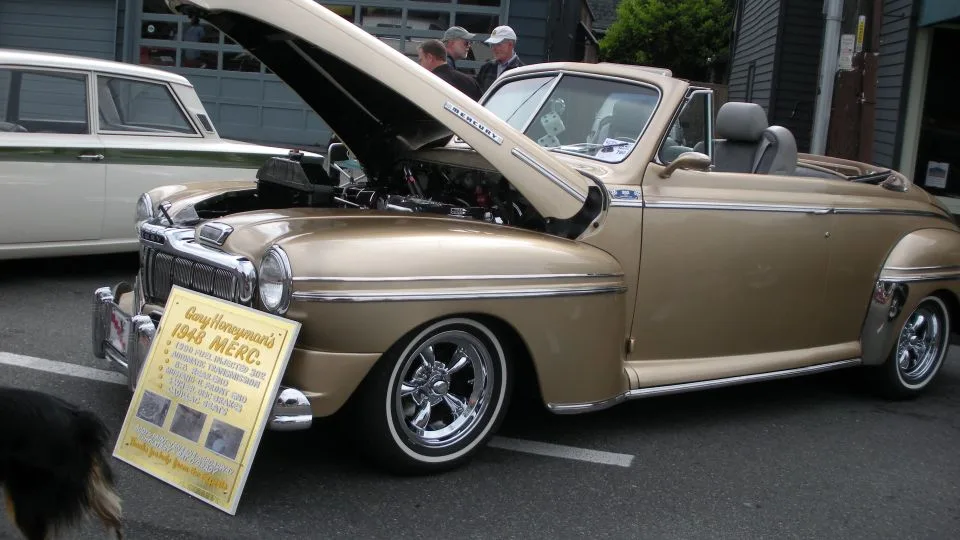
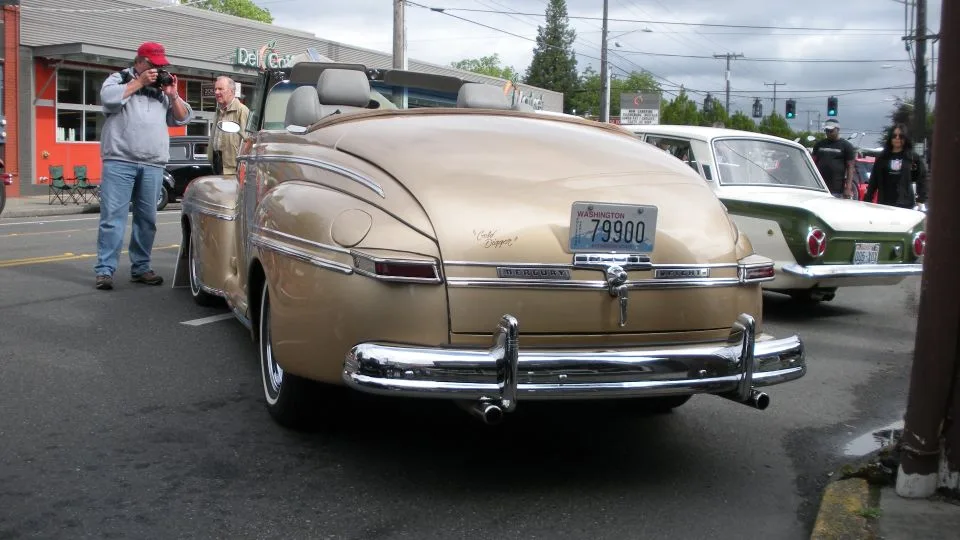
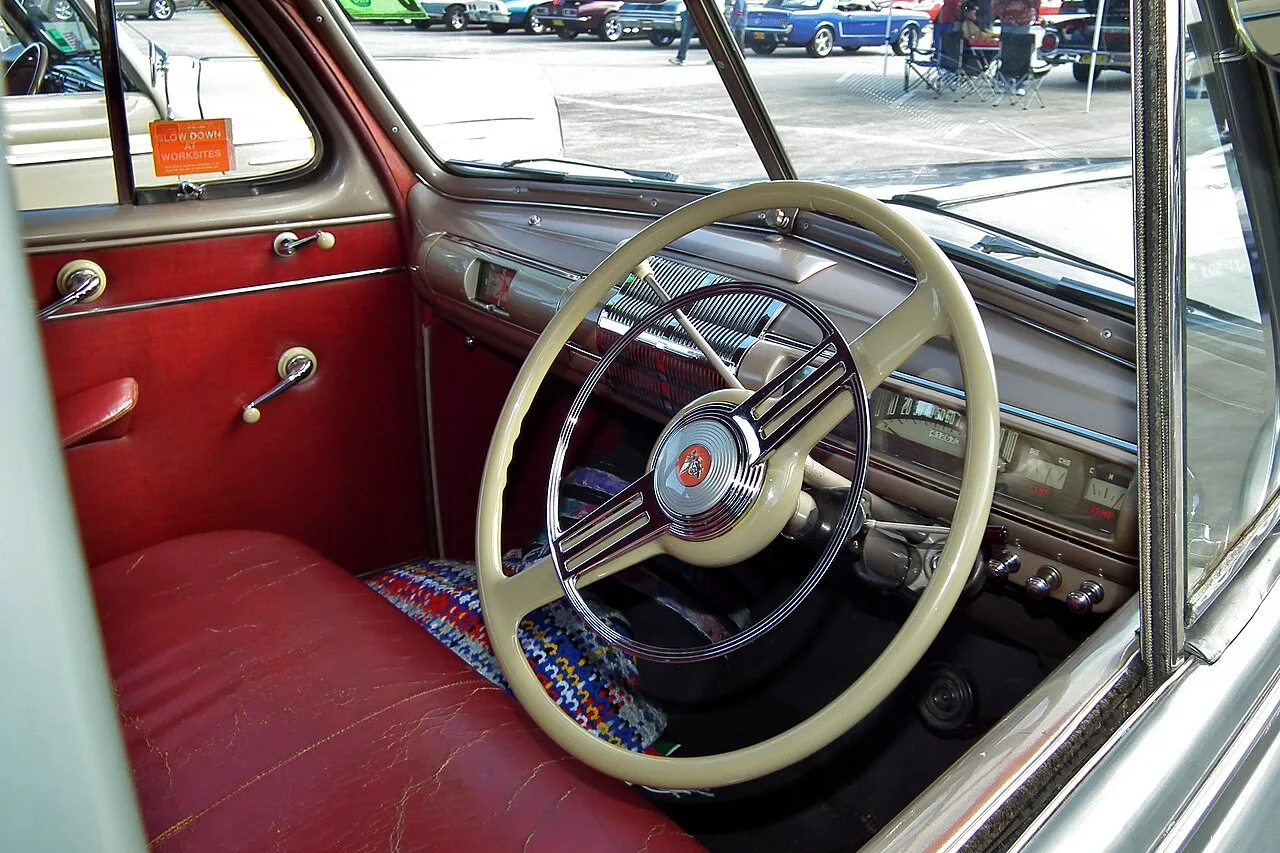
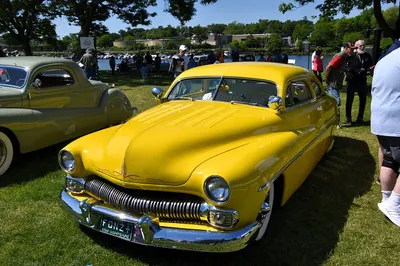
This is the car that invented the 'lead sled': in 1949 Sam Barris chopped and leaded one into the definitive custom, the same year the Ford V-8 'deuce' was becoming the definitive hot rod.
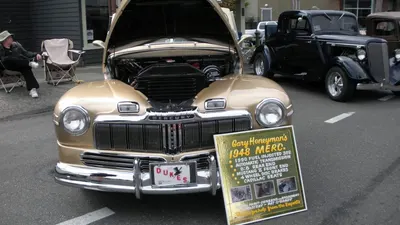
Mercury's big engineering news for 1942 was Liquamatic — the brand's first semiautomatic transmission, years before automatics became the norm.
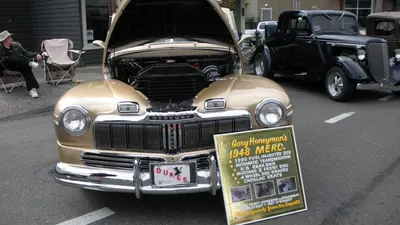
Launching a whole new brand is risky, so Mercury's ads leaned into it with a dare: "The car that truly dares to ask 'Why?'" - daring buyers to believe a big car could also be economical.
Rivals
Same body, same money, other badges — tap any card to flip.

It briefly served as senior sibling to Marquette, a GM companion brand cancelled after just one year.

Nissan hired former BMW engineers to help develop the 510's suspension, which is why period reviewers frequently compared its handling to the BMW 1600/2002.

A Trabant 601 won its class at the 1970 Monte Carlo Rally, with a second 601 right behind it in second.

The 600 was a stopgap: the P50's body over the 601's mechanicals, and for a while its estate was built alongside the new 601 saloon.

The G80 Sport brought a 370 PS twin-turbo 3.3 V6, a mesh grille and copper-tinted chrome with copper stitching to match.

The Vigor was sold only with a five-cylinder engine, an unusual configuration Honda used to fit a longer engine transversely under a short hood.

The GS/E coupe earned the nickname "German Charger" for its long hood, short deck stance borrowed from Detroit muscle cars.

This DeVille/Fleetwood was the first production car anywhere to mount its V8 sideways, Cadillac's front-drive gamble on the new C-body.