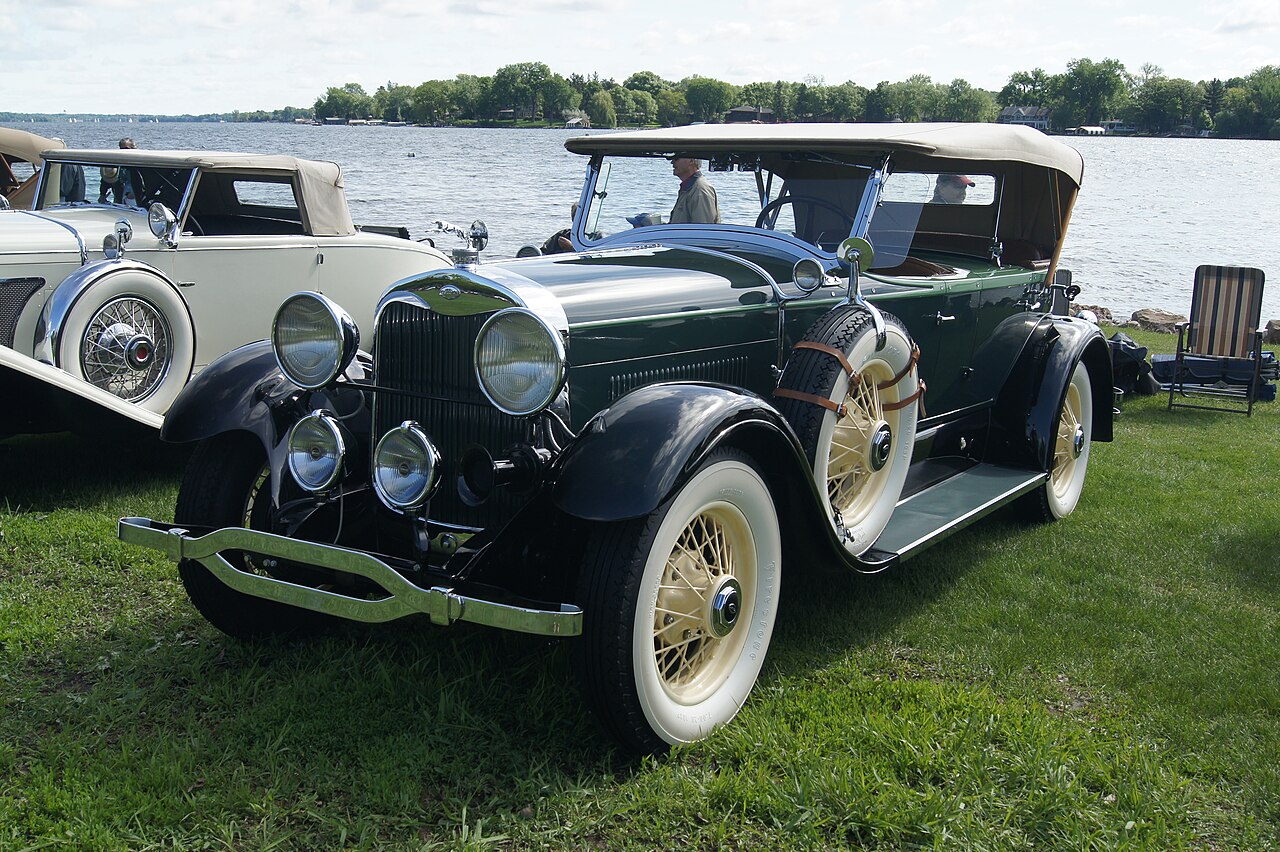
Henry Leland built this at age 74 after Henry Ford bought his bankrupt company out for $8 million in 1922.
Lead trim: Model L 384.8 cu in Fork and Blade V8 (90 hp, 1928–1930)
Lincoln Model L1920–1930
- 0spots by members
- Unclaimednobody has spotted one yet
- 0sets it belongs to
Nobody in Burbles has spotted a Lincoln Model L yet. See one on the street, point the app at it, and the first card is yours — with your @handle permanently credited on this page.
FactHenry Leland built this at age 74 after Henry Ford bought his bankrupt company out for $8 million in 1922.
The Lincoln L series (Model L) is a luxury car introduced by the Lincoln Motor Company in 1921 as its first automobile, manufactured in Detroit and continuing after the 1922 bankruptcy and purchase by Ford Motor Company. Cadillac founder Henry Leland created the Lincoln Motor Company after leaving Cadillac over a dispute with William Durant over World War I production (initially building Liberty V12 aircraft engines); at age 74 he decided to make the Lincoln car, which the company created in 1920 for sale as a 1921 model, designed by Angus Woodbridge, his son-in-law, and considered old-fashioned for the time. It was positioned at the top end of the market against the Mercedes-Benz 630, Rolls-Royce Phantom I, Renault Type MC, Packard Twin Six and Cadillac Type 61, with 15 body selections from Lincoln's own coachbuilders (a Town Car at US$6,600) and a rolling chassis for US$4,000. Leland sold the company to Henry Ford on February 4, 1922 for $8 million; Edsel Ford became president and designed a new body. The wheelbase was extended from 130 to 136 inches and the 60-degree L-head Fork and Blade V8 (two connecting rods sharing one bearing on the crankshaft, a short crankshaft and a smaller engine) displaced 357.8 cu in (5.9 L) and was rated 90 hp (the 1921 data table says 81 hp while the infobox says 90 hp for 1917–1927, so no rating is entered for 1921–22), with 3-speed manual transmission; a larger 384.8 cu in (6.3 L) engine came in 1928 with no horsepower increase. Sales rose about 45% in 1923 to 7,875 cars and the company was profitable by the end of 1923. Four-wheel mechanical brakes became standard in 1927 (police "Police Flyers" had them from 1924), safety glass and dual wipers arrived in 1929, and 1930 was the last year; Lincoln chose not to make yearly model changes and contracted dozens of coachbuilders including Brunn, Judkins, LeBaron, Dietrich, Derham, Fleetwood, Locke and Willoughby.
Collectors Spotted in the Lincoln Model L Lineage
No member has published a public street spot of the Lincoln Model L yet — the First · Worldwide stamp is wide open.
Trims & Figures
3 published trims in the catalogue. A blank is a figure not recorded, not zero.
| Trim | Years | Engine | Power | Torque | 0–60 | Drive | Gearbox | MSRP |
|---|---|---|---|---|---|---|---|---|
| Model L 357.8 cu in Fork and Blade V8 (1921–1922) | 1920–1922 | 5.9 L V8 | — | — | — | — | — | — |
| Model L 357.8 cu in Fork and Blade V8 (90 hp, 1923–1927) | 1923–1927 | 5.9 L V8 | 90 hp | — | — | — | — | — |
| Model L 384.8 cu in Fork and Blade V8 (90 hp, 1928–1930) | 1928–1930 | 6.3 L V8 | 90 hp | — | — | — | — | — |
Owning one
We don’t estimate running costs for a car like this. What it costs depends on its condition, its specialist and how it is driven, and an average would mislead.
Owners’ builds
Nobody has claimed one yet.
Photographs
Rivals
Same body, same money, other badges — tap any card to flip.

It briefly served as senior sibling to Marquette, a GM companion brand cancelled after just one year.

Nissan hired former BMW engineers to help develop the 510's suspension, which is why period reviewers frequently compared its handling to the BMW 1600/2002.

A Trabant 601 won its class at the 1970 Monte Carlo Rally, with a second 601 right behind it in second.

The 600 was a stopgap: the P50's body over the 601's mechanicals, and for a while its estate was built alongside the new 601 saloon.

The G80 Sport brought a 370 PS twin-turbo 3.3 V6, a mesh grille and copper-tinted chrome with copper stitching to match.

The Vigor was sold only with a five-cylinder engine, an unusual configuration Honda used to fit a longer engine transversely under a short hood.

The GS/E coupe earned the nickname "German Charger" for its long hood, short deck stance borrowed from Detroit muscle cars.

This DeVille/Fleetwood was the first production car anywhere to mount its V8 sideways, Cadillac's front-drive gamble on the new C-body.