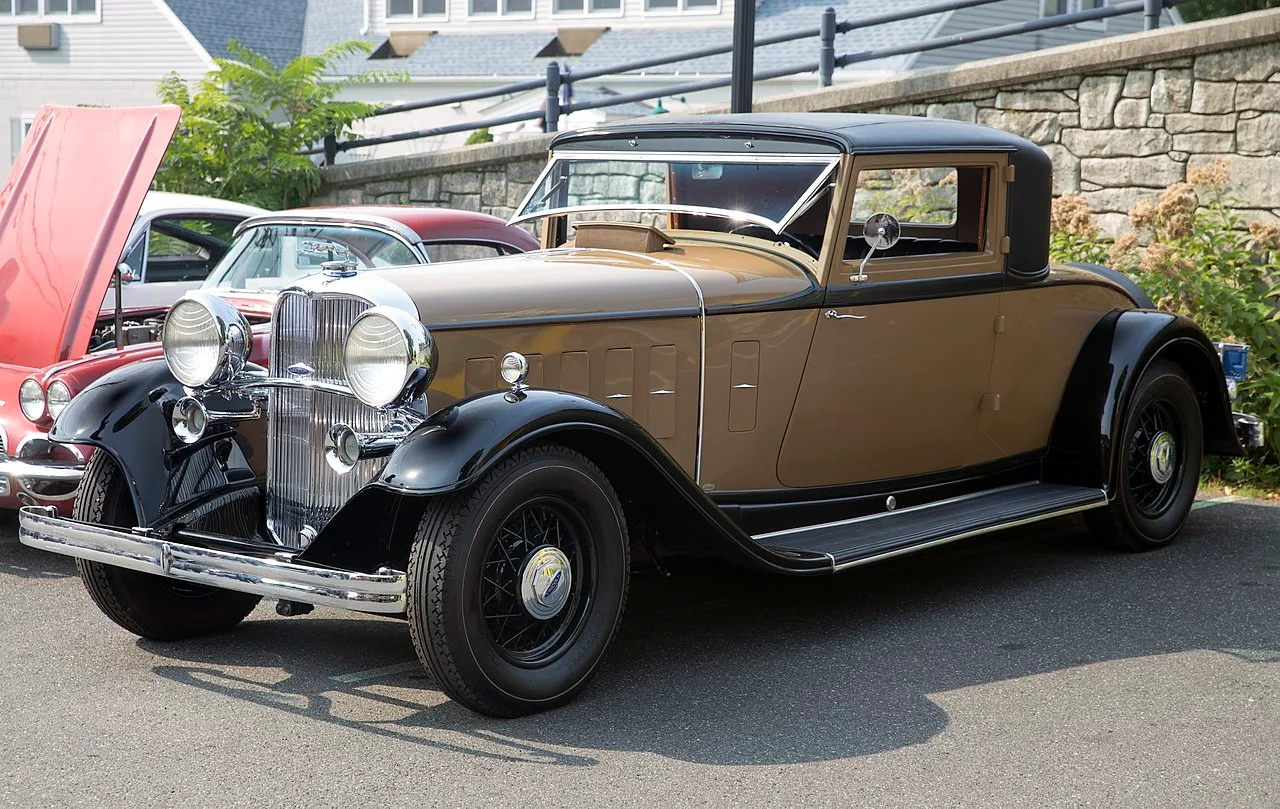
Roosevelt's 1939 parade phaeton, the Sunshine Special, got new front sheet metal grafted on in 1942 and kept rolling.
Lead trim: Model K 385 cu in Fork and Blade V8 (120 hp, 1931) · up to 150 hp
Lincoln Model K1931–1940
- 0spots by members
- Unclaimednobody has spotted one yet
- 0sets it belongs to
Nobody in Burbles has spotted a Lincoln Model K yet. See one on the street, point the app at it, and the first card is yours — with your @handle permanently credited on this page.
FactRoosevelt's 1939 parade phaeton, the Sunshine Special, got new front sheet metal grafted on in 1942 and kept rolling.
The Lincoln K series (Model K) is a luxury vehicle produced by the Lincoln Motor Company between 1931 and 1940, the second motor line of the company, developed from the Model L with a modernized chassis on a longer wheelbase; in 1931 Lincoln also introduced a V12, a feature of the company for nearly 20 years. One of the most exclusive vehicles produced in the United States in the 1930s, it competed against the Cadillac V-12 and V-16, Packard Twin Six, Chrysler Imperial, Pierce-Arrow Model 53 and Duesenberg Model J, with bare chassis provided for coachbuilders alongside factory body configurations. The original 1931 Model K had a new 145 in (3,683 mm) wheelbase chassis and a 384.8 cu in (6.3 L) V8 derived from the L-series 60-degree V8, raised to 120 hp by a dual-venturi downdraft Stromberg carburetor, higher compression and altered timing. For 1932 the line split into the V8 carryover Model KA (136 in wheelbase, 125 hp) and the new V12 Model KB (447.9 cu in, 7.3 L, 65-degree L-head, 150 hp); the V8 was replaced in the KA for 1933 by a 381.7 cu in (6.3 L) V12; both V12s were replaced for 1934 by a single 414 cu in (6.8 L) version, with KA and KB then denoting the wheelbase only. In 1935 all cars were simply called Model K in an attempt to improve profitability at the lofty over-US$4,000 segment; in 1936 the seven-passenger limousine was the best-selling model despite a US$4,700 price. Production was evidently completed during the 1939 model year, the last K delivered in January 1940; the Lincoln Custom was the indirect successor for 1941–42. The 1939 "Sunshine Special" parade phaeton built for President Franklin D. Roosevelt was modified in 1942 with current Lincoln front sheet metal.
Collectors Spotted in the Lincoln Model K Lineage
No member has published a public street spot of the Lincoln Model K yet — the First · Worldwide stamp is wide open.
Trims & Figures
5 published trims in the catalogue. A blank is a figure not recorded, not zero.
| Trim | Years | Engine | Power | Torque | 0–60 | Drive | Gearbox | MSRP |
|---|---|---|---|---|---|---|---|---|
| Model K 385 cu in Fork and Blade V8 (120 hp, 1931) | 1931–1931 | 6.3 L V8 | 120 hp | — | — | — | — | — |
| Model K 414 cu in L-head V12 (1934–1940) | 1934–1940 | 6.8 L V12 | 150 hp | — | — | — | — | — |
| Model KA 382 cu in L-head V12 (1933) | 1933–1933 | 6.3 L V12 | 125 hp | — | — | — | — | — |
| Model KA 385 cu in V8 (125 hp, 1932) | 1932–1932 | 6.3 L V8 | 125 hp | — | — | — | — | — |
| Model KB 448 cu in L-head V12 (150 hp, 1932–1933) | 1932–1933 | 7.3 L V12 | 150 hp | — | — | — | — | — |
Owning one
We don’t estimate running costs for a car like this. What it costs depends on its condition, its specialist and how it is driven, and an average would mislead.
Owners’ builds
Nobody has claimed one yet.
Photographs
Rivals
Same body, same money, other badges — tap any card to flip.

It briefly served as senior sibling to Marquette, a GM companion brand cancelled after just one year.

Nissan hired former BMW engineers to help develop the 510's suspension, which is why period reviewers frequently compared its handling to the BMW 1600/2002.

A Trabant 601 won its class at the 1970 Monte Carlo Rally, with a second 601 right behind it in second.

The 600 was a stopgap: the P50's body over the 601's mechanicals, and for a while its estate was built alongside the new 601 saloon.

The G80 Sport brought a 370 PS twin-turbo 3.3 V6, a mesh grille and copper-tinted chrome with copper stitching to match.

The Vigor was sold only with a five-cylinder engine, an unusual configuration Honda used to fit a longer engine transversely under a short hood.

The GS/E coupe earned the nickname "German Charger" for its long hood, short deck stance borrowed from Detroit muscle cars.

This DeVille/Fleetwood was the first production car anywhere to mount its V8 sideways, Cadillac's front-drive gamble on the new C-body.