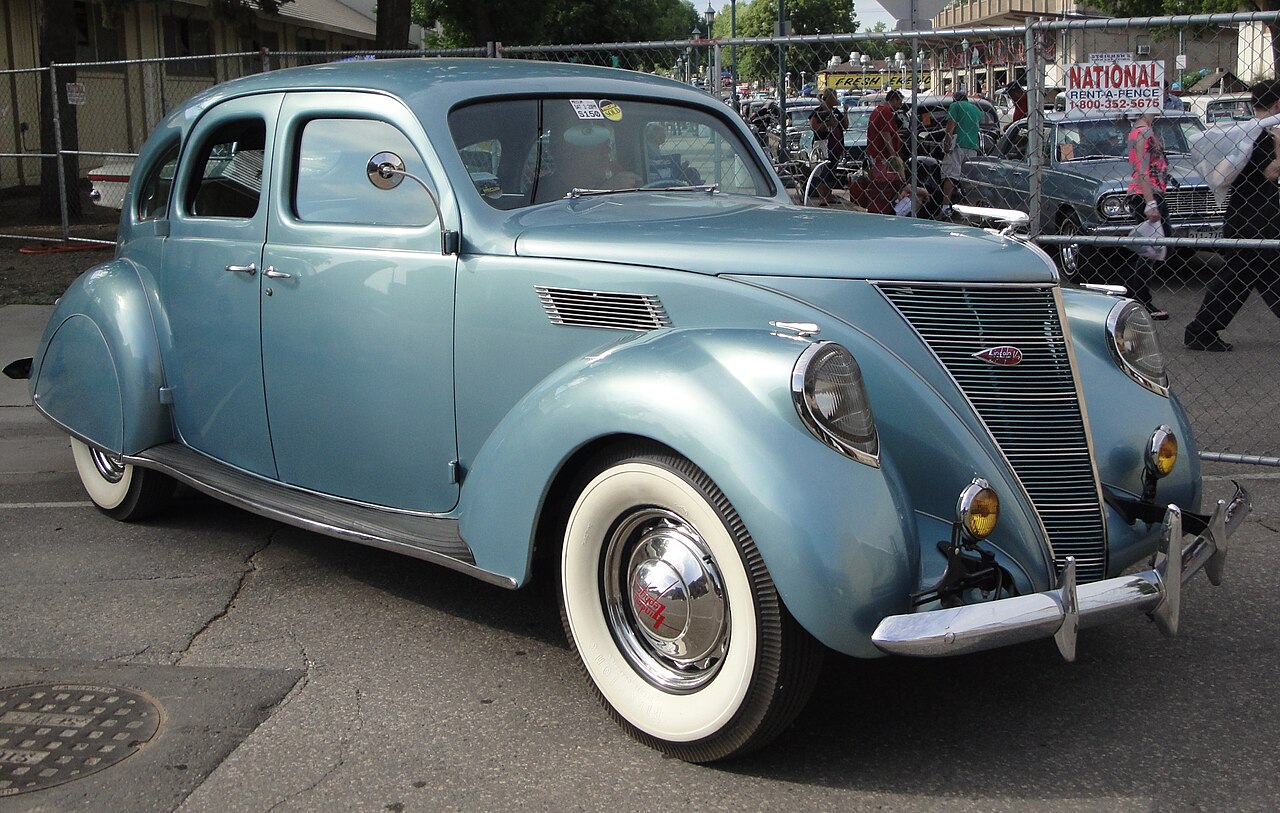
Its grille helped it beat the Chrysler Airflow's drag coefficient, despite the Airflow being the one everyone remembers for streamlining.
Median 80 hp across 129 similar cars
Lead trim: Lincoln-Zephyr 267 cu in flathead V12 (110 hp, 1936–1939) · up to 120 hp
Lincoln Lincoln-Zephyr1936–1942
- 0spots by members
- Unclaimednobody has spotted one yet
- 0sets it belongs to
Nobody in Burbles has spotted a Lincoln Lincoln-Zephyr yet. See one on the street, point the app at it, and the first card is yours — with your @handle permanently credited on this page.
FactIts grille helped it beat the Chrysler Airflow's drag coefficient, despite the Airflow being the one everyone remembers for streamlining.
The Lincoln-Zephyr was a line of luxury cars produced by Lincoln from 1936 until 1942, bridging the gap between the Ford V8 DeLuxe and the Lincoln Model K in size and price and competing against the Chrysler Airflow, LaSalle and Packard One-Twenty. Introduced on November 2, 1935 as a 1936 model, it was conceived by Edsel Ford and designed by Eugene Turenne "Bob" Gregorie (the Specifications section credits the design to John Tjaarda, whose unibody construction was light and rigid for its size), extremely modern with a low raked windscreen, integrated fenders and a prow-like grille, one of the first successful streamlined cars after the Airflow's market resistance and, thanks in part to that grille, with a lower coefficient of drag than the Airflow (0.45 per the Specifications section). It was powered by a V12 (in contrast with its competitors' V8 and inline-8 engines): the 1936–39 models used a 267 cu in (4.4 L) flathead of 110 hp with a 90 mph top speed, hydraulic lifters added in 1938, the 1940 and 1941 cars an enlarged 292 cu in (4.8 L), and 1942 and early 1946 models a 306 cu in (5.0 L) with lower compression; weight was 3,350 lb, wheelbase 122–125 in, length 202.5–210 in and height 69 in. In its first year 15,000 were sold, 80% of Lincoln's total sales; the two-door sedan listed at US$1,275 and the four-door at US$1,320. Body styles expanded to a Coupe-Sedan and 3-window Coupe and a formal Town-Limousine for 1937, a Convertible Coupe and Convertible Sedan for 1938, and a Club Coupe for 1940. The Lincoln-Zephyr Continental (1940), a Cabriolet from December 13, 1939 and a Club Coupe from June 1940 (350 Cabriolets and 54 Club Coupes built), was the first Lincoln named Continental; from the 1941 model year all Lincolns were Zephyr-based and the Zephyr marque was phased out (the Zephyr V12 continued in 1941–42 as a Lincoln), with the last Zephyr produced on February 10, 1942.
Collectors Spotted in the Lincoln Lincoln-Zephyr Lineage
No member has published a public street spot of the Lincoln Lincoln-Zephyr yet — the First · Worldwide stamp is wide open.
Trims & Figures
2 published trims in the catalogue. A blank is a figure not recorded, not zero.
| Trim | Years | Engine | Power | Torque | 0–60 | Drive | Gearbox | MSRP |
|---|---|---|---|---|---|---|---|---|
| Lincoln-Zephyr 267 cu in flathead V12 (110 hp, 1936–1939) | 1936–1939 | 4.4 L V12 | 110 hp | — | — | — | — | — |
| Lincoln-Zephyr 292 cu in V12 (1940–1941) | 1940–1941 | 4.8 L V12 | 120 hp | 220 lb-ft | — | — | — | — |
Owning one
We don’t estimate running costs for a car like this. What it costs depends on its condition, its specialist and how it is driven, and an average would mislead.
Owners’ builds
Nobody has claimed one yet.
Photographs
Rivals
Same body, same money, other badges — tap any card to flip.

It briefly served as senior sibling to Marquette, a GM companion brand cancelled after just one year.

Nissan hired former BMW engineers to help develop the 510's suspension, which is why period reviewers frequently compared its handling to the BMW 1600/2002.

A Trabant 601 won its class at the 1970 Monte Carlo Rally, with a second 601 right behind it in second.

The 600 was a stopgap: the P50's body over the 601's mechanicals, and for a while its estate was built alongside the new 601 saloon.

The G80 Sport brought a 370 PS twin-turbo 3.3 V6, a mesh grille and copper-tinted chrome with copper stitching to match.

The Vigor was sold only with a five-cylinder engine, an unusual configuration Honda used to fit a longer engine transversely under a short hood.

The GS/E coupe earned the nickname "German Charger" for its long hood, short deck stance borrowed from Detroit muscle cars.

This DeVille/Fleetwood was the first production car anywhere to mount its V8 sideways, Cadillac's front-drive gamble on the new C-body.