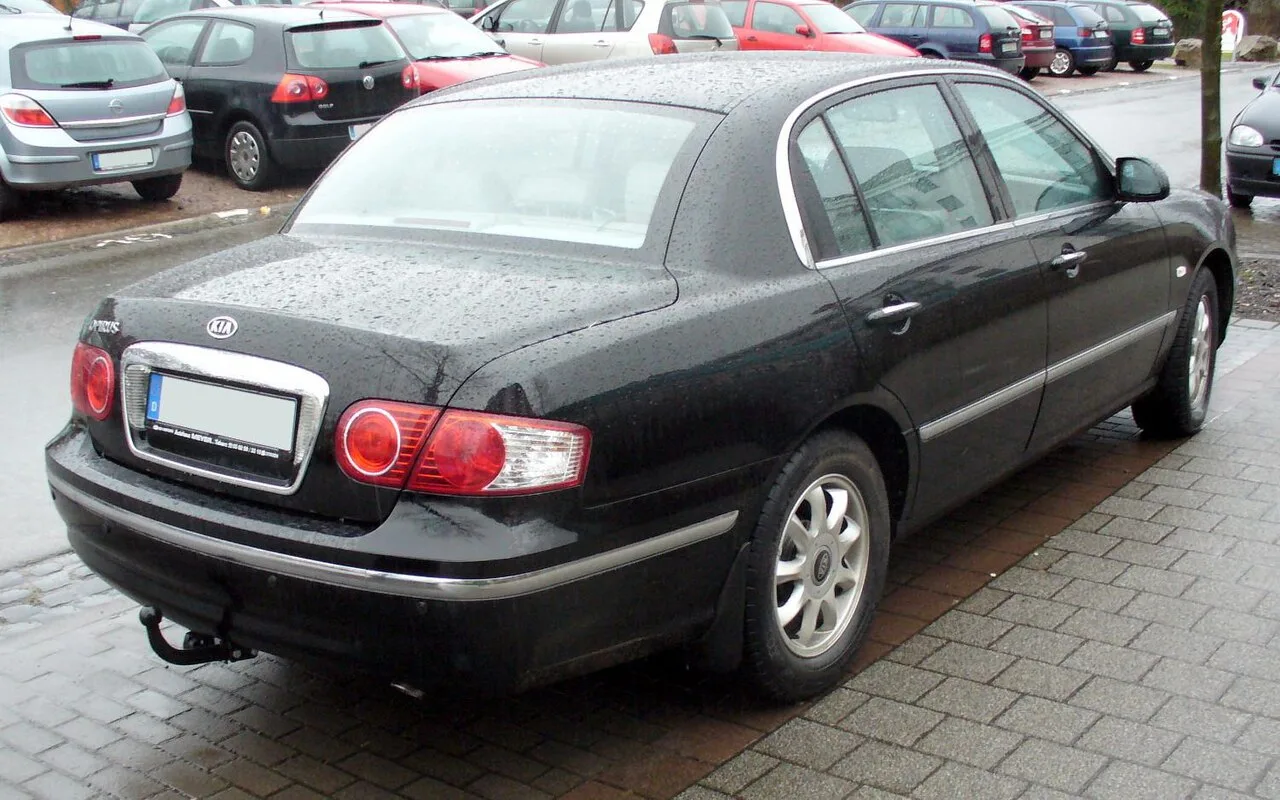
Kia spent $167 million and 22 months building the Opirus just to buy its way into premium markets, replacing a Mazda-derived sedan.
Lead trim: Opirus 2.7 Mu LPi V6 LPG (163 hp) · up to 280 hp
Kia Opirus / Amanti2003–2012
- 0spots by members
- Unclaimednobody has spotted one yet
- 0sets it belongs to
Nobody in Burbles has spotted a Kia Opirus / Amanti yet. See one on the street, point the app at it, and the first card is yours — with your @handle permanently credited on this page.
FactKia spent $167 million and 22 months building the Opirus just to buy its way into premium markets, replacing a Mazda-derived sedan.
The Kia Opirus is an executive / full-size sedan made by Kia across a single generation for model years 2003–2012 globally (2004–2009 in North America, where it was the Amanti; produced at Hwasung, South Korea and by Avtotor in Kaliningrad), debuting internationally at the 2003 Geneva Motor Show and launched in North America at the New York show and in San Diego. It was Kia's first premium vehicle, designed to give Kia upward access to global premium markets and replacing the Mazda 929-derived Enterprise in Korea, developed over 22 months at a cost of US$167 million (18% of it R&D, 41% for production technologies), with a transverse front-engine, front-drive layout related to the Hyundai Grandeur (XG and TG), prioritising luxury and comfort over agility. The page lists the engines with power by year: Delta 2.7 (176 PS / 174 hp 2003–2004, 182 PS / 180 hp 2005–2006, 206 km/h), Mu 2.7 (192 PS / 189 hp 2007–2009, 195 PS / 192 hp 2010–2012), Sigma 3.0 (187 PS / 184 hp, 2003–2006, 208 km/h), Lambda 3.3 (247 PS / 244 hp 2007–2009, 259 PS / 255 hp 2010–2012), Sigma 3.5 (203 PS / 200 hp, 2003–2006, 0–100 km/h in 9.2 s and 220 km/h; the North American Amanti's 3.5 made 200 bhp at 5500 rpm and 220 lb·ft at 3500 rpm), Lambda 3.8 (250 PS / 247 hp 2005–2006; 267 PS / 263 hp 2007–2010 with 0–100 km/h in 7.5 s and 230 km/h; 284 PS / 280 hp 2010–2012) and an LPG Mu 2.7 LPi (165 PS / 163 hp, 2010–2012), with a 5-speed automatic and a 6-speed automatic from 2010.
Collectors Spotted in the Kia Opirus Lineage
No member has published a public street spot of the Kia Opirus yet — the First · Worldwide stamp is wide open.
Trims & Figures
12 published trims in the catalogue. A blank is a figure not recorded, not zero.
| Trim | Years | Engine | Power | Torque | 0–60 | Drive | Gearbox | MSRP |
|---|---|---|---|---|---|---|---|---|
| Opirus 2.7 Delta V6 (174 hp) | 2003–2004 | 2.7 L V6 | 174 hp | 175 lb-ft | — | FWD | — | — |
| Opirus 2.7 Delta V6 (180 hp) | 2005–2006 | 2.7 L V6 | 180 hp | 179 lb-ft | — | FWD | — | — |
| Opirus 2.7 Mu LPi V6 LPG (163 hp) | 2010–2012 | 2.7 L V6 | 163 hp | 181 lb-ft | — | FWD | — | — |
| Opirus 2.7 Mu V6 (189 hp) | 2007–2009 | 2.7 L V6 | 189 hp | 184 lb-ft | — | FWD | — | — |
| Opirus 2.7 Mu V6 (192 hp) | 2010–2012 | 2.7 L V6 | 192 hp | 185 lb-ft | — | FWD | — | — |
| Opirus 3.0 Sigma V6 (184 hp) | 2003–2006 | 3.0 L V6 | 184 hp | 187 lb-ft | — | FWD | — | — |
| Opirus 3.3 Lambda V6 (244 hp) | 2007–2009 | 3.3 L V6 | 244 hp | 228 lb-ft | — | FWD | — | — |
| Opirus 3.3 Lambda V6 (255 hp) | 2010–2012 | 3.3 L V6 | 255 hp | 233 lb-ft | — | FWD | — | — |
| Opirus 3.5 Sigma V6 (200 hp) | 2003–2006 | 3.5 L V6 | 200 hp | 220 lb-ft | — | FWD | — | — |
| Opirus 3.8 Lambda V6 (247 hp) | 2005–2006 | 3.8 L V6 | 247 hp | 253 lb-ft | — | FWD | — | — |
| Opirus 3.8 Lambda V6 (263 hp) | 2007–2010 | 3.8 L V6 | 263 hp | 260 lb-ft | — | FWD | — | — |
| Opirus 3.8 Lambda V6 (280 hp) | 2010–2012 | 3.8 L V6 | 280 hp | 263 lb-ft | — | FWD | — | — |
Owning one
An estimate, for the Opirus 2.7 Delta V6 (174 hp) trim: fuel on its EPA figure and a dated national price, upkeep on a per-mile average for the kind of car it is.
Owners’ builds
Nobody has claimed one yet.
Photographs
Rivals
Same body, same money, other badges — tap any card to flip.

It briefly served as senior sibling to Marquette, a GM companion brand cancelled after just one year.

Nissan hired former BMW engineers to help develop the 510's suspension, which is why period reviewers frequently compared its handling to the BMW 1600/2002.

A Trabant 601 won its class at the 1970 Monte Carlo Rally, with a second 601 right behind it in second.

The 600 was a stopgap: the P50's body over the 601's mechanicals, and for a while its estate was built alongside the new 601 saloon.

The G80 Sport brought a 370 PS twin-turbo 3.3 V6, a mesh grille and copper-tinted chrome with copper stitching to match.

The Vigor was sold only with a five-cylinder engine, an unusual configuration Honda used to fit a longer engine transversely under a short hood.

The GS/E coupe earned the nickname "German Charger" for its long hood, short deck stance borrowed from Detroit muscle cars.

This DeVille/Fleetwood was the first production car anywhere to mount its V8 sideways, Cadillac's front-drive gamble on the new C-body.