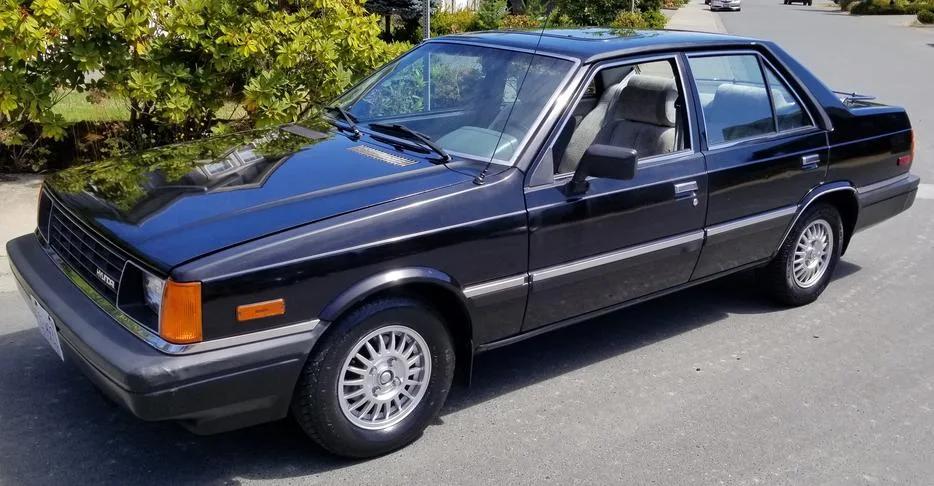
Hyundai's UK ads for the Stellar mocked the Sierra's shape directly — printing a jelly mould shaped like a Sierra above a photo of this car, to win over buyers scared of Ford's new styling.
Lead trim: Stellar 1.4 Mitsubishi 4G33
Hyundai Stellar1983–1992
- 0spots by members
- Unclaimednobody has spotted one yet
- 0sets it belongs to
Nobody in Burbles has spotted a Hyundai Stellar yet. See one on the street, point the app at it, and the first card is yours — with your @handle permanently credited on this page.
FactHyundai's UK ads for the Stellar mocked the Sierra's shape directly — printing a jelly mould shaped like a Sierra above a photo of this car, to win over buyers scared of Ford's new styling.
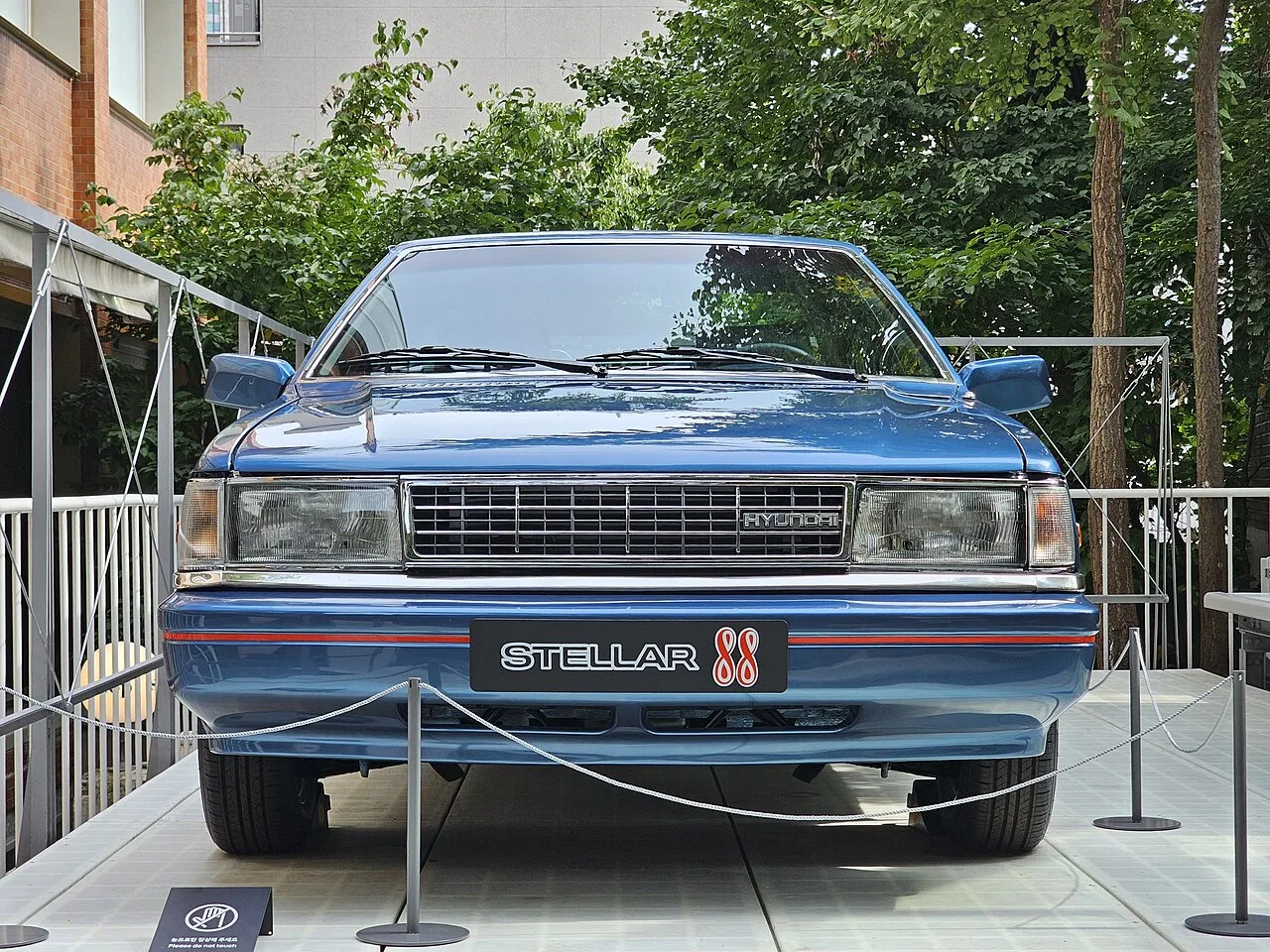
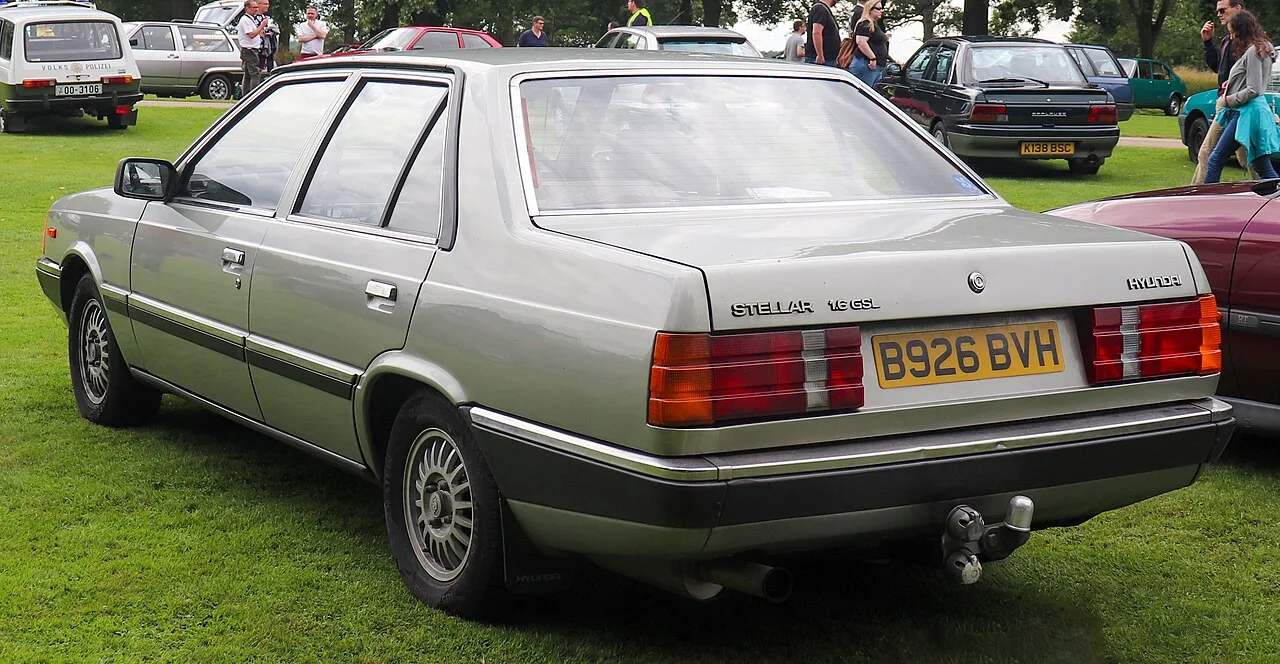
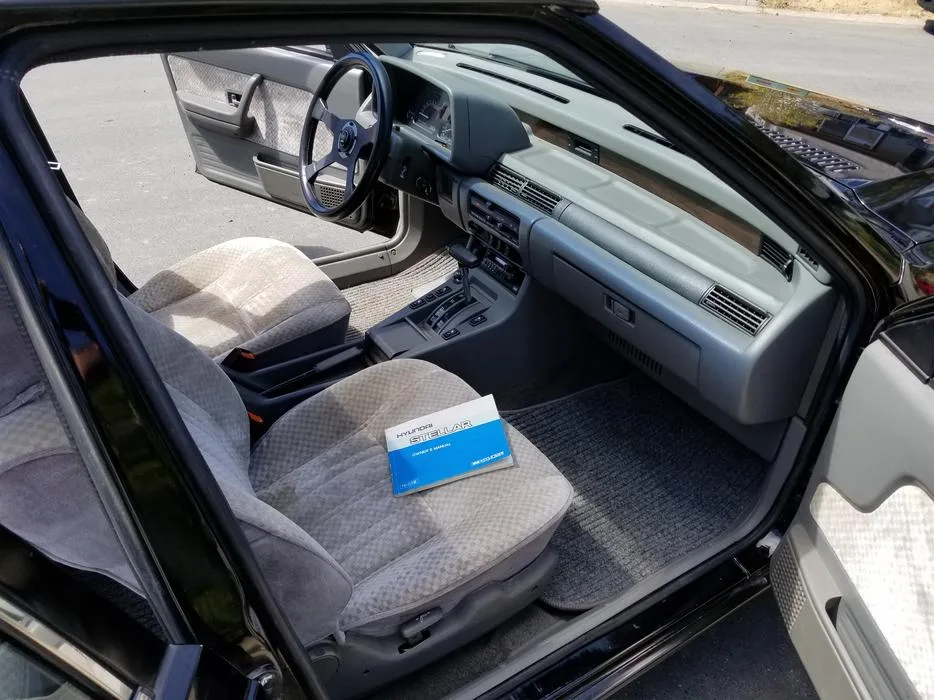
The Hyundai Stellar is a large family car produced by Hyundai from May 1983 until the 1992 model year (until January 1997 for LPG taxi models in Korea), designed by Giorgetto Giugiaro at Italdesign on the rear-wheel-drive chassis of the Ford Cortina Mark V (related to the Ford Taunus TC), which it succeeded after Hyundai had built the Cortina under licence. The engines and transmissions were licensed from Mitsubishi: 1.4 L (4G33, as in the Pony) and 1.6 L (4G32) inline-fours until 1986 with a KM119 4- or 5-speed manual or a Borg-Warner 03-55L 3-speed automatic, and a 2.0 L (4G63, SOHC eight-valve, with a feedback two-barrel carburettor) in 1987; the infobox lists a 1.5 L 4G31 (1984–1990) and a 1.8 L 4G62 (1990–1997), and the 1.4 was discontinued for the 1987 model year. Trim levels included L (base), GL/CL/SL and CXL/GSL, and the lineup ran Prima, TX, FX, GX, GSL, SL, CXL (Canada and Korea only), Apex, 88 (Seoul Olympic limited edition), GXL and 1.8 i. It shared the Cortina's wishbone front suspension and coil-sprung live rear axle; British observers compared it with the recently discontinued Cortina, and it sold well in the UK (June 1984 to the arrival of the Lantra in 1991) at a price comparable to a smaller Escort, as the second Hyundai imported to Europe two years after the Pony. In 1987 it was refreshed as the Stellar II (Stellar 2.0 in Canada; the first Korean car sold as the Sonata domestically) with a two-way catalytic converter, a new instrument cluster, the 2.0 engine, MacPherson-strut front suspension, larger brake callipers, a two-piece driveshaft, restyled lights and an optional Borg-Warner 03-71 overdrive automatic; in Europe the 2.0 GSL is sometimes called the Stellar Prima. It was not available in the United States because of emissions standards but was sold in Canada, and it was replaced by the New Sonata in Canada and Europe in 1992; with the Pony it was Hyundai's last rear-drive car for North America until the 2009 Genesis. The 1.8 and 2.0 trims run only to the generation end here.
Collectors Spotted in the Hyundai Stellar Lineage
No member has published a public street spot of the Hyundai Stellar yet — the First · Worldwide stamp is wide open.
Trims & Figures
5 published trims in the catalogue. A blank is a figure not recorded, not zero.
| Trim | Years | Engine | Power | Torque | 0–60 | Drive | Gearbox | MSRP |
|---|---|---|---|---|---|---|---|---|
| Stellar 1.4 Mitsubishi 4G33 | 1983–1987 | 1.4 L Inline-4 | 68 hp | 82 lb-ft | — | RWD | — | — |
| Stellar 1.5 Mitsubishi 4G31 | 1984–1990 | 1.5 L Inline-4 | — | — | — | RWD | — | — |
| Stellar 1.6 Mitsubishi 4G32 | 1983–1990 | 1.6 L Inline-4 | — | — | — | RWD | — | — |
| Stellar 1.8 Mitsubishi 4G62 | 1990–1992 | 1.8 L Inline-4 | — | — | — | RWD | — | — |
| Stellar II 2.0 Mitsubishi 4G63 SOHC | 1987–1992 | 2.0 L Inline-4 | — | — | — | RWD | — | — |
Owning one
We don’t estimate running costs for a car like this. What it costs depends on its condition, its specialist and how it is driven, and an average would mislead.
Owners’ builds
Nobody has claimed one yet.
Photographs
Rivals
Same body, same money, other badges — tap any card to flip.

It briefly served as senior sibling to Marquette, a GM companion brand cancelled after just one year.

Nissan hired former BMW engineers to help develop the 510's suspension, which is why period reviewers frequently compared its handling to the BMW 1600/2002.

A Trabant 601 won its class at the 1970 Monte Carlo Rally, with a second 601 right behind it in second.

The 600 was a stopgap: the P50's body over the 601's mechanicals, and for a while its estate was built alongside the new 601 saloon.

The G80 Sport brought a 370 PS twin-turbo 3.3 V6, a mesh grille and copper-tinted chrome with copper stitching to match.

The Vigor was sold only with a five-cylinder engine, an unusual configuration Honda used to fit a longer engine transversely under a short hood.

The GS/E coupe earned the nickname "German Charger" for its long hood, short deck stance borrowed from Detroit muscle cars.

This DeVille/Fleetwood was the first production car anywhere to mount its V8 sideways, Cadillac's front-drive gamble on the new C-body.