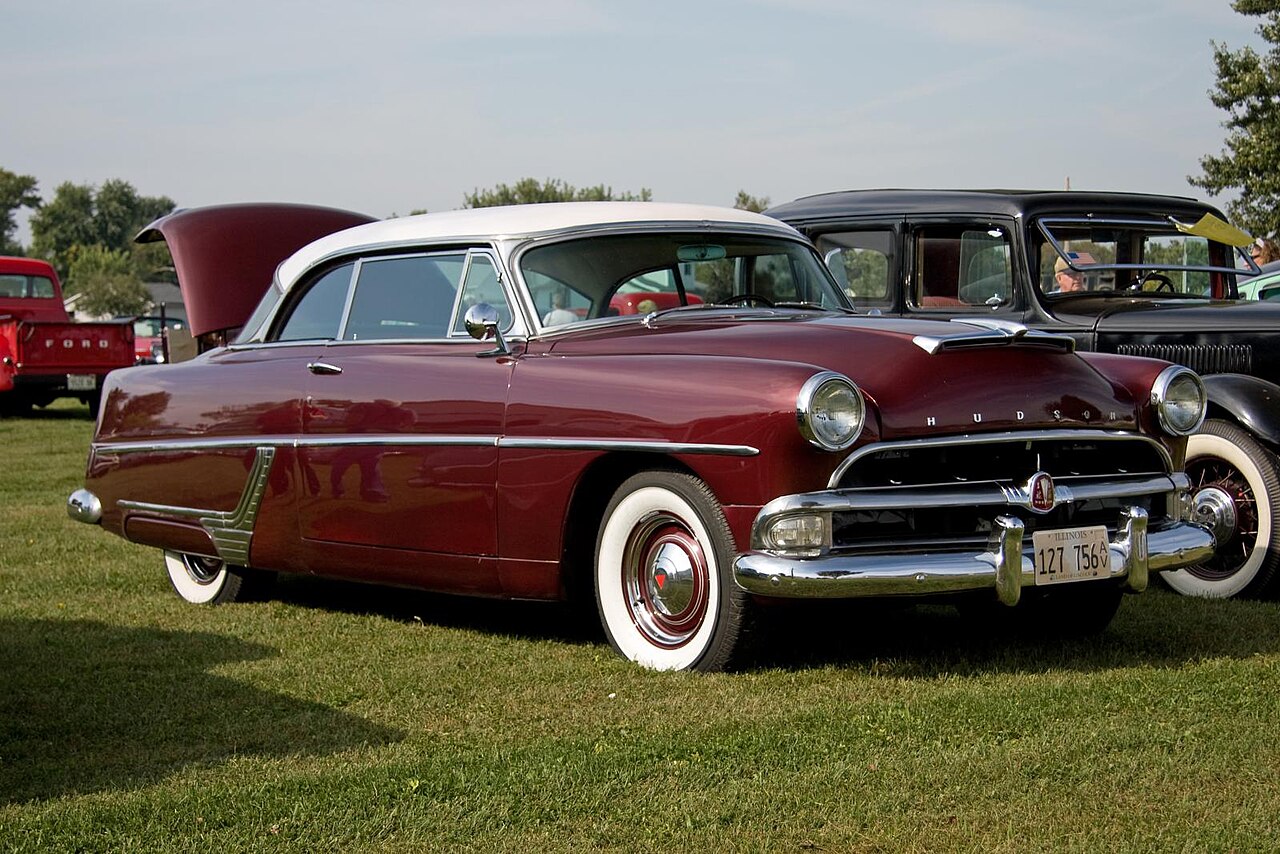
Hudson deliberately underrated the Super Wasp's 262 at 127 hp, one below the Commodore Eight, so the cheaper six would never outrank the flagship.
Lead trim: Wasp 232 cu in I6 (126 hp, 1954) · up to 149 hp
Hudson Wasp1952–1954
- 0spots by members
- Unclaimednobody has spotted one yet
- 0sets it belongs to
Nobody in Burbles has spotted a Hudson Wasp yet. See one on the street, point the app at it, and the first card is yours — with your @handle permanently credited on this page.
FactHudson deliberately underrated the Super Wasp's 262 at 127 hp, one below the Commodore Eight, so the cheaper six would never outrank the flagship.
The Hudson Wasp (Series 58) was introduced for 1952 as an upgraded Pacemaker replacing the Super Custom models, on the unitized "Monobilt" step-down chassis with a 119 in wheelbase and 202.5 in length, five inches shorter than the Hornet and a lower-priced running mate; the 1952 Wasp used the 262 cu in (4.3 L) L-head I6 rated at 127 hp shared with the Commodore. For 1953 an upper-level Super Wasp (a two-door Hollywood hardtop and 50 Brougham convertibles) replaced the Commodore 6, while the base Wasp used the 232 cu in (3.8 L) I6 of the discontinued Pacemaker; the Super Wasp's 262 with a single two-barrel carburetor was rated at 127 hp (deliberately underrated so it would not beat the Commodore Eight's 128 hp), with a "twin H" option matching the 308-equipped Hornet; 21,876 Wasps were built in 1953 and 11,603 in 1954. For 1954 the line was reskinned; the standard Super Wasp engine was 140 hp with 290 lb-ft, with an optional aluminium head (7.5:1) at 143 hp and Twin H-Power at 149 hp, and the Wasp's 232 was 126 hp (129 hp with the aluminium head); Hudson merged with Nash on 1 May 1954 and the last true Hudson was built on 2 October 1954. A Wasp ran the 1954 Carrera Panamericana; it was also assembled in Australia. Wheelbase 119 in, length 202.5 in, width 77 in, height 60 in.
Collectors Spotted in the Hudson Wasp Lineage
No member has published a public street spot of the Hudson Wasp yet — the First · Worldwide stamp is wide open.
Trims & Figures
4 published trims in the catalogue. A blank is a figure not recorded, not zero.
| Trim | Years | Engine | Power | Torque | 0–60 | Drive | Gearbox | MSRP |
|---|---|---|---|---|---|---|---|---|
| Super Wasp 262 cu in I6 (140 hp, 290 lb-ft, 1954) | 1954–1954 | 4.3 L Inline-6 | 140 hp | 290 lb-ft | — | RWD | — | — |
| Super Wasp Twin H-Power 262 cu in I6 (149 hp, 1954) | 1954–1954 | 4.3 L Inline-6 | 149 hp | — | — | RWD | — | — |
| Wasp / Super Wasp 262 cu in I6 (127 hp, 1952–1953) | 1952–1953 | 4.3 L Inline-6 | 127 hp | — | — | RWD | — | — |
| Wasp 232 cu in I6 (126 hp, 1954) | 1954–1954 | 3.8 L Inline-6 | 126 hp | — | — | RWD | — | — |
Owning one
We don’t estimate running costs for a car like this. What it costs depends on its condition, its specialist and how it is driven, and an average would mislead.
Owners’ builds
Nobody has claimed one yet.
Photographs
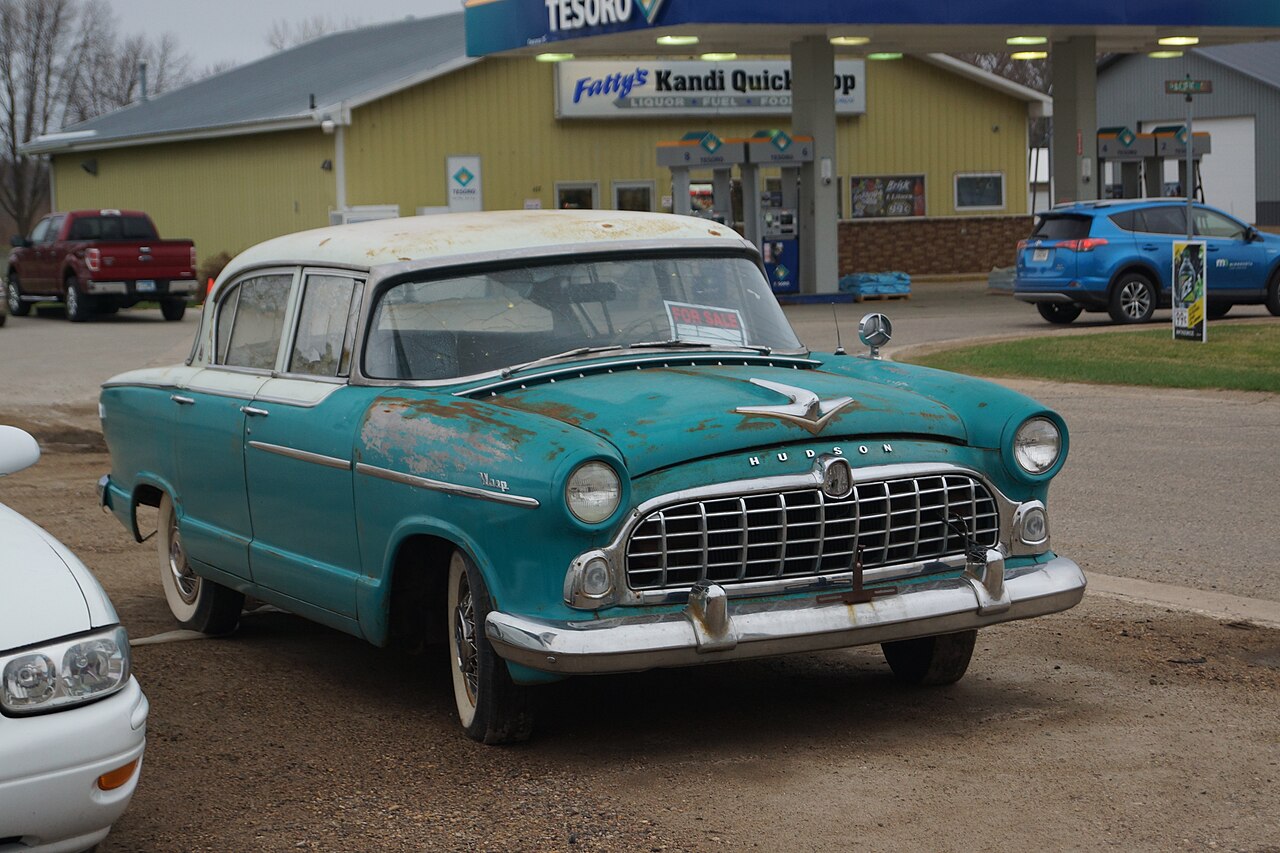
For its final year, designer Richard Arbib covered the Wasp in his elaborate "V-Line Styling" motif. Buyers weren't won over — sales fell to just 2,519 before Hudson pulled the plug.
Hudson deliberately underrated the Super Wasp's 262 at 127 hp, one below the Commodore Eight, so the cheaper six would never outrank the flagship.
Rivals
Same body, same money, other badges — tap any card to flip.

It briefly served as senior sibling to Marquette, a GM companion brand cancelled after just one year.

Nissan hired former BMW engineers to help develop the 510's suspension, which is why period reviewers frequently compared its handling to the BMW 1600/2002.

A Trabant 601 won its class at the 1970 Monte Carlo Rally, with a second 601 right behind it in second.

The 600 was a stopgap: the P50's body over the 601's mechanicals, and for a while its estate was built alongside the new 601 saloon.

The G80 Sport brought a 370 PS twin-turbo 3.3 V6, a mesh grille and copper-tinted chrome with copper stitching to match.

The Vigor was sold only with a five-cylinder engine, an unusual configuration Honda used to fit a longer engine transversely under a short hood.

The GS/E coupe earned the nickname "German Charger" for its long hood, short deck stance borrowed from Detroit muscle cars.

This DeVille/Fleetwood was the first production car anywhere to mount its V8 sideways, Cadillac's front-drive gamble on the new C-body.