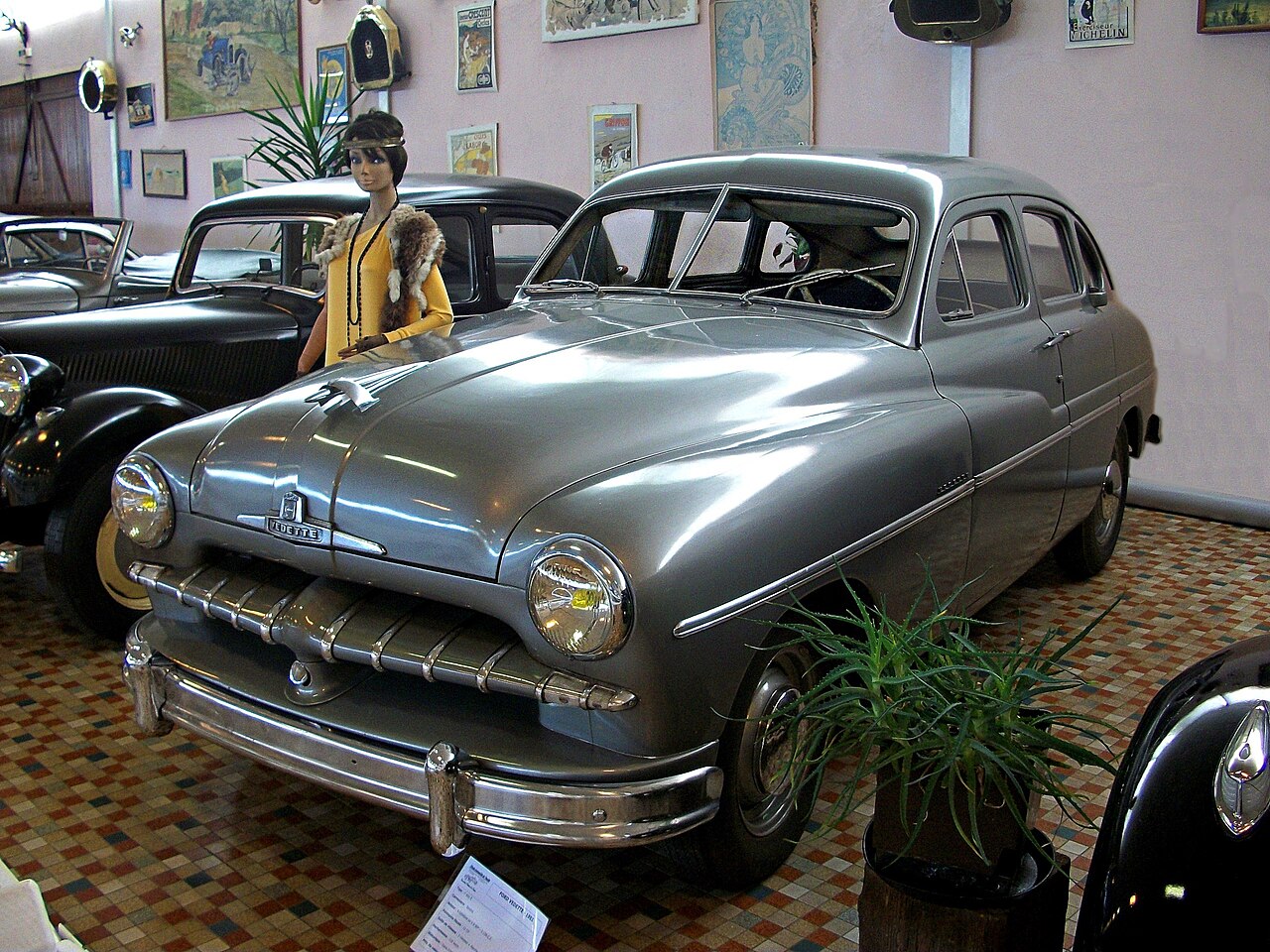
In postwar France, where fuel and taxes punished big engines, Ford's Vedette stood alone — it was the only French car of its era built around a V8.
Lead trim: Vedette 2.2 Aquilon sidevalve V8
Ford VedetteVEDETTE · 1948–1954
- 0spots by members
- Unclaimednobody has spotted one yet
- 0sets it belongs to
Nobody in Burbles has spotted a Ford Vedette yet. See one on the street, point the app at it, and the first card is yours — with your @handle permanently credited on this page.
FactIn postwar France, where fuel and taxes punished big engines, Ford's Vedette stood alone — it was the only French car of its era built around a V8.
The Ford Vedette was a large car manufactured by Ford SAF at Poissy from 1948 to 1954, originally conceived by Edsel Ford and designer Eugene T. "Bob" Gregorie as a "light" Ford smaller than the 1942 Ford; after Edsel's death in 1943 and Ford corporate's worry that it would pull sales from the full-size Ford, that car was transferred to Ford France. Introduced at the 1948 Salon de l'automobile in Paris and designed entirely in Detroit (resembling contemporary Mercury models), it featured the Poissy-made 2158 cc Aquillon sidevalve V8 of Ford's Flathead engine family, the same as in pre-war Matford cars, and was the only French car of its time with a V8. Because Poissy could not resume complete automobile production after the war and had no stamping equipment, many vital components came from subcontractors, which reportedly hurt quality and popularity. It came as an original four-door fastback (with rear suicide doors), a later four-door saloon, a Sunliner two-door landaulet with a roll-down roof, a two-door coupé and a Cabriolet Décapotable; it was refreshed for 1950 and again in 1952, when it finally received a one-piece windscreen, new interior and bumpers, better brakes, a lengthened rear overhang and trunk and a cigarette lighter. The five-door, five-seat Abeille ("bee") estate with a two-piece tailgate, exhibited in October 1951 as a "farmer's car" and launched in June 1952, was a no-frills Vedette with a 500 kg payload and a rear overhang 220 mm shorter; the luxury Vendôme is catalogued as its own generation. In 1954 Ford France, with the Poissy plant and the rights to all its models including a new Vedette, was merged into Simca, which sold it as the Simca Vedette (badged a Ford in some export markets until at least 1956). Wheelbase 2,690 mm (105.9 in), length 4,500 mm (177.2 in) until 1952 and 4,670 mm (183.9 in) from 1952, width 1,720 mm (67.7 in), height 1,570 mm (61.8 in), curb weight 1,180 kg (2,601 lb), 3-speed manual. The page gives no power figure.
Collectors Spotted in the Ford Vedette Lineage
No member has published a public street spot of the Ford Vedette yet — the First · Worldwide stamp is wide open.
Trims & Figures
One published trim in the catalogue. A blank is a figure not recorded, not zero.
| Trim | Years | Engine | Power | Torque | 0–60 | Drive | Gearbox | MSRP |
|---|---|---|---|---|---|---|---|---|
| Vedette 2.2 Aquilon sidevalve V8 | 1948–1954 | 2.2 L V8 | 59 hp | — | — | RWD | — | — |
Owning one
We don’t estimate running costs for a car like this. What it costs depends on its condition, its specialist and how it is driven, and an average would mislead.
Owners’ builds
Nobody has claimed one yet.
Photographs
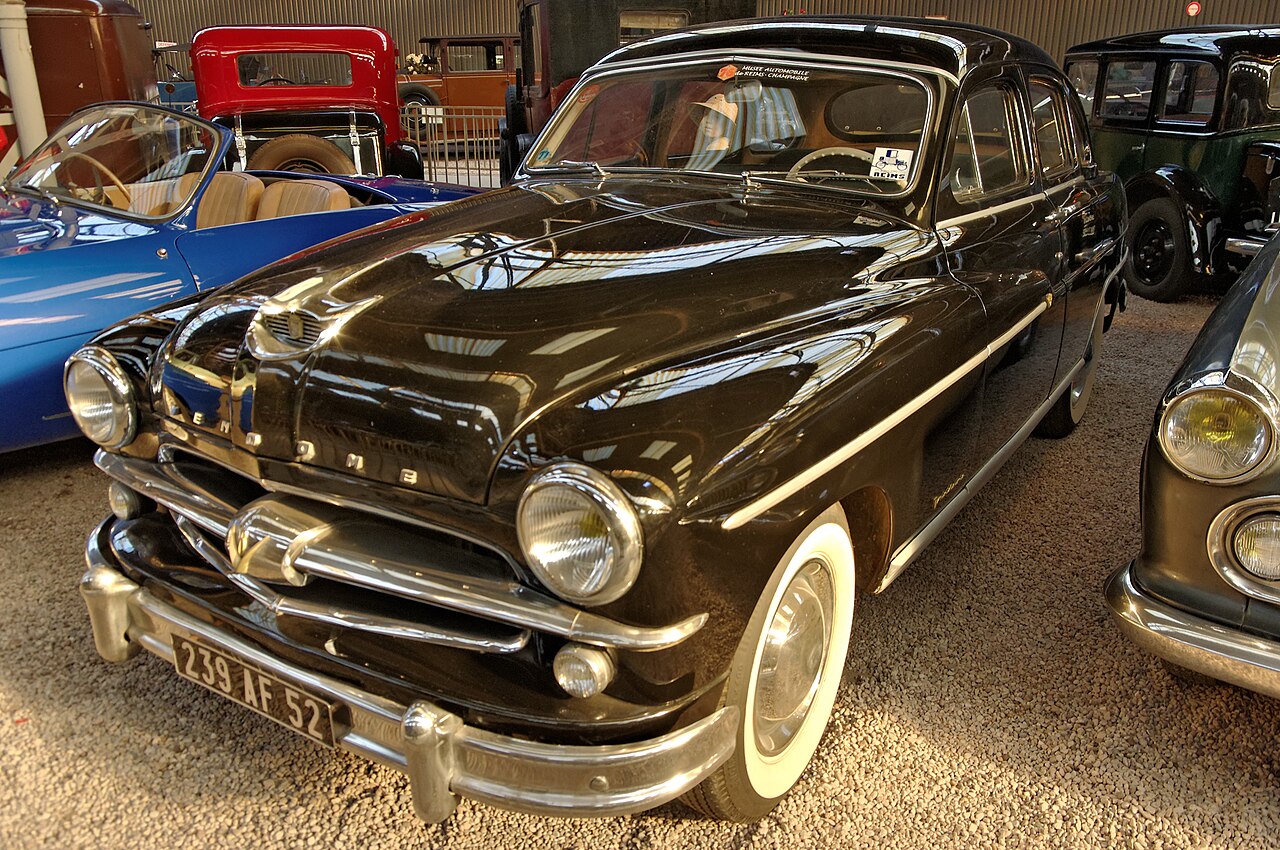
The posh Vendôme version of the Vedette got its extra shove from a 3.9-litre Mistral V8 — an engine first designed for Ford France trucks, not its cars.
In postwar France, where fuel and taxes punished big engines, Ford's Vedette stood alone — it was the only French car of its era built around a V8.
Rivals
Same body, same money, other badges — tap any card to flip.

It briefly served as senior sibling to Marquette, a GM companion brand cancelled after just one year.

Nissan hired former BMW engineers to help develop the 510's suspension, which is why period reviewers frequently compared its handling to the BMW 1600/2002.

A Trabant 601 won its class at the 1970 Monte Carlo Rally, with a second 601 right behind it in second.

The 600 was a stopgap: the P50's body over the 601's mechanicals, and for a while its estate was built alongside the new 601 saloon.

The G80 Sport brought a 370 PS twin-turbo 3.3 V6, a mesh grille and copper-tinted chrome with copper stitching to match.

The Vigor was sold only with a five-cylinder engine, an unusual configuration Honda used to fit a longer engine transversely under a short hood.

The GS/E coupe earned the nickname "German Charger" for its long hood, short deck stance borrowed from Detroit muscle cars.

This DeVille/Fleetwood was the first production car anywhere to mount its V8 sideways, Cadillac's front-drive gamble on the new C-body.