For $50, a 1969 Monaco buyer could option a third headlamp: "Super-Lite," the first modern projector-style road lamp, built jointly by Chrysler and Sylvania.
Lead trim: Monaco 360 cu in LA V8 (210 hp net, 1972) · up to 375 hp
Dodge MonacoC-body · 1969–1973
- 0spots by members
- Unclaimednobody has spotted one yet
- 0sets it belongs to
Nobody in Burbles has spotted a Dodge Monaco yet. See one on the street, point the app at it, and the first card is yours — with your @handle permanently credited on this page.
FactFor $50, a 1969 Monaco buyer could option a third headlamp: "Super-Lite," the first modern projector-style road lamp, built jointly by Chrysler and Sylvania.
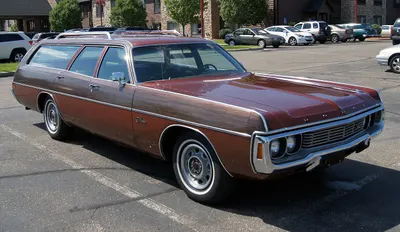
For the 1969 model year the Monaco's wheelbase was increased from 121 inches to 122 inches and its length to about 220 inches, and the "500" option returned, giving U.S. cars front bucket seats and a center armrest. All full-sized Dodges adopted Chrysler Corporation's new "fuselage" styling, in which the upper and lower body are melded into a uniformly curved unit with curved side glass and a five-segment egg-crate grille surrounding the headlamps; at the rear, Dodge's delta-shaped taillamps were presented in a new form. The standard engine on the 1969 Monaco was Chrysler's 245-horsepower B-block 383 cu in (6.3 L) V8 with a two-barrel carburetor, the 383 with a four-barrel carburetor giving 330 hp, or the 375-horsepower 440 cu in (7.2 L) Magnum RB-block. The 1969 Monaco also offered the first modern polyellipsoidal (projector) automotive road lamp, the "Super-Lite", mounted in the driver's side of the grille and developed in a joint venture between Chrysler and Sylvania, using an 85-watt halogen bulb as a mid-beam. Models were a two-door hardtop coupe, four-door hardtop sedan, four-door pillared sedan and four-door station wagons with six- or nine-passenger capacity, plus a new Brougham option package. The 1970 models had new front and rear styling with complex loop-type bumpers front and rear, a front end that grew by three inches, the "Torsion-Quiet" suspension system with strategically placed rubber isolators, and the 350 horsepower 440 (previously wagon-only) as the new top engine, the 440 Magnum being dropped. For 1971 the Monaco received a facelift with a new grille, a single-loop rear bumper and larger taillamps; the Super-Lite was dropped and the 500 option package discontinued, and with compression ratios reduced to run on regular-grade gasoline the two-barrel 383 kept its 245 hp, the four-barrel 383 dropped to 290 hp and the 440 to 320 hp. For 1972 the full-sized Dodges had all-new sheet metal, with a new front end with hidden headlamps, a leaner look and, on wagons, "stacked" vertical taillamps; the standard V8 was the 360 cu in (5.9 L) LA-block rated at 210 hp net, with a 400 cu in (6.6 L) B-block optional and the 440 producing 275 hp net. The 1973 model was the last year of the fuselage body, gaining large black rubber bumper guards to comply with the new five-mile-per-hour impact standards; sales dropped to 29,396. After 14 years the Polara name was discontinued and from 1974 all big Dodges carried the Monaco name. In July 1969 Chrysler South Africa introduced a rebadged locally built version as the Chrysler 383, with a 383 cu in (6.3 L) V8 rated at 290 hp; the badge was dropped in early 1973.
Collectors Spotted in the Dodge Monaco Lineage
No member has published a public street spot of the Dodge Monaco yet — the First · Worldwide stamp is wide open.
Trims & Figures
10 published trims in the catalogue. A blank is a figure not recorded, not zero.
| Trim | Years | Engine | Power | Torque | 0–60 | Drive | Gearbox | MSRP |
|---|---|---|---|---|---|---|---|---|
| Monaco 360 cu in LA V8 (210 hp net, 1972) | 1972–1972 | 5.9 L V8 | 210 hp | — | — | RWD | — | — |
| Monaco 383 cu in B V8, 2-bbl (245 hp, 1969) | 1969–1969 | 6.3 L V8 | 245 hp | — | — | RWD | — | — |
| Monaco 383 cu in B V8, 2-bbl (245 hp, 1971) | 1971–1971 | 6.3 L V8 | 245 hp | — | — | RWD | — | — |
| Monaco 383 cu in B V8, 4-bbl (290 hp, 1971) | 1971–1971 | 6.3 L V8 | 290 hp | — | — | RWD | — | — |
| Monaco 383 cu in B V8, 4-bbl (330 hp, 1969) | 1969–1969 | 6.3 L V8 | 330 hp | — | — | RWD | — | — |
| Monaco 400 cu in B V8 (1972, optional) | 1972–1972 | 6.6 L V8 | — | — | — | RWD | — | — |
| Monaco 440 cu in Magnum RB V8 (375 hp, 1969) | 1969–1969 | 7.2 L V8 | 375 hp | 480 lb-ft | — | RWD | — | — |
| Monaco 440 cu in RB V8 (275 hp net, 1972) | 1972–1972 | 7.2 L V8 | 275 hp | — | — | RWD | — | — |
| Monaco 440 cu in RB V8 (320 hp, 1971) | 1971–1971 | 7.2 L V8 | 320 hp | — | — | RWD | — | — |
| Monaco 440 cu in RB V8 (350 hp, 1970) | 1970–1970 | 7.2 L V8 | 350 hp | 480 lb-ft | — | RWD | — | — |
Owning one
We don’t estimate running costs for a car like this. What it costs depends on its condition, its specialist and how it is driven, and an average would mislead.
Owners’ builds
Nobody has claimed one yet.
Photographs
This Monaco exists because of fine print: buying AMC obligated Chrysler to use 260,000 PRV V6 engines, and the Renault-based Monaco helped burn through the quota.
This Monaco kept its name but lost its platform: for 1977 Chrysler simply moved the badge onto the smaller B-body, in name only.
Chrysler fully redesigned the 1974 Monaco, new unibody and all — and the press's verdict was that it looked like a three-year-old Buick or Oldsmobile.
For $50, a 1969 Monaco buyer could option a third headlamp: "Super-Lite," the first modern projector-style road lamp, built jointly by Chrysler and Sylvania.
The '65 Monaco's cabin went full lounge: bucket seats front and rear, a contoured package tray, and rattan wicker trim on the doors — upscale touches nobody expected on a full-size Dodge.
Rivals
Same body, same money, other badges — tap any card to flip.

It briefly served as senior sibling to Marquette, a GM companion brand cancelled after just one year.

Nissan hired former BMW engineers to help develop the 510's suspension, which is why period reviewers frequently compared its handling to the BMW 1600/2002.

A Trabant 601 won its class at the 1970 Monte Carlo Rally, with a second 601 right behind it in second.

The 600 was a stopgap: the P50's body over the 601's mechanicals, and for a while its estate was built alongside the new 601 saloon.

The G80 Sport brought a 370 PS twin-turbo 3.3 V6, a mesh grille and copper-tinted chrome with copper stitching to match.

The Vigor was sold only with a five-cylinder engine, an unusual configuration Honda used to fit a longer engine transversely under a short hood.

The GS/E coupe earned the nickname "German Charger" for its long hood, short deck stance borrowed from Detroit muscle cars.

This DeVille/Fleetwood was the first production car anywhere to mount its V8 sideways, Cadillac's front-drive gamble on the new C-body.