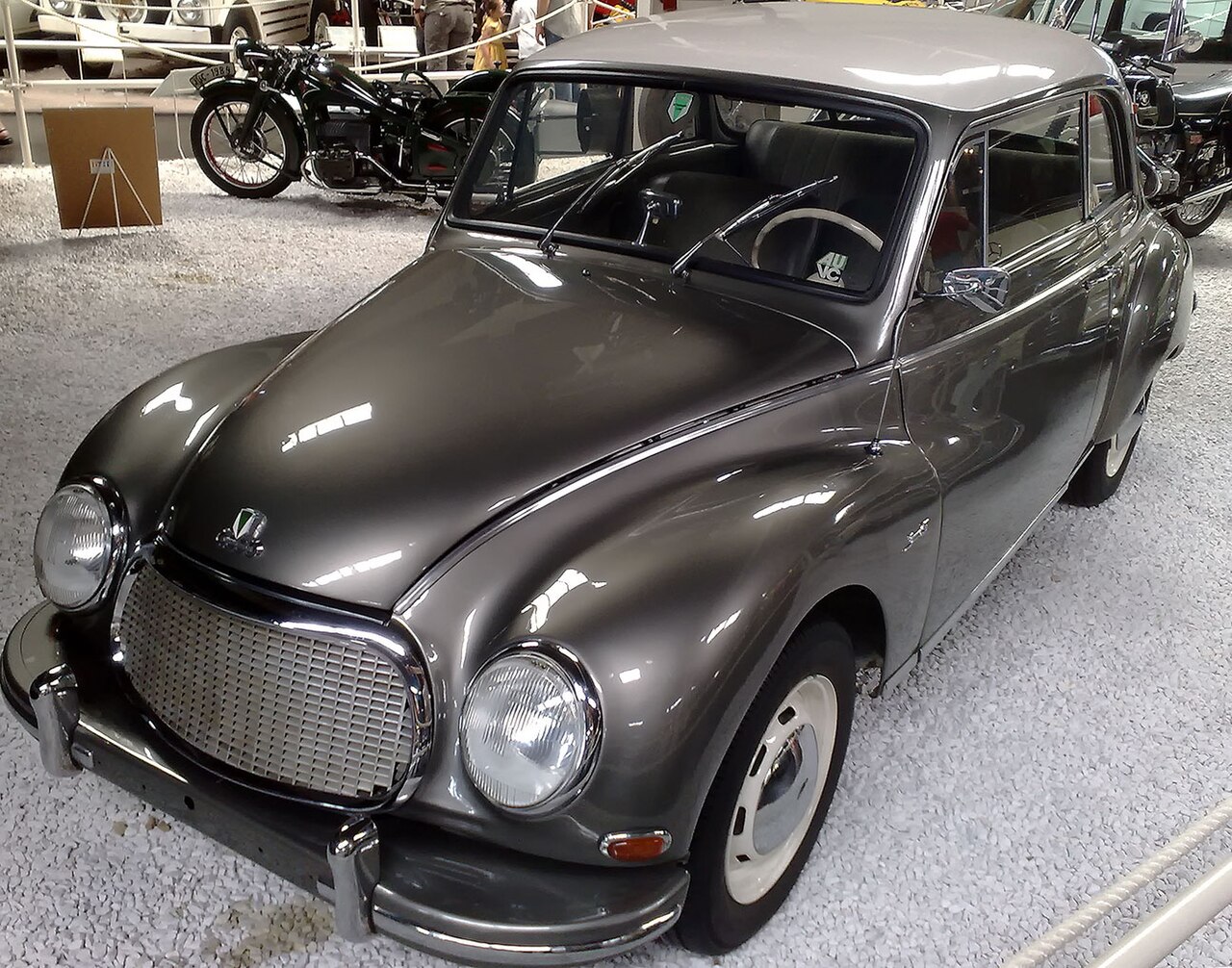
The Big DKW's three-cylinder two-stroke ran on a triple-redundant ignition — three separate sets of points and coils, one per cylinder, clustered around a single lobed cam.
Lead trim: F93 two-door saloon (896 cc two-stroke I3, 38 hp) · up to 40 hp
DKW 3=6 (Sonderklasse)F93-F94 · 1955–1959
- 0spots by members
- Unclaimednobody has spotted one yet
- 0sets it belongs to
Nobody in Burbles has spotted a DKW 3=6 (Sonderklasse) yet. See one on the street, point the app at it, and the first card is yours — with your @handle permanently credited on this page.
FactThe Big DKW's three-cylinder two-stroke ran on a triple-redundant ignition — three separate sets of points and coils, one per cylinder, clustered around a single lobed cam.
The F93 launched in 1955 (for the 1956 model year) was also known as the Big DKW 3=6 (Großer 3=6): a wider car with a number of improvements — width and track grew by almost 4 inches (the track by 10 cm), an oval front grille with five horizontal slats (replaced by a chrome grid in 1957), improved instrumentation and heating, a strengthened chassis and better suspension and brakes — sharing the F91's 2,350 mm wheelbase but slightly longer, wider and taller. Power rose to 38 bhp (28 kW) in 1955 and to 40 bhp (30 kW) in 1957; a four-speed gearbox became standard in late 1956 and a Saxomat automatic centrifugal clutch became available in 1956. There were three production series (model 1956 from September 1955, 1957 from October 1956, 1958 from September 1957 to August 1959), the Karmann cabriolet of the F93 was only available for the 1956 model year, and in 1956 the F94 brought a four-door saloon (wheelbase extended by 10 cm) and the F94U Universal estate. The DKW-Vemag Belcar sedan, Vemaguet station wagon and Fissore coupé were built under licence in Brazil from 1956 to 1967, about 109,343 cars altogether. From 1958 the car was sold simply as the DKW 900 in the US and the Netherlands, and the Auto Union 1000 succeeded it from late 1957 for the 1958 model year. The page's table lists the F93 two-door saloon (38 hp at 4250 rpm, 71.1 N·m (52.4 lb·ft) at 3000 rpm, 7.25:1, 123 km/h (76 mph), length 4,225 mm (166.3 in), width 1,695 mm (66.7 in), height 1,465 mm (57.7 in)) and later cars at 40 hp with 73.6 N·m (54.3 lb·ft) at 3500 rpm; the DKW Monza is catalogued as its own generation.
Collectors Spotted in the DKW 3=6 (Sonderklasse) Lineage
No member has published a public street spot of the DKW 3=6 (Sonderklasse) yet — the First · Worldwide stamp is wide open.
Trims & Figures
2 published trims in the catalogue. A blank is a figure not recorded, not zero.
| Trim | Years | Engine | Power | Torque | 0–60 | Drive | Gearbox | MSRP |
|---|---|---|---|---|---|---|---|---|
| F93 / F94 (896 cc two-stroke I3, 40 hp from 1957) | 1957–1959 | 0.9 L Inline-3 | 40 hp | 54.3 lb-ft | — | FWD | — | — |
| F93 two-door saloon (896 cc two-stroke I3, 38 hp) | 1955–1957 | 0.9 L Inline-3 | 38 hp | 52.4 lb-ft | — | FWD | — | — |
Owning one
We don’t estimate running costs for a car like this. What it costs depends on its condition, its specialist and how it is driven, and an average would mislead.
Owners’ builds
Nobody has claimed one yet.
Photographs
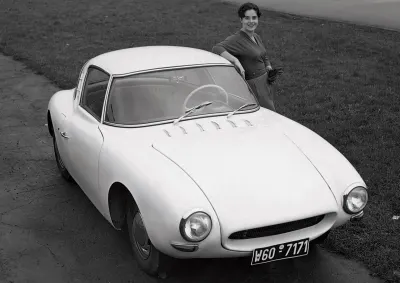
The Monza was never an official DKW — it was an independent coachbuilder's car, and it died in 1958 the moment Auto Union simply stopped supplying chassis for it.
The Big DKW's three-cylinder two-stroke ran on a triple-redundant ignition — three separate sets of points and coils, one per cylinder, clustered around a single lobed cam.
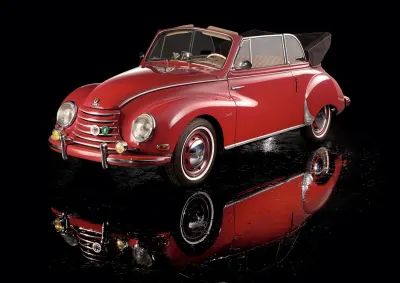
The three-cylinder two-stroke in DKW's 1953 F91 needed three separate ignition systems — one set of points and coil per cylinder, all clustered around a single lobed cam.
Rivals
Same body, same money, other badges — tap any card to flip.

It briefly served as senior sibling to Marquette, a GM companion brand cancelled after just one year.

Nissan hired former BMW engineers to help develop the 510's suspension, which is why period reviewers frequently compared its handling to the BMW 1600/2002.

A Trabant 601 won its class at the 1970 Monte Carlo Rally, with a second 601 right behind it in second.

The 600 was a stopgap: the P50's body over the 601's mechanicals, and for a while its estate was built alongside the new 601 saloon.

The G80 Sport brought a 370 PS twin-turbo 3.3 V6, a mesh grille and copper-tinted chrome with copper stitching to match.

The Vigor was sold only with a five-cylinder engine, an unusual configuration Honda used to fit a longer engine transversely under a short hood.

The GS/E coupe earned the nickname "German Charger" for its long hood, short deck stance borrowed from Detroit muscle cars.

This DeVille/Fleetwood was the first production car anywhere to mount its V8 sideways, Cadillac's front-drive gamble on the new C-body.