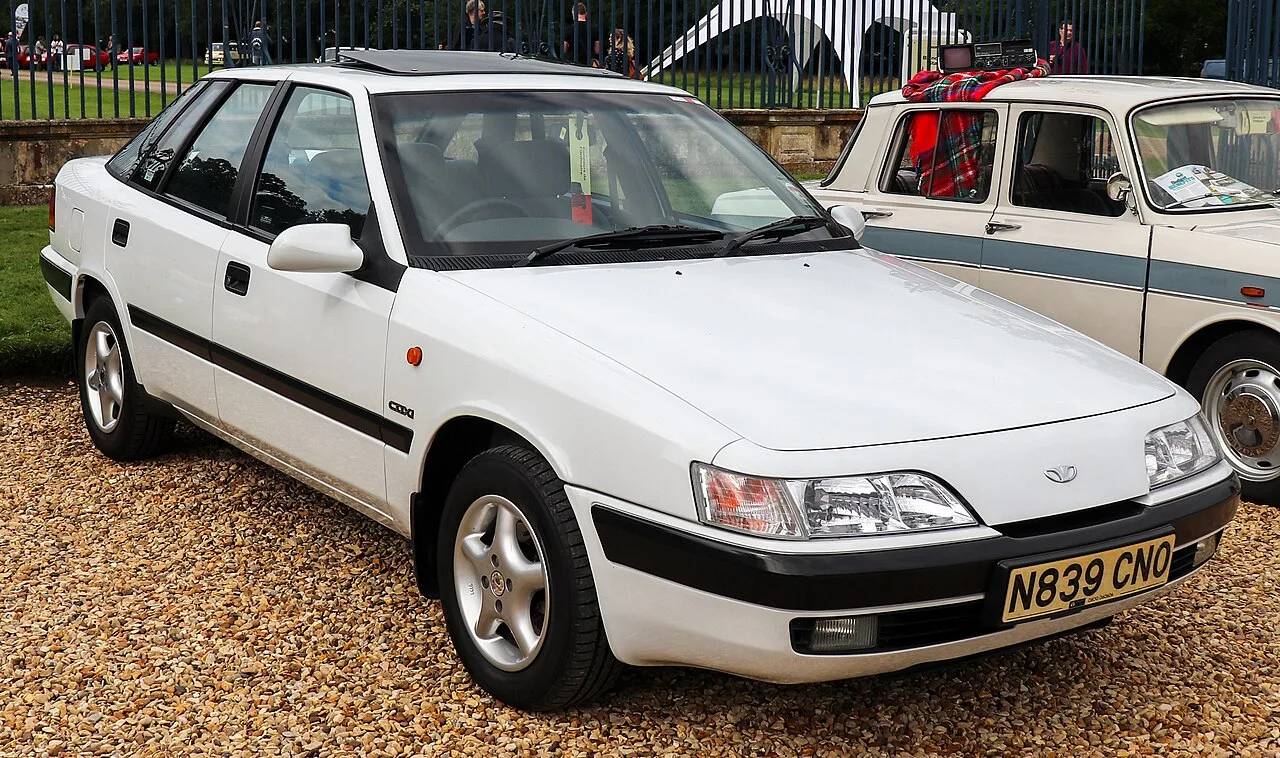
Bertone designed the Espero's body only after Citroën had already rejected it for one of its own cars.
Lead trim: Espero 1.5 G15MF four · up to 105 hp
Daewoo Espero1990–1997
- 0spots by members
- Unclaimednobody has spotted one yet
- 0sets it belongs to
Nobody in Burbles has spotted a Daewoo Espero yet. See one on the street, point the app at it, and the first card is yours — with your @handle permanently credited on this page.
FactBertone designed the Espero's body only after Citroën had already rejected it for one of its own cars.
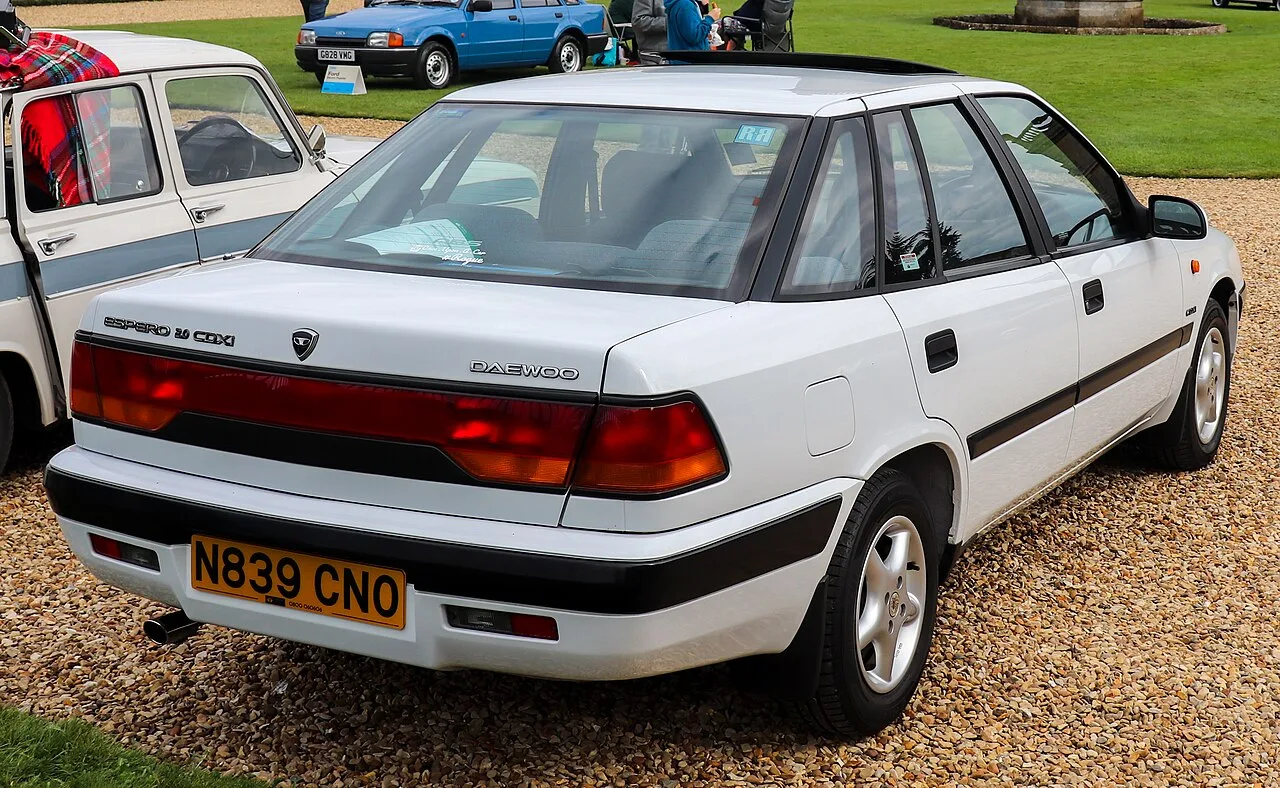
The Daewoo Espero (Daewoo Aranos in Spain) is a four-door, five-seater mid-size saloon produced from September 1990 to February 1997 in South Korea (export markets to May 1999, Romania 1996–2002, also Poland and Russia), the first car entirely developed by Daewoo, which until then had built only Opel-derived models. Bertone (under Marc Deschamps) designed the body, previously discarded by Citroën, on the platform of the Daewoo LeMans (a badge-engineered Opel Kadett E), with engines supplied by Holden from the GM Family 1 1.5 L to the GM Family II 2.0 L; development began in 1986 under the codename "J-Car", aimed at rivals like the Hyundai Sonata. Trims included the base GLX (1.5-litre DOHC, three-spoke wheel, electric windows, "DOHC 16V" badge), the CDi (1.8-litre SOHC, air conditioning standard) and the CDXi (2.0-litre SOHC, alloy wheels, CD player); the 2.0 was the only engine in the later years. It was replaced by the Nubira in 1997 but built until 2002 in Eastern Europe; the 2.0 Espero was succeeded by the Leganza. A 1995 prototype, the DEV 2 (Daewoo Electric Vehicle), used an 86 kW water-cooled AC induction motor and lead-acid batteries for a claimed 13-second 0–100 km/h and about 85 mph, with an 80 km range, and was shown only once at the 1995 Seoul Motor Show.
Collectors Spotted in the Daewoo Espero Lineage
No member has published a public street spot of the Daewoo Espero yet — the First · Worldwide stamp is wide open.
Trims & Figures
5 published trims in the catalogue. A blank is a figure not recorded, not zero.
| Trim | Years | Engine | Power | Torque | 0–60 | Drive | Gearbox | MSRP |
|---|---|---|---|---|---|---|---|---|
| Espero 1.5 A15MF four | 1990–1997 | 1.5 L Inline-4 | 84 hp | 97 lb-ft | — | FWD | — | — |
| Espero 1.5 G15MF four | 1990–1997 | 1.5 L Inline-4 | 69 hp | 86 lb-ft | — | FWD | — | — |
| Espero 1.6 G16LF LPG four (taxi) | 1990–1997 | 1.6 L Inline-4 | — | — | — | FWD | — | — |
| Espero CDXi 2.0 C20LE four | 1990–1997 | 2.0 L Inline-4 | 105 hp | 125 lb-ft | — | FWD | — | — |
| Espero CDi 1.8 C18LE four | 1990–1997 | 1.8 L Inline-4 | 95 hp | 107 lb-ft | — | FWD | — | — |
Owning one
We don’t estimate running costs for a car like this. What it costs depends on its condition, its specialist and how it is driven, and an average would mislead.
Owners’ builds
Nobody has claimed one yet.
Photographs
Rivals
Same body, same money, other badges — tap any card to flip.

It briefly served as senior sibling to Marquette, a GM companion brand cancelled after just one year.

Nissan hired former BMW engineers to help develop the 510's suspension, which is why period reviewers frequently compared its handling to the BMW 1600/2002.

A Trabant 601 won its class at the 1970 Monte Carlo Rally, with a second 601 right behind it in second.

The 600 was a stopgap: the P50's body over the 601's mechanicals, and for a while its estate was built alongside the new 601 saloon.

The G80 Sport brought a 370 PS twin-turbo 3.3 V6, a mesh grille and copper-tinted chrome with copper stitching to match.

The Vigor was sold only with a five-cylinder engine, an unusual configuration Honda used to fit a longer engine transversely under a short hood.

The GS/E coupe earned the nickname "German Charger" for its long hood, short deck stance borrowed from Detroit muscle cars.

This DeVille/Fleetwood was the first production car anywhere to mount its V8 sideways, Cadillac's front-drive gamble on the new C-body.