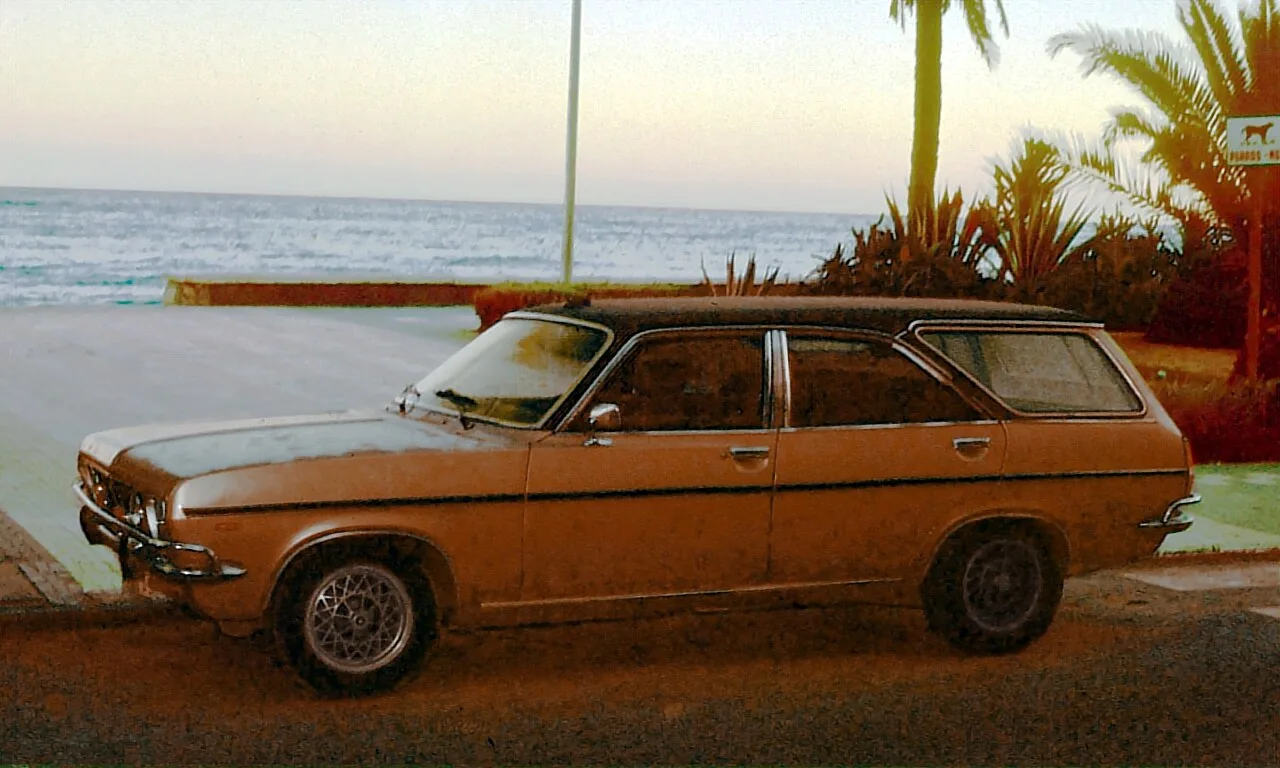
Spain kept this car alive as a diesel three years after everyone else had rebadged it a Talbot.
Lead trim: 160 1.6 L Type 180 four (80 PS, 1970) · up to 109 hp
Chrysler 180/2 LitreC Car · 1970–1982
- 0spots by members
- Unclaimednobody has spotted one yet
- 0sets it belongs to
Nobody in Burbles has spotted a Chrysler 180/2 Litre yet. See one on the street, point the app at it, and the first card is yours — with your @handle permanently credited on this page.
FactSpain kept this car alive as a diesel three years after everyone else had rebadged it a Talbot.
The Chrysler 180 was the base name for a series of executive cars produced by Chrysler Europe, the first common European Chrysler car, the result of joining the development efforts of Rootes Group and Simca. It was produced from 1970 to 1975 at Poissy, France, and later at Chrysler's Spanish subsidiary Barreiros' Villaverde plant, and was the base for the Chrysler Australia Centura. Depending on the engine it was marketed as the Chrysler 160/180/2 litre, since 1977 in continental Europe as the Chrysler-Simca 1609/1610/2 litres, and from 1979 as the Talbot 1610/2 litres, after which it was discontinued in Europe except for Spain, where a diesel was sold until 1982; its successor, developed under the codename C9, was the Talbot Tagora. The Rootes "C Car" had begun in 1966 under Roy Axe; Simca was meanwhile working on Projet 929, and in early 1969 Chrysler chose the British C Car program, then in 1970 trimmed it to one version built at Simca's Poissy factory, dropping the planned V6 engine, and giving it a coil-sprung rear live axle, MacPherson struts in front and a four-speed manual transmission (with a three-speed automatic option). It was launched in 1970 as the Chrysler 160, 160 GT and 180 under the slogan "An American from Paris": the 160 had the 1632 cc unit with 80 PS, the 180 the 1812 cc unit, and the 160 GT the larger engine, the 160 GT and 180 having 97 PS; the British launch came in 1971 with only the 180. The 2.0 L "Chrysler 2 litre" (1981 cc) joined for 1973, available only with Chrysler's TorqueFlite automatic (an option on the 180), with a full-length vinyl roof, bumper-mounted auxiliary driving lights and a "2L" badge; the 160 GT was discontinued at the same time and all models moved to 14-inch wheels. Motor magazine tested a UK 180 in April 1971: top speed 101.0 mph, 0–60 mph in 12.4 seconds and 21.7 mpg. In 1979 the 1.8 L engine was discontinued and from 1 August 1979 the cars became Talbots. In Spain the 160 was not offered but a diesel version with Barreiros's indirect-injection four-cylinder engine (48 kW, 65 hp, four-speed manual, 160 dashboard) was, its displacement cut from 2007 cc to 1917 cc for 1978 without a drop in maximum power to stay below a new Spanish tax band. The wheelbase was 2,667 mm (105.0 in) and the width 1,730 mm (68.1 in). Sales were poor in France and the UK (about 2,000 a year in Britain by 1976) but best in Spain.
Collectors Spotted in the Chrysler 180 Lineage
No member has published a public street spot of the Chrysler 180 yet — the First · Worldwide stamp is wide open.
Trims & Figures
5 published trims in the catalogue. A blank is a figure not recorded, not zero.
| Trim | Years | Engine | Power | Torque | 0–60 | Drive | Gearbox | MSRP |
|---|---|---|---|---|---|---|---|---|
| 160 1.6 L Type 180 four (80 PS, 1970) | 1970–1970 | 1.6 L Inline-4 | 79 hp | — | — | RWD | — | — |
| 160 GT 1.8 L Type 180 four (97 PS, 1970–1973) | 1970–1973 | 1.8 L Inline-4 | 96 hp | — | — | RWD | — | — |
| 180 1.8 L Type 180 four (97 PS, 1970–1979) | 1970–1979 | 1.8 L Inline-4 | 96 hp | — | 12.4 s | RWD | — | — |
| 2 Litre 2.0 L Type 180 four (1973–1980) | 1973–1980 | 2.0 L Inline-4 | 109 hp | 117 lb-ft | — | RWD | — | — |
| Diesel Barreiros 1.9 L four (1978–1982, Spain) | 1978–1982 | 1.9 L Inline-4 | 65 hp | — | — | RWD | — | — |
Owning one
We don’t estimate running costs for a car like this. What it costs depends on its condition, its specialist and how it is driven, and an average would mislead.
Owners’ builds
Nobody has claimed one yet.
Photographs
Rivals
Same body, same money, other badges — tap any card to flip.

It briefly served as senior sibling to Marquette, a GM companion brand cancelled after just one year.

Nissan hired former BMW engineers to help develop the 510's suspension, which is why period reviewers frequently compared its handling to the BMW 1600/2002.

A Trabant 601 won its class at the 1970 Monte Carlo Rally, with a second 601 right behind it in second.

The 600 was a stopgap: the P50's body over the 601's mechanicals, and for a while its estate was built alongside the new 601 saloon.

The G80 Sport brought a 370 PS twin-turbo 3.3 V6, a mesh grille and copper-tinted chrome with copper stitching to match.

The Vigor was sold only with a five-cylinder engine, an unusual configuration Honda used to fit a longer engine transversely under a short hood.

The GS/E coupe earned the nickname "German Charger" for its long hood, short deck stance borrowed from Detroit muscle cars.

This DeVille/Fleetwood was the first production car anywhere to mount its V8 sideways, Cadillac's front-drive gamble on the new C-body.