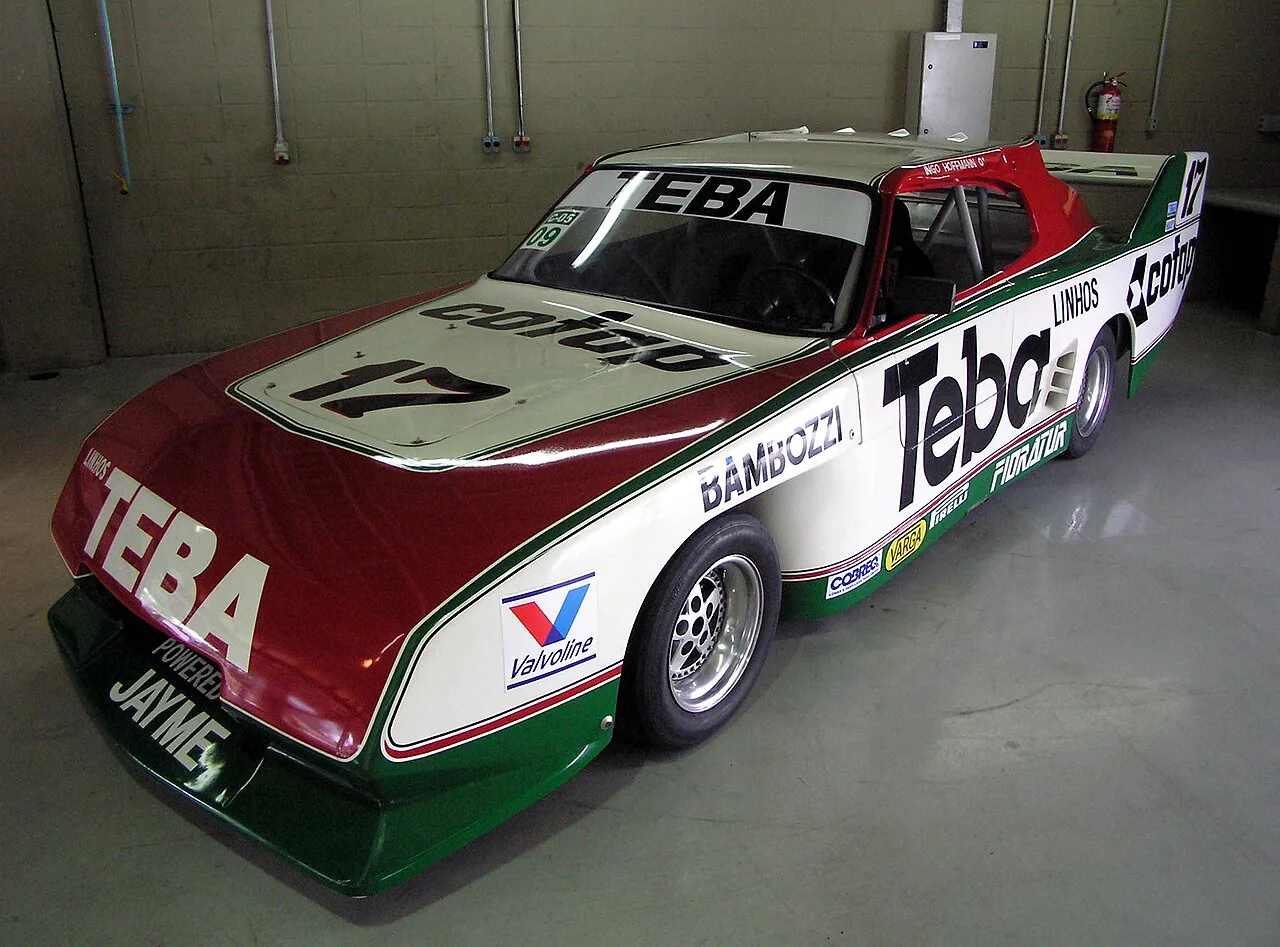
GM's first Brazilian-built car wore round headlamps by design, breaking from the square-lit Opel Rekord it was copied from.
Lead trim: Opala 153 four, 2,512 cc · up to 125 hp
Chevrolet OpalaOPALA-1968 · 1968–1992
- 0spots by members
- Unclaimednobody has spotted one yet
- 0sets it belongs to
Nobody in Burbles has spotted a Chevrolet Opala yet. See one on the street, point the app at it, and the first card is yours — with your @handle permanently credited on this page.
FactGM's first Brazilian-built car wore round headlamps by design, breaking from the square-lit Opel Rekord it was copied from.
The Chevrolet Opala is a Brazilian mid-size car sold under the Chevrolet brand in South America from 1968 to 1992 by General Motors do Brasil, derived from the German Opel Rekord Series C and Opel Commodore Series A but with local styling and engines derived from North American designs; about one million were made as the Opala sedan, Opala Coupé and Opala Caravan station wagon, and it was replaced by the Chevrolet Omega in 1992. It was the first passenger car GM built in Brazil, announced as "Project 676" on 23 November 1966 and shown on a rotating stand at the sixth São Paulo Auto Show on 23 November 1968. The first model was the four-door sedan in "Especial" and "Luxo" trims, with "Coke Bottle" styling, round headlamps (not the squared ones of the Rekord and Commodore) and badges giving the engine size in cubic centimeters (2500 or 3800, later 4100 too); a hardtop coupe was also offered, and the Opala Coupé stayed a pillarless hardtop well into the late 1980s. The engines were traditional cast-iron designs with overhead valves actuated by pushrods from a block-mounted camshaft, already used in the USA: the 153 cu in (2,512 cc) four had debuted in the 1962 Chevy II, the first inline-four in a Chevrolet since 1928, and the 230 cu in (3,768 cc) straight-six in the 1963 Impala. The six was replaced in 1971 by a bigger 4,093 cc (250 cu in) version, and in 1973 GM do Brasil shortened the four's stroke to 3 inches, lengthened the rods to 6 inches and widened the bores to 4 inches to keep the displacement similar at 2,471 cc (151 cu in); the six had seven main bearings (five on the fours) and hydraulic valve lifters. The Especial and Luxo had a manual gearbox, rear-wheel drive, independent front suspension and a live rear axle, both on coil springs, and used the first tubeless tires fitted to a Brazilian-made car. The Opala SS, originally only with the "250" engine, was the first version with a four-speed manual, and GM introduced the 250-S engine as an option for the Opala 4100 in July 1974 after Bob Sharp and Jan Balder placed second in the 1973 24 Hours of Interlagos against the Ford Maverick. The Comodoro-4 got a somewhat more powerful version of the 2.5 four at 88 PS instead of 80 PS in some model years, also used in the Opala SS-4; the page dates the Comodoro to fall 1970 in one place and to 1975 in another, and the Diplomata to November 1979. Transmissions were a 3-, 4- or 5-speed manual and a 3-speed GM 3L30 or 4-speed ZF 4HP22 automatic. Brazil's Federal Police used Opalas for many years, taxi drivers chose them for reliability and easy maintenance, and the 250 engine also powered the Omega from 1995 to 1998. Wheelbase 105.0 in and height 54.5 in; length (180.1–190.8 in) and width (69.2–69.5 in) are given only as ranges and are not entered. The page's list of power ratings is tagged "citation needed", so no power figures are entered.
Collectors Spotted in the Chevrolet Opala Lineage
No member has published a public street spot of the Chevrolet Opala yet — the First · Worldwide stamp is wide open.
Trims & Figures
4 published trims in the catalogue. A blank is a figure not recorded, not zero.
| Trim | Years | Engine | Power | Torque | 0–60 | Drive | Gearbox | MSRP |
|---|---|---|---|---|---|---|---|---|
| Opala 151 four, 2,471 cc | 1973–1992 | 2.5 L Inline-4 | — | — | — | RWD | — | — |
| Opala 153 four, 2,512 cc | 1968–1972 | 2.5 L Inline-4 | 79 hp | — | — | RWD | — | — |
| Opala 230 straight-six, 3,768 cc | 1968–1970 | 3.8 L Inline-6 | 125 hp | 190 lb-ft | — | RWD | — | — |
| Opala 250 straight-six, 4,093 cc | 1971–1992 | 4.1 L Inline-6 | — | — | — | RWD | — | — |
Owning one
We don’t estimate running costs for a car like this. What it costs depends on its condition, its specialist and how it is driven, and an average would mislead.
Owners’ builds
Nobody has claimed one yet.
Photographs
Rivals
Same body, same money, other badges — tap any card to flip.

It briefly served as senior sibling to Marquette, a GM companion brand cancelled after just one year.

Nissan hired former BMW engineers to help develop the 510's suspension, which is why period reviewers frequently compared its handling to the BMW 1600/2002.

A Trabant 601 won its class at the 1970 Monte Carlo Rally, with a second 601 right behind it in second.

The 600 was a stopgap: the P50's body over the 601's mechanicals, and for a while its estate was built alongside the new 601 saloon.

The G80 Sport brought a 370 PS twin-turbo 3.3 V6, a mesh grille and copper-tinted chrome with copper stitching to match.

The Vigor was sold only with a five-cylinder engine, an unusual configuration Honda used to fit a longer engine transversely under a short hood.

The GS/E coupe earned the nickname "German Charger" for its long hood, short deck stance borrowed from Detroit muscle cars.

This DeVille/Fleetwood was the first production car anywhere to mount its V8 sideways, Cadillac's front-drive gamble on the new C-body.