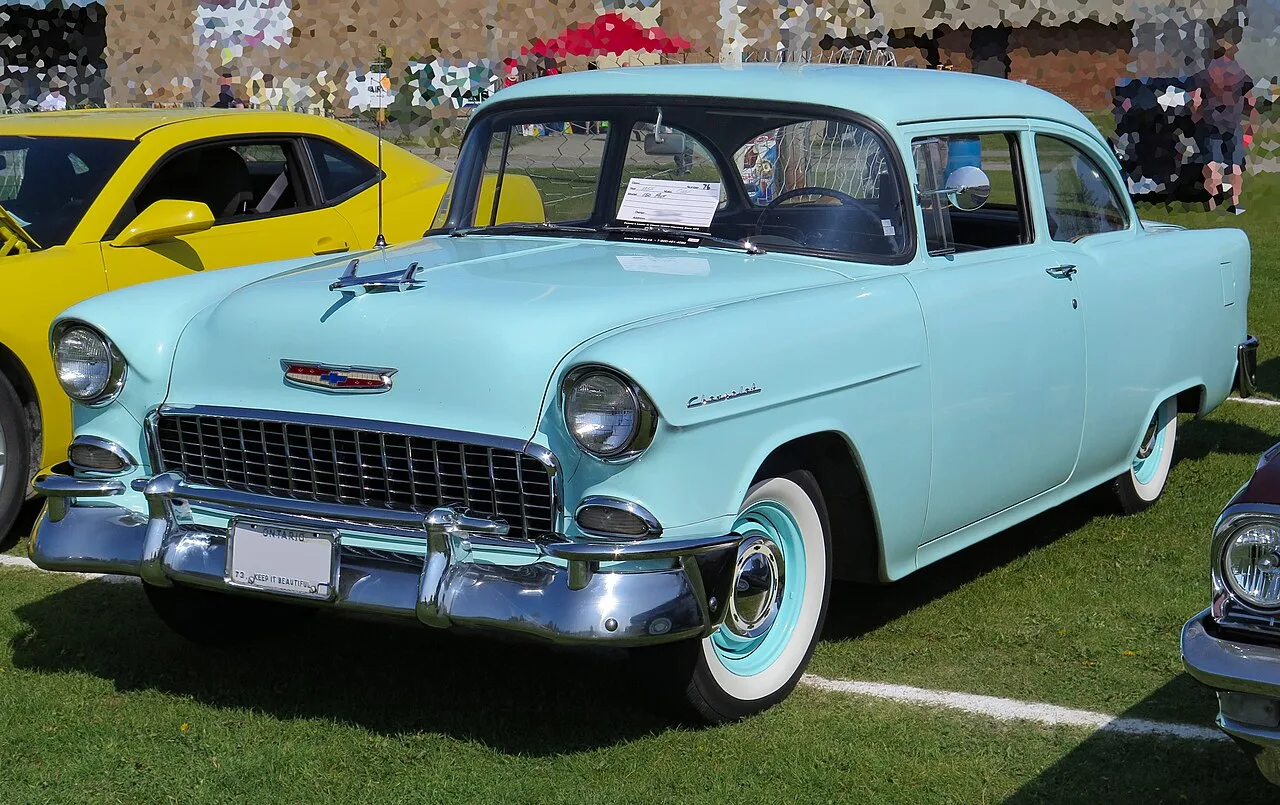
Chevrolet drew the line between trims right down to the steering wheel — the budget One-Fifty got a plain horn button while the 210 and Bel Air got a fancier horn ring.
Median 88 hp across 108 similar cars
Lead trim: One-Fifty 235 "Thrift-master" I6 (1953; 93 hp, sedan delivery only) · up to 125 hp
Chevrolet One-FiftyONE-FIFTY-1953 · 1953–1954
- 0spots by members
- Unclaimednobody has spotted one yet
- 0sets it belongs to
Nobody in Burbles has spotted a Chevrolet One-Fifty yet. See one on the street, point the app at it, and the first card is yours — with your @handle permanently credited on this page.
FactChevrolet drew the line between trims right down to the steering wheel — the budget One-Fifty got a plain horn button while the 210 and Bel Air got a fancier horn ring.
The Chevrolet One-Fifty (or 150) was the economy and fleet model of the Chevrolet car from 1953 until 1957, named by shortening the production series number (1500) by one digit to capitalize on the 1950s trend for numerical auto names, and it replaced the Styleline Special; it was discontinued after 1957 to be replaced by the Delray. It was mainly conceived as a fleet model with little effort spent marketing it to the average car buyer, most popular with police, state governments, small businesses, economy-minded consumers and hot rodders, and Chevrolet sold substantially fewer One-Fifties than Two-Tens or Bel Airs in every year. True to Chevrolet's vision it was no-frills basic transportation: limited options, stark trim, solid colors, plain heavy-duty upholstery and rubberized flooring, with ashtrays, cigarette lighters and even mirrors extra-cost options. Bodies were limited to sedans, Handyman wagons (four-door in 1953 and 1954) and, until 1955, the club coupe, the only body style specific to the One-Fifty being the fleet-oriented business sedan (a 2-door sedan with immobile rear windows and the back seat removed); powertrain choices were limited to manual transmissions and low-output engines until 1954. 1953 was the first year for both the One-Fifty and the Two-Ten and the two model years were essentially the same, except that the short-roof business coupe became the Utility Sedan (a 2-door sedan body) for 1954; the 150 came only with the base engine in 1953 and had a horn button rather than the horn ring of the 210 and Bel Air. All 1953 cars used a 3-speed Synchromesh manual, with Powerglide available from 1954. Wheelbase 115 in; the length is 195.5 in for cars and 197.8 in for wagons, so no length is entered. The infobox also lists a 216 cu in I6 that has no rating on the page and is not entered.
Collectors Spotted in the Chevrolet One-Fifty Lineage
No member has published a public street spot of the Chevrolet One-Fifty yet — the First · Worldwide stamp is wide open.
Trims & Figures
4 published trims in the catalogue. A blank is a figure not recorded, not zero.
| Trim | Years | Engine | Power | Torque | 0–60 | Drive | Gearbox | MSRP |
|---|---|---|---|---|---|---|---|---|
| One-Fifty 235 "Blue Flame" I6 (1954; 115 hp) | 1954–1954 | 3.9 L Inline-6 | 115 hp | 200 lb-ft | — | RWD | — | — |
| One-Fifty 235 "Thrift-King" I6 (1953; 108 hp) | 1953–1953 | 3.9 L Inline-6 | 108 hp | 200 lb-ft | — | RWD | — | — |
| One-Fifty 235 "Thrift-master" I6 (1953; 93 hp, sedan delivery only) | 1953–1953 | 3.9 L Inline-6 | 93 hp | — | — | RWD | — | — |
| One-Fifty 235.5 "Blue Flame" I6 7.5:1 (1954 option; 125 hp) | 1954–1954 | 3.9 L Inline-6 | 125 hp | 200 lb-ft | — | RWD | — | — |
Owning one
We don’t estimate running costs for a car like this. What it costs depends on its condition, its specialist and how it is driven, and an average would mislead.
Owners’ builds
Nobody has claimed one yet.
Photographs
Chevy's plainest full-size car hid a secret weapon: in 1957 you could order a factory race-ready 150, nicknamed the 'Black Widow' for its black-and-white livery.
Chevrolet drew the line between trims right down to the steering wheel — the budget One-Fifty got a plain horn button while the 210 and Bel Air got a fancier horn ring.
Rivals
Same body, same money, other badges — tap any card to flip.

It briefly served as senior sibling to Marquette, a GM companion brand cancelled after just one year.

Nissan hired former BMW engineers to help develop the 510's suspension, which is why period reviewers frequently compared its handling to the BMW 1600/2002.

A Trabant 601 won its class at the 1970 Monte Carlo Rally, with a second 601 right behind it in second.

The 600 was a stopgap: the P50's body over the 601's mechanicals, and for a while its estate was built alongside the new 601 saloon.

The G80 Sport brought a 370 PS twin-turbo 3.3 V6, a mesh grille and copper-tinted chrome with copper stitching to match.

The Vigor was sold only with a five-cylinder engine, an unusual configuration Honda used to fit a longer engine transversely under a short hood.

The GS/E coupe earned the nickname "German Charger" for its long hood, short deck stance borrowed from Detroit muscle cars.

This DeVille/Fleetwood was the first production car anywhere to mount its V8 sideways, Cadillac's front-drive gamble on the new C-body.