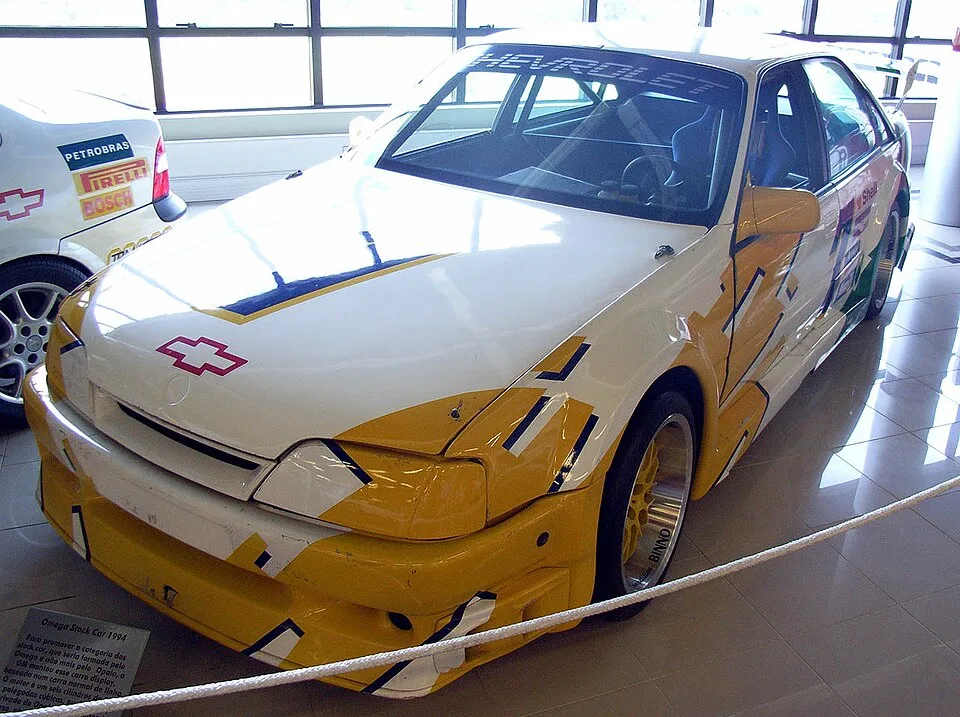
When German production of the Omega ended, Chevrolet do Brasil kept it alive with a locally-built 4.1-litre straight-six — tuned by Lotus.
Lead trim: Omega A 2.2 I4 (GLS; 1995–1998; 116 PS) · up to 166 hp
Chevrolet Omega AOMEGA-A · 1992–1998
- 0spots by members
- Unclaimednobody has spotted one yet
- 0sets it belongs to
Nobody in Burbles has spotted a Chevrolet Omega A yet. See one on the street, point the app at it, and the first card is yours — with your @handle permanently credited on this page.
FactWhen German production of the Omega ended, Chevrolet do Brasil kept it alive with a locally-built 4.1-litre straight-six — tuned by Lotus.
The Chevrolet Omega is an executive car sold by Chevrolet for the Brazilian market, replacing the Opala; the original Omega A was based on the Opel Omega A and built locally at São Caetano do Sul from 1992 to 1998. It debuted in 1992 with a choice of a 2.0-liter four-cylinder (GLS and GL trim) and a 3.0-liter six-cylinder (CD trim); from 1995, after the Omega A was discontinued in Germany, the engines were upgraded to a 2.2-liter four (GLS) and a 4.1 L (250 cu in) Chevrolet straight-six (CD), as used in the Opala but tuned by Lotus and with electronic multiport fuel injection added. Sedan and station wagon (Omega Suprema) bodies were offered, the wagon sharing the exact powertrain and trims; some funeral parlor owners chose the Suprema for hearse conversions, and the CD could be had with the 4L30-E automatic. General Motors do Brasil fitted bigger engines suited to the local gasoline quality and beefed up the suspension for Brazilian roads, and the car served as a presidential state car under Fernando Henrique Cardoso and Luiz Inácio Lula da Silva. Wheelbase 107.5 in, width 69.8 in; the length (184.5 in sedan, 186.2 in Suprema), height (56.9 in, 58.3 in) and curb weight (2,535 lb) are not tied to an engine and are not entered.
Collectors Spotted in the Chevrolet Omega Lineage
No member has published a public street spot of the Chevrolet Omega yet — the First · Worldwide stamp is wide open.
Trims & Figures
4 published trims in the catalogue. A blank is a figure not recorded, not zero.
| Trim | Years | Engine | Power | Torque | 0–60 | Drive | Gearbox | MSRP |
|---|---|---|---|---|---|---|---|---|
| Omega A 2.0 I4 (GLS/GL; 1992–1995; 116 PS) | 1992–1995 | 2.0 L Inline-4 | 114 hp | 125 lb-ft | — | RWD | — | — |
| Omega A 2.2 I4 (GLS; 1995–1998; 116 PS) | 1995–1998 | 2.2 L Inline-4 | 114 hp | 145 lb-ft | — | RWD | — | — |
| Omega A 3.0 I6 (CD; 1992–1995; 165 PS) | 1992–1995 | 3.0 L Inline-6 | 163 hp | 170 lb-ft | — | RWD | — | — |
| Omega A 4.1 (250) I6 (CD; 1995–1998; 168 PS, Lotus-tuned) | 1995–1998 | 4.1 L Inline-6 | 166 hp | 210 lb-ft | — | RWD | — | — |
Owning one
We don’t estimate running costs for a car like this. What it costs depends on its condition, its specialist and how it is driven, and an average would mislead.
Owners’ builds
Nobody has claimed one yet.
Photographs
When Brazil's Omega came back in 2010, the first 600 units were a special "Fittipaldi Edition," named for 1970s Formula One world champion Emerson Fittipaldi.
This Australian-built Holden wearing Chevrolet badges wasn't just a Brazilian family car: it served as Brazil's presidential state car, carrying both Cardoso and Lula.
When German production of the Omega ended, Chevrolet do Brasil kept it alive with a locally-built 4.1-litre straight-six — tuned by Lotus.
Rivals
Same body, same money, other badges — tap any card to flip.

It briefly served as senior sibling to Marquette, a GM companion brand cancelled after just one year.

Nissan hired former BMW engineers to help develop the 510's suspension, which is why period reviewers frequently compared its handling to the BMW 1600/2002.

A Trabant 601 won its class at the 1970 Monte Carlo Rally, with a second 601 right behind it in second.

The 600 was a stopgap: the P50's body over the 601's mechanicals, and for a while its estate was built alongside the new 601 saloon.

The G80 Sport brought a 370 PS twin-turbo 3.3 V6, a mesh grille and copper-tinted chrome with copper stitching to match.

The Vigor was sold only with a five-cylinder engine, an unusual configuration Honda used to fit a longer engine transversely under a short hood.

The GS/E coupe earned the nickname "German Charger" for its long hood, short deck stance borrowed from Detroit muscle cars.

This DeVille/Fleetwood was the first production car anywhere to mount its V8 sideways, Cadillac's front-drive gamble on the new C-body.