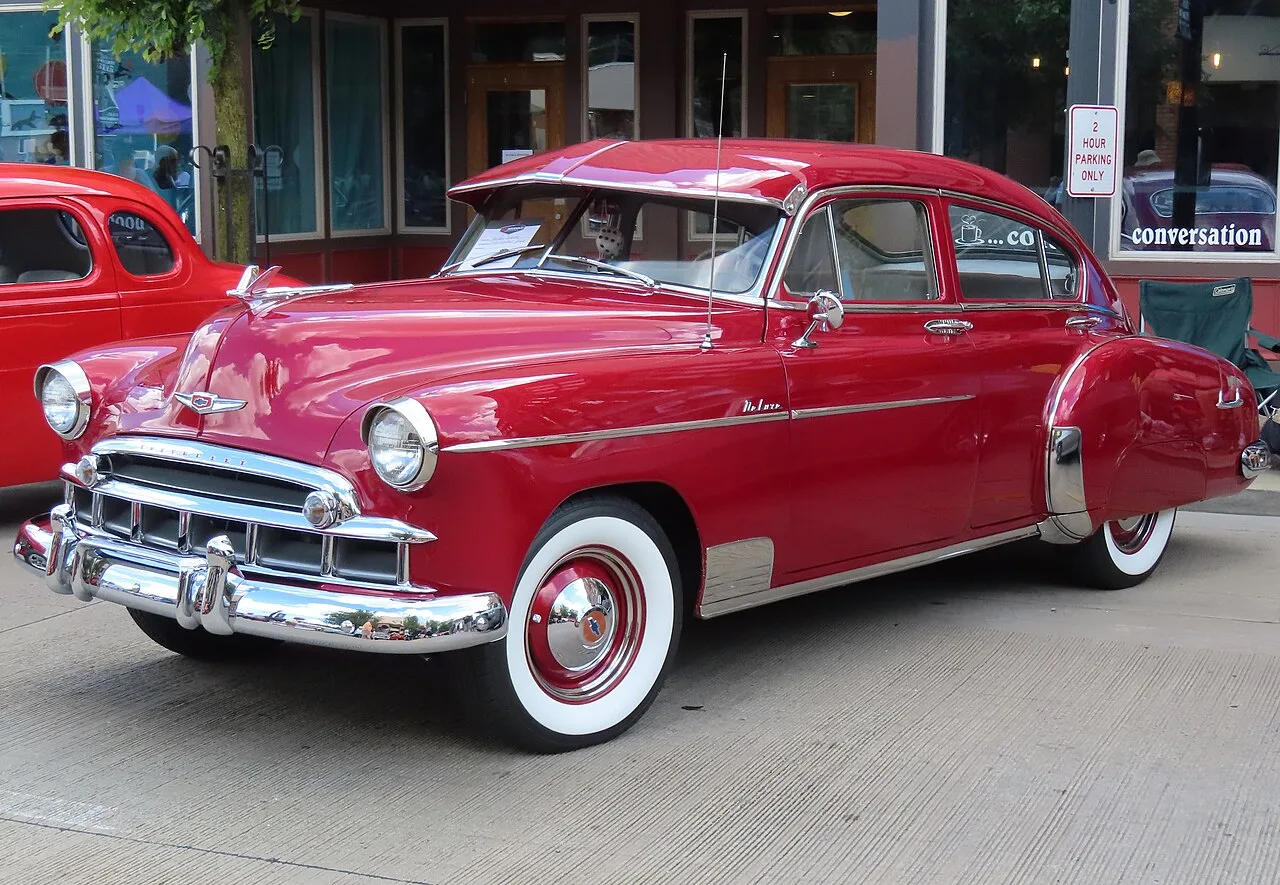
Fleetline production was halted mid-1942 for the war after just 110,000 built, with a handful of wartime coupes reserved for military staff.
Median 90 hp across 154 similar cars
Lead trim: Fleetline 216 I6 (1941–1942; 90 hp at 3,300 rpm) · up to 105 hp
Chevrolet FleetlineFLEETLINE-1941 · 1941–1952
- 0spots by members
- Unclaimednobody has spotted one yet
- 0sets it belongs to
Nobody in Burbles has spotted a Chevrolet Fleetline yet. See one on the street, point the app at it, and the first card is yours — with your @handle permanently credited on this page.
FactFleetline production was halted mid-1942 for the war after just 110,000 built, with a handful of wartime coupes reserved for military staff.
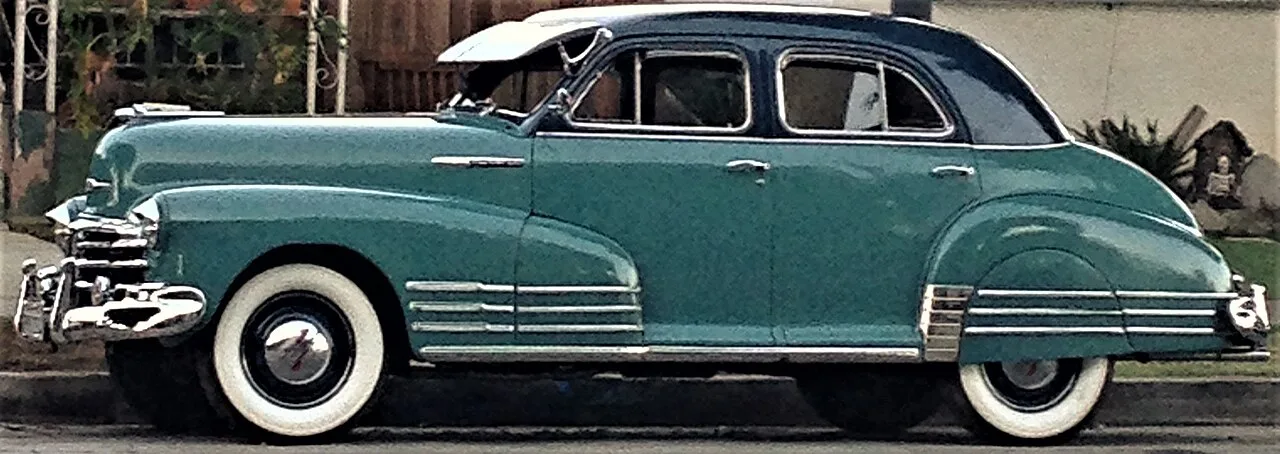
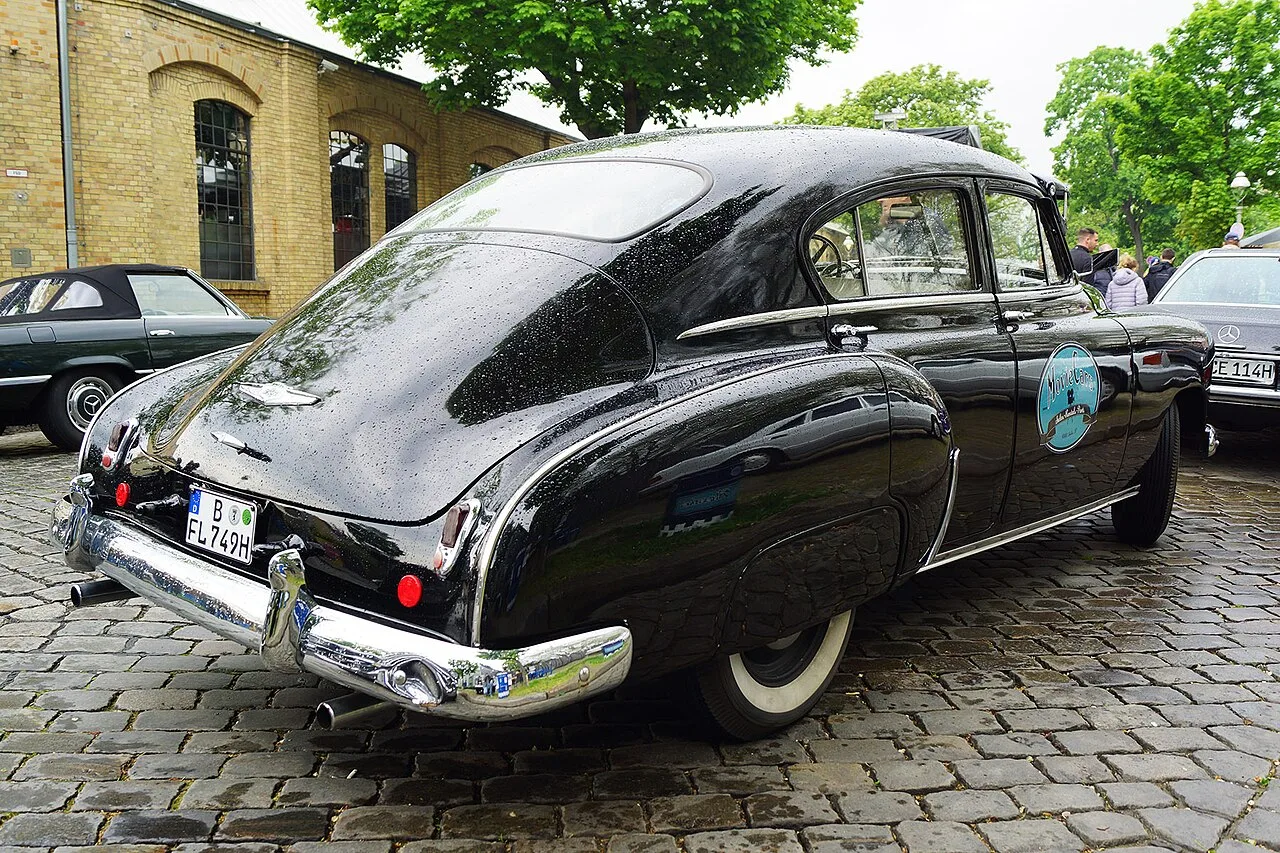
The Chevrolet Special Deluxe Series AH Fleetline was produced by Chevrolet from 1941 to 1952; from 1946 to 1948 it was a sub-series of the Fleetmaster rather than of the Special Deluxe, from 1949 to 1951 a sub-series of both the Special and the Deluxe, and in its final year of the Deluxe only. It was introduced late in the 1941 model year as a four-door sedan only; in 1942 a fastback two-door "Aerosedan" was also offered while the sedan was renamed "Sport Master". Production was deferred indefinitely in 1942 for the war after 110,000 had been made, though several thousand coupes and sedans were built during the war years for military staff, and civilian production resumed in 1945. For 1949 through 1952 the fastback was the only model offered, and Chevrolet dropped the Fleetline for 1953: the redesigned 1949 to 1952 Fleetline had reduced body contour and integrated rear fenders, a sloping roof extending to the trunk lid, a lower look than a sedan with a windshield one inch shorter in 1949 and 1950, and four-door and two-door bodies through 1951 with only the lower part of the doors interchangeable with a sedan door. By 1952 it was reduced to one model, the Deluxe 2-door sedan, of which 37,164 were built against 215,417 Styleline equivalents and a fifth of the 1950 high of 189,509. In 1941 and 1942 the 216 cubic inch inline-six was the only engine, producing 90 horsepower at 3,300 rpm; in 1950 higher compression increased it to 92 horsepower and a 235.5 cubic inch single-barrel six producing 105 hp was added, the page dating only the start of each. A synchromesh three-speed manual was standard, an automatic was offered from 1950 through 1952 and overdrive was a rare option, with hydraulic drum brakes all round (larger in 1951). The infobox gives a wheelbase of 115 in, length 197 in, width 74 in and curb weight 3,155 lb without saying for which years, and the Fleetmaster and Stylemaster pages give 116 in for 1946 to 1948, so no dimensions are entered. The page gives no displacement in litres for the 235.5.
Collectors Spotted in the Chevrolet Fleetline Lineage
No member has published a public street spot of the Chevrolet Fleetline yet — the First · Worldwide stamp is wide open.
Trims & Figures
3 published trims in the catalogue. A blank is a figure not recorded, not zero.
| Trim | Years | Engine | Power | Torque | 0–60 | Drive | Gearbox | MSRP |
|---|---|---|---|---|---|---|---|---|
| Fleetline 216 I6 (1941–1942; 90 hp at 3,300 rpm) | 1941–1942 | 3.5 L Inline-6 | 90 hp | 174 lb-ft | — | RWD | — | — |
| Fleetline 216 I6 higher compression (1950; 92 hp) | 1950–1950 | 3.5 L Inline-6 | 92 hp | 176 lb-ft | — | RWD | — | — |
| Fleetline 235.5 I6 single-barrel (1950–1952; 105 hp) | 1950–1952 | Inline-6 | 105 hp | 193 lb-ft | — | RWD | — | — |
Owning one
We don’t estimate running costs for a car like this. What it costs depends on its condition, its specialist and how it is driven, and an average would mislead.
Owners’ builds
Nobody has claimed one yet.
Photographs
Rivals
Same body, same money, other badges — tap any card to flip.

It briefly served as senior sibling to Marquette, a GM companion brand cancelled after just one year.

Nissan hired former BMW engineers to help develop the 510's suspension, which is why period reviewers frequently compared its handling to the BMW 1600/2002.

A Trabant 601 won its class at the 1970 Monte Carlo Rally, with a second 601 right behind it in second.

The 600 was a stopgap: the P50's body over the 601's mechanicals, and for a while its estate was built alongside the new 601 saloon.

The G80 Sport brought a 370 PS twin-turbo 3.3 V6, a mesh grille and copper-tinted chrome with copper stitching to match.

The Vigor was sold only with a five-cylinder engine, an unusual configuration Honda used to fit a longer engine transversely under a short hood.

The GS/E coupe earned the nickname "German Charger" for its long hood, short deck stance borrowed from Detroit muscle cars.

This DeVille/Fleetwood was the first production car anywhere to mount its V8 sideways, Cadillac's front-drive gamble on the new C-body.