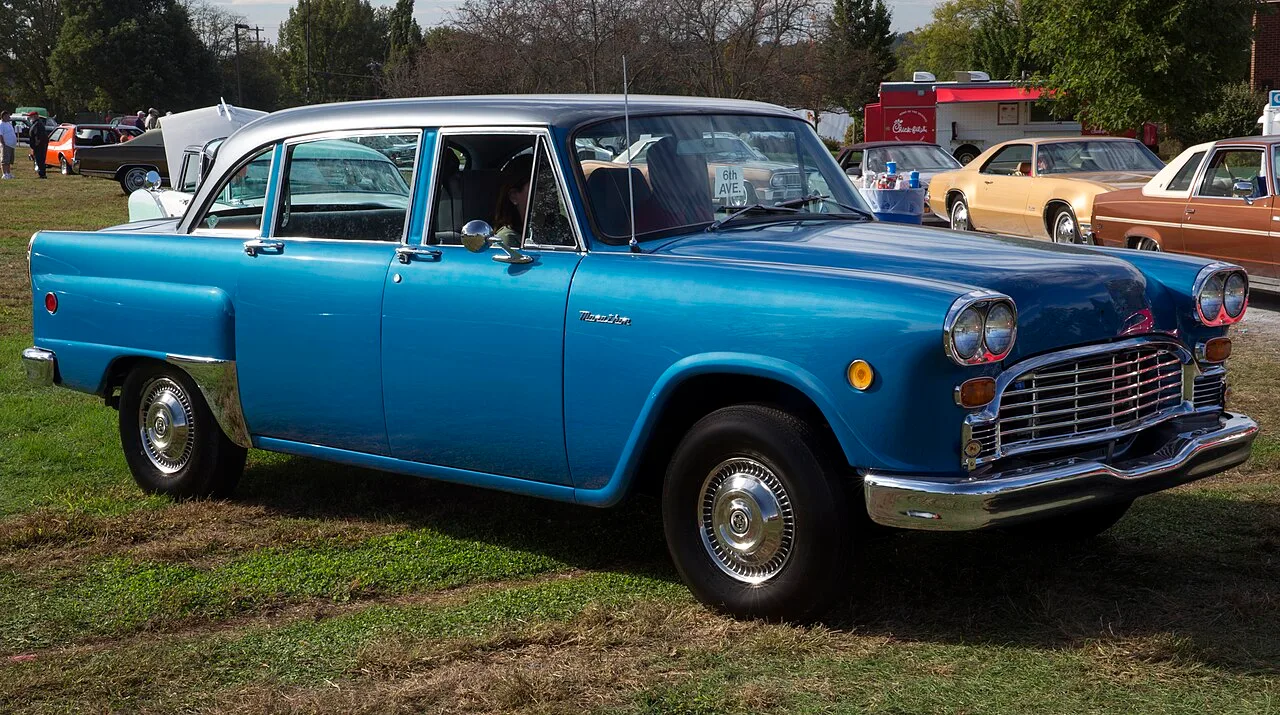
Hollywood used the boxy Checker Marathon as a Soviet stand-in, dressing it up as a GAZ-13 Chaika in Cold War-era films and TV like Gorky Park and Mission: Impossible.
Lead trim: Marathon Continental L-head I6 226 cu in (80 hp at 3,100 rpm, 1961–1964) · up to 300 hp
Checker MarathonA12 · 1960–1982
- 0spots by members
- Unclaimednobody has spotted one yet
- 0sets it belongs to
Nobody in Burbles has spotted a Checker Marathon yet. See one on the street, point the app at it, and the first card is yours — with your @handle permanently credited on this page.
FactHollywood used the boxy Checker Marathon as a Soviet stand-in, dressing it up as a GAZ-13 Chaika in Cold War-era films and TV like Gorky Park and Mission: Impossible.
The Checker Marathon was produced by the Checker Motors Corporation of Kalamazoo, Michigan between September 1960 and 1982 (model years 1961–1982; designer Ray Dietrich), marketed as a passenger car for consumers as opposed to the similar fleet Taxi, as a four-door sedan and five-door station wagon and the rarer six-door 9-seater and eight-door 12-seater Aerobus; the 1963 Marathon Town Custom limousine (A19E) had a 129 in wheelbase and seated eight and A12 Marathons carried Pope Paul VI's entourage. Engines were Continental L-head inline sixes (OHV for the wagons), swapped for Chevrolet sixes and small-block V8s for 1965 (mid-1964 change), peaking with the 1969 L-48 350 V8 at 300 hp (gross); a Perkins 3.9 L four-cylinder diesel was an option for one year in 1969, the 350 fell to 145 hp by 1973, catalytic converters arrived in 1975 and for 1980 the lineup changed to a 3.8-litre V6, a smaller 4.4 L standard V8 and an Oldsmobile LF9 5.7 L diesel V8. Wheelbase 120 in (129 in limousine).
Collectors Spotted in the Checker Marathon Lineage
No member has published a public street spot of the Checker Marathon yet — the First · Worldwide stamp is wide open.
Trims & Figures
7 published trims in the catalogue. A blank is a figure not recorded, not zero.
| Trim | Years | Engine | Power | Torque | 0–60 | Drive | Gearbox | MSRP |
|---|---|---|---|---|---|---|---|---|
| Marathon Chevrolet L-48 350 V8 (300 hp gross, 1969) | 1969–1969 | V8 | 300 hp | 380 lb-ft | — | RWD | — | — |
| Marathon Chevrolet OHV I6 230 cu in (140 hp at 4,400 rpm, 1965–1968) | 1965–1968 | 3.8 L Inline-6 | 140 hp | 220 lb-ft | — | RWD | — | — |
| Marathon Chevrolet OHV I6 250 cu in 2-bbl (155 hp at 4,200 rpm, 1969–1970) | 1969–1970 | 4.1 L Inline-6 | 155 hp | 235 lb-ft | — | RWD | — | — |
| Marathon Chevrolet OHV V6 229 cu in (115 hp at 4,000 rpm, 1980) | 1980–1980 | 3.8 L V6 | 115 hp | — | — | RWD | — | — |
| Marathon Continental L-head I6 226 cu in (80 hp at 3,100 rpm, 1961–1964) | 1961–1964 | 3.7 L Inline-6 | 80 hp | — | — | RWD | — | — |
| Marathon Continental OHV I6 226 cu in 2-bbl (141 hp at 4,400 rpm, 1963–1964) | 1963–1964 | 3.7 L Inline-6 | 141 hp | — | — | RWD | — | — |
| Marathon Continental OHV I6 226 cu in station wagon (122 hp at 4,000 rpm, 1961–1962) | 1961–1962 | 3.7 L Inline-6 | 122 hp | — | — | RWD | — | — |
Owning one
We don’t estimate running costs for a car like this. What it costs depends on its condition, its specialist and how it is driven, and an average would mislead.
Owners’ builds
Nobody has claimed one yet.
Photographs
Rivals
Same body, same money, other badges — tap any card to flip.

It briefly served as senior sibling to Marquette, a GM companion brand cancelled after just one year.

Nissan hired former BMW engineers to help develop the 510's suspension, which is why period reviewers frequently compared its handling to the BMW 1600/2002.

A Trabant 601 won its class at the 1970 Monte Carlo Rally, with a second 601 right behind it in second.

The 600 was a stopgap: the P50's body over the 601's mechanicals, and for a while its estate was built alongside the new 601 saloon.

The G80 Sport brought a 370 PS twin-turbo 3.3 V6, a mesh grille and copper-tinted chrome with copper stitching to match.

The Vigor was sold only with a five-cylinder engine, an unusual configuration Honda used to fit a longer engine transversely under a short hood.

The GS/E coupe earned the nickname "German Charger" for its long hood, short deck stance borrowed from Detroit muscle cars.

This DeVille/Fleetwood was the first production car anywhere to mount its V8 sideways, Cadillac's front-drive gamble on the new C-body.