Cadillac's cross-plane crankshaft was so hard to engineer that a rival, Peerless, patented the same idea at the same time — so the two companies just agreed to share it.
Median 52 hp across 73 similar cars
Lead trim: Series 341 341 cu in L-head V8 (1928–1929)
Cadillac V-63 / Series 314 / 341 / 3531924–1931
- 0spots by members
- Unclaimednobody has spotted one yet
- 0sets it belongs to
Nobody in Burbles has spotted a Cadillac V-63 / Series 314 / 341 / 353 yet. See one on the street, point the app at it, and the first card is yours — with your @handle permanently credited on this page.
FactCadillac's cross-plane crankshaft was so hard to engineer that a rival, Peerless, patented the same idea at the same time — so the two companies just agreed to share it.
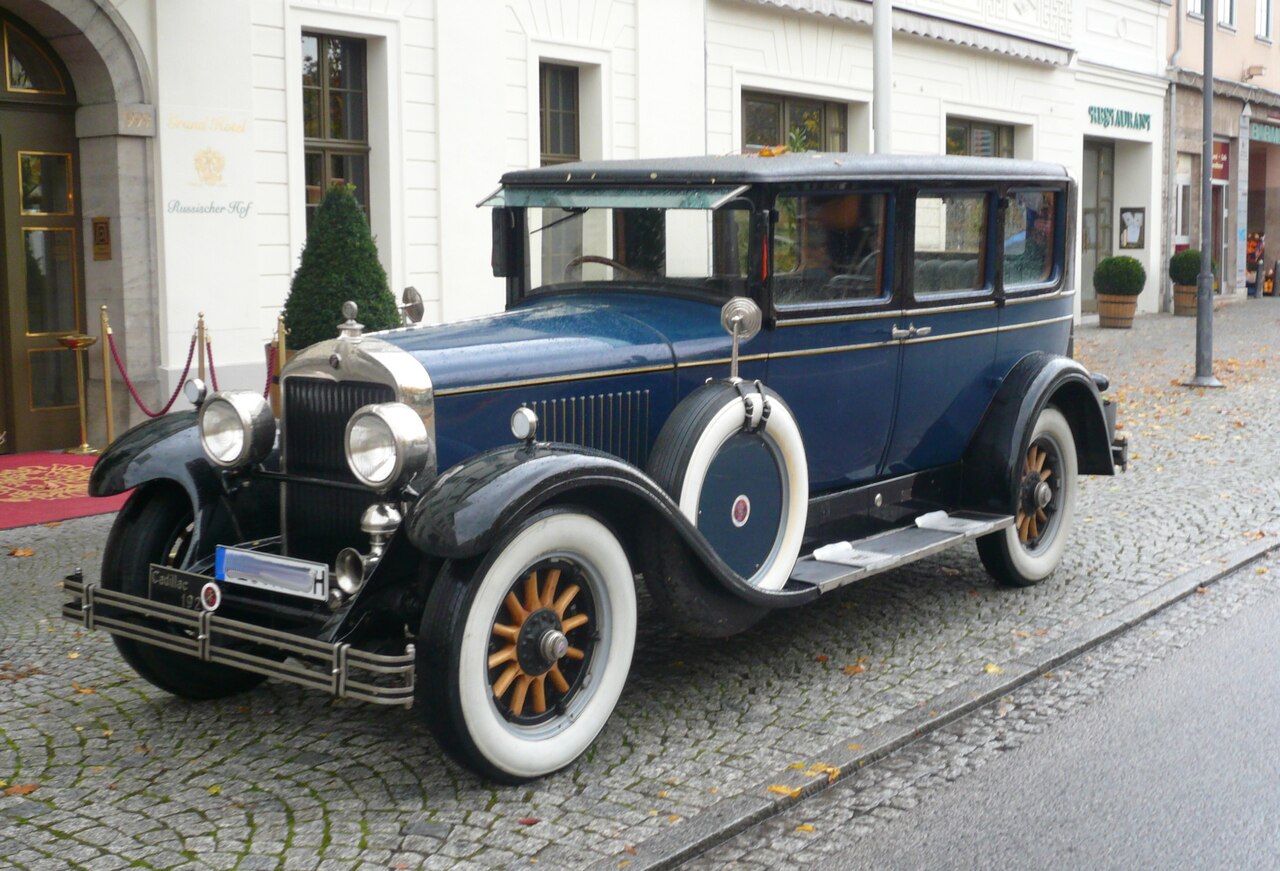
The Cadillac V-63 is a large luxury automobile introduced in September 1923 as a 1924 model, replacing the Type 61, on the GM C platform; it was replaced by the Series 355 in 1931 and retained the name Cadillac V8. It used an improved version of the L-head V8 whose main innovation was a cross-plane crankshaft that improved balance and smoothness (simultaneously patented by Peerless; both companies agreed to share the innovation), and body style choices were expanded to 14 with balloon tires and front-wheel brakes available for 1924. For 1925 "Standard" and higher-content "Custom" bodies were offered (retail prices from US$2,995 for the Brougham to US$4,485 for the top Imperial limousine), with Duco lacquer paint giving a choice of 24 matched colors. The naming convention was refreshed for 1926 as the Series 314 (signifying the engine displacement), with a further enlargement to 341 in 1928 (the first displacement upgrade since the engine's 1915 introduction; Series 341-A) and the 1929 Series 341-B introducing a synchromesh transmission, Security-Plate safety glass and electric windshield wipers; the "New Ninety Degree Cadillac" shared chassis, body and engineering with the all-new LaSalle Series 303, and Fleetwood Metal Body began supplementing coachwork in 1927. September 1929 saw the all-new 1930 Series 353. Engines: 314 cu in (5.1 L), 341 cu in (5.6 L) and 353 cu in (5.8 L) L-head V8s with a 3-speed synchromesh manual; wheelbases of 132, 138, 140, 145, 150 and 152 in. The page gives no horsepower ratings.
Collectors Spotted in the Cadillac V-63 Lineage
No member has published a public street spot of the Cadillac V-63 yet — the First · Worldwide stamp is wide open.
Trims & Figures
3 published trims in the catalogue. A blank is a figure not recorded, not zero.
| Trim | Years | Engine | Power | Torque | 0–60 | Drive | Gearbox | MSRP |
|---|---|---|---|---|---|---|---|---|
| Series 314 314 cu in L-head V8 (1926–1927) | 1926–1927 | 5.1 L V8 | — | — | — | RWD | — | — |
| Series 341 341 cu in L-head V8 (1928–1929) | 1928–1929 | 5.6 L V8 | 90 hp | — | — | RWD | — | — |
| Series 353 353 cu in L-head V8 (1930) | 1930–1930 | 5.8 L V8 | — | — | — | RWD | — | — |
Owning one
We don’t estimate running costs for a car like this. What it costs depends on its condition, its specialist and how it is driven, and an average would mislead.
Owners’ builds
Nobody has claimed one yet.
Photographs
Rivals
Same body, same money, other badges — tap any card to flip.

It briefly served as senior sibling to Marquette, a GM companion brand cancelled after just one year.

Nissan hired former BMW engineers to help develop the 510's suspension, which is why period reviewers frequently compared its handling to the BMW 1600/2002.

A Trabant 601 won its class at the 1970 Monte Carlo Rally, with a second 601 right behind it in second.

The 600 was a stopgap: the P50's body over the 601's mechanicals, and for a while its estate was built alongside the new 601 saloon.

The G80 Sport brought a 370 PS twin-turbo 3.3 V6, a mesh grille and copper-tinted chrome with copper stitching to match.

The Vigor was sold only with a five-cylinder engine, an unusual configuration Honda used to fit a longer engine transversely under a short hood.

The GS/E coupe earned the nickname "German Charger" for its long hood, short deck stance borrowed from Detroit muscle cars.

This DeVille/Fleetwood was the first production car anywhere to mount its V8 sideways, Cadillac's front-drive gamble on the new C-body.