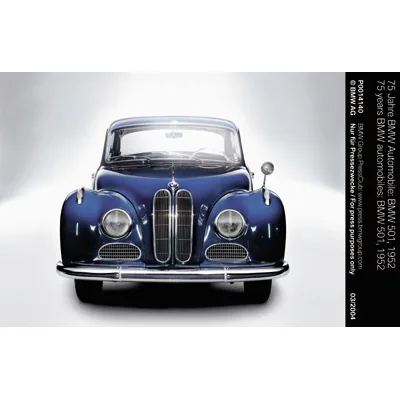
BMW's 501 mounted its four-speed gearbox away from the engine, on its own shaft-driven mount — a trade that made the shifter vague but bought the front passengers real extra legroom.
Median 97 hp across 238 similar cars
Lead trim: 501A / 501B (M337/2 2.0 I6) · up to 71 hp
BMW 501 (Baroque Angel)501 · 1952–1958
- 0spots by members
- Unclaimednobody has spotted one yet
- 0sets it belongs to
Nobody in Burbles has spotted a BMW 501 (Baroque Angel) yet. See one on the street, point the app at it, and the first card is yours — with your @handle permanently credited on this page.
FactBMW's 501 mounted its four-speed gearbox away from the engine, on its own shaft-driven mount — a trade that made the shifter vague but bought the front passengers real extra legroom.
The BMW 501 was a luxury car manufactured by BMW from 1952 to 1958, introduced to the public at the 1951 Frankfurt Motor Show; it was the first BMW model manufactured and sold after the Second World War and the first BMW automobile actually built in Bavaria. The German public nicknamed the 501 and its derivatives "Barockengel" (Baroque Angel) for their graceful if dated styling, designed in house by Peter Szymanowski (a Pininfarina prototype was thought too similar to the Alfa Romeo 1900). It was an all-new platform with a perimeter frame, double A-arm front suspension with torsion bar springs and a live axle with torsion bar springs at the rear, steering similar to rack and pinion but with a semi-circular rack, and a 2-litre straight-six OHV M337 engine developed from the pre-war 326's M78; the four-speed gearbox was a separate shaft-driven unit mounted between the second and third crossmembers, which gave vague shifter action but more front legroom. The steel body was heavier than calculated, so the finished car had a dry weight of 1,430 kg (3,150 lb), a top speed of 135 km/h (84 mph) and a 100 km/h time of 27 seconds, which compared unfavourably with the six-cylinder Mercedes-Benz 220; its list price of more than fifteen thousand Deutsche Mark was about four times the average yearly salary in Germany. Development issues delayed production until late 1952, and the first 2,045 four-door saloon bodies were built by Karosserie Baur and shipped to Munich for assembly; coupé and convertible versions were custom orders from Baur or Autenrieth. The 501A of 1954 cost DM14,180, more than DM800 less than the original, the 501B was decontented at DM500 below that, and both used a revised M337; in spring 1955 they were replaced by the 501/3 with an updated M337 (built to 1958, when the six-cylinder engine and the 501 designation were discontinued). Built: 501 2,125 (1952–1954), 501A and 501B 3,327 (1954–1955), 501/3 3,459 (1955–1958). Wheelbase 2,835 mm (111.6 in), length 4,730 mm (186 in), width 1,780 mm (70 in), height 1,530 mm (60 in). The page gives no power figure for the six-cylinder cars.
Collectors Spotted in the BMW 501 (Baroque Angel) Lineage
No member has published a public street spot of the BMW 501 (Baroque Angel) yet — the First · Worldwide stamp is wide open.
Trims & Figures
3 published trims in the catalogue. A blank is a figure not recorded, not zero.
| Trim | Years | Engine | Power | Torque | 0–60 | Drive | Gearbox | MSRP |
|---|---|---|---|---|---|---|---|---|
| 501 (M337/1 2.0 I6) | 1952–1954 | 2.0 L Inline-6 | 64 hp | 95 lb-ft | — | RWD | — | — |
| 501/3 (M337/3 2.1 I6) | 1955–1958 | 2.1 L Inline-6 | 71 hp | — | — | RWD | — | — |
| 501A / 501B (M337/2 2.0 I6) | 1954–1955 | 2.0 L Inline-6 | 64 hp | — | — | RWD | — | — |
Owning one
We don’t estimate running costs for a car like this. What it costs depends on its condition, its specialist and how it is driven, and an average would mislead.
Owners’ builds
Nobody has claimed one yet.
Photographs
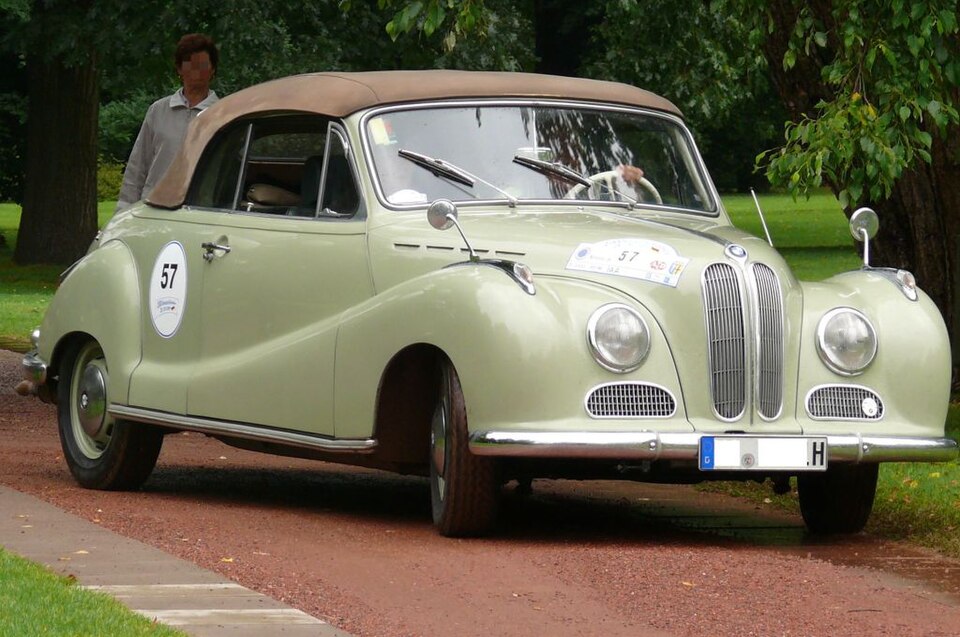
BMW's six-cylinder 501 was so slow that police on the autobahn got the V8 instead: traffic units on country roads and motorways were issued V8-powered cars specifically because they were faster.
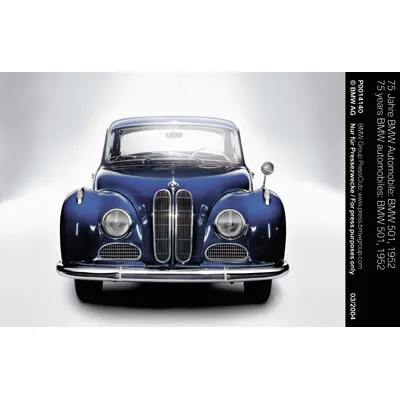
BMW's 501 mounted its four-speed gearbox away from the engine, on its own shaft-driven mount — a trade that made the shifter vague but bought the front passengers real extra legroom.
Rivals
Same body, same money, other badges — tap any card to flip.

It briefly served as senior sibling to Marquette, a GM companion brand cancelled after just one year.

Nissan hired former BMW engineers to help develop the 510's suspension, which is why period reviewers frequently compared its handling to the BMW 1600/2002.

A Trabant 601 won its class at the 1970 Monte Carlo Rally, with a second 601 right behind it in second.

The 600 was a stopgap: the P50's body over the 601's mechanicals, and for a while its estate was built alongside the new 601 saloon.

The G80 Sport brought a 370 PS twin-turbo 3.3 V6, a mesh grille and copper-tinted chrome with copper stitching to match.

The Vigor was sold only with a five-cylinder engine, an unusual configuration Honda used to fit a longer engine transversely under a short hood.

The GS/E coupe earned the nickname "German Charger" for its long hood, short deck stance borrowed from Detroit muscle cars.

This DeVille/Fleetwood was the first production car anywhere to mount its V8 sideways, Cadillac's front-drive gamble on the new C-body.