Several early Princess saloons got an unglamorous second act: converted into taxis in the late 1950s and fitted with Perkins diesel engines to save on fuel.
Median 93 hp across 228 similar cars
Lead trim: Princess 3.5 D-Series six (3460 cc) · up to 130 hp
Austin Princess (A120/A135)1947–1956
- 0spots by members
- Unclaimednobody has spotted one yet
- 0sets it belongs to
Nobody in Burbles has spotted a Austin Princess (A120/A135) yet. See one on the street, point the app at it, and the first card is yours — with your @handle permanently credited on this page.
FactSeveral early Princess saloons got an unglamorous second act: converted into taxis in the late 1950s and fitted with Perkins diesel engines to save on fuel.
The first Austin Princess A120 was launched in 1947 as the most expensive flagship model in the Austin range, alongside the A110 Sheerline built on the same chassis at Longbridge; the Princess had a body by Vanden Plas at their Kingsbury works and a higher-specification leather, wool and burr-walnut interior. It came as a saloon ("DS") or limousine ("DM") with a sliding glass partition and picnic tables; the standard saloon weighed almost two tons, was 16 ft 9 in long and 6 ft 1¼ in wide on a 10 ft 1¼ in short wheelbase, and the model was updated through Mark I (A120, 1947–1950), Mark II (A135, 1950–1953) and Mark III (1953–1956), the biggest variation being the 1952 long-wheelbase seven-seat version. The engine was a 3.5-litre straight-six, enlarged to a 4.0-litre unit without further modifications (D-Series 3460 cc and 3991 cc); customers could specify triple or single carburettors and twin or single exhausts, the sportier multi-carb version returning only 12 to 14 mpg. Performance was good for its size, with a top speed of 90 mph and 0–60 mph in 20 seconds. Many saloons were converted to taxis in the late 1950s with Perkins diesels, and the D-Series 3993 cc six was also a rarely taken petrol option in the Austin and Morris WEK and WFK commercial vehicles. Production was Princess I DM2 57 / DS2 743, Princess III DM5 51 / DS5 299 (Mark II unknown). From August 1957 the Austin part of the badging was dropped so Nuffield dealers could sell it as "Princess". The page does not say which engine went with which mark, so both trims carry the generation span.
Collectors Spotted in the Austin Princess (A120/A135) Lineage
No member has published a public street spot of the Austin Princess (A120/A135) yet — the First · Worldwide stamp is wide open.
Trims & Figures
2 published trims in the catalogue. A blank is a figure not recorded, not zero.
| Trim | Years | Engine | Power | Torque | 0–60 | Drive | Gearbox | MSRP |
|---|---|---|---|---|---|---|---|---|
| Princess 3.5 D-Series six (3460 cc) | 1947–1956 | 3.5 L Inline-6 | 120 hp | 199 lb-ft | — | — | — | — |
| Princess 4.0 D-Series six (3991 cc) | 1947–1956 | 4.0 L Inline-6 | 130 hp | 210 lb-ft | — | — | — | — |
Owning one
We don’t estimate running costs for a car like this. What it costs depends on its condition, its specialist and how it is driven, and an average would mislead.
Owners’ builds
Nobody has claimed one yet.
Austin priced the flagship Princess IV at 6.5 times an Austin A30 — so far above the market that almost nobody bought one.
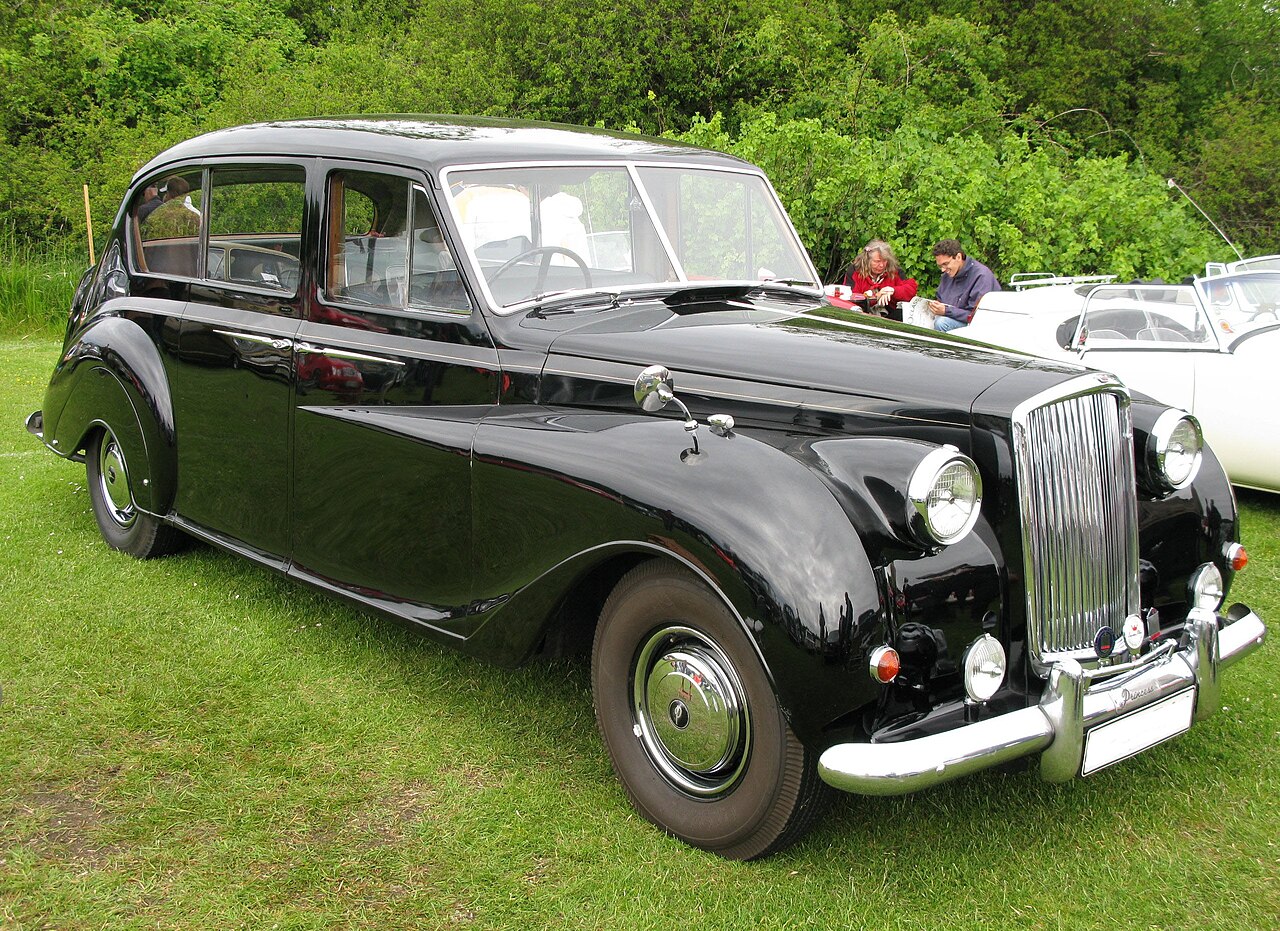
Austin's flagship limousine was no hot rod: a 1953 road test of the Princess Long-Wheelbase by The Motor clocked 0-60 mph in a leisurely 23.3 seconds.
Several early Princess saloons got an unglamorous second act: converted into taxis in the late 1950s and fitted with Perkins diesel engines to save on fuel.
Rivals
Same body, same money, other badges — tap any card to flip.

It briefly served as senior sibling to Marquette, a GM companion brand cancelled after just one year.

Nissan hired former BMW engineers to help develop the 510's suspension, which is why period reviewers frequently compared its handling to the BMW 1600/2002.

A Trabant 601 won its class at the 1970 Monte Carlo Rally, with a second 601 right behind it in second.

The 600 was a stopgap: the P50's body over the 601's mechanicals, and for a while its estate was built alongside the new 601 saloon.

The G80 Sport brought a 370 PS twin-turbo 3.3 V6, a mesh grille and copper-tinted chrome with copper stitching to match.

The Vigor was sold only with a five-cylinder engine, an unusual configuration Honda used to fit a longer engine transversely under a short hood.

The GS/E coupe earned the nickname "German Charger" for its long hood, short deck stance borrowed from Detroit muscle cars.

This DeVille/Fleetwood was the first production car anywhere to mount its V8 sideways, Cadillac's front-drive gamble on the new C-body.