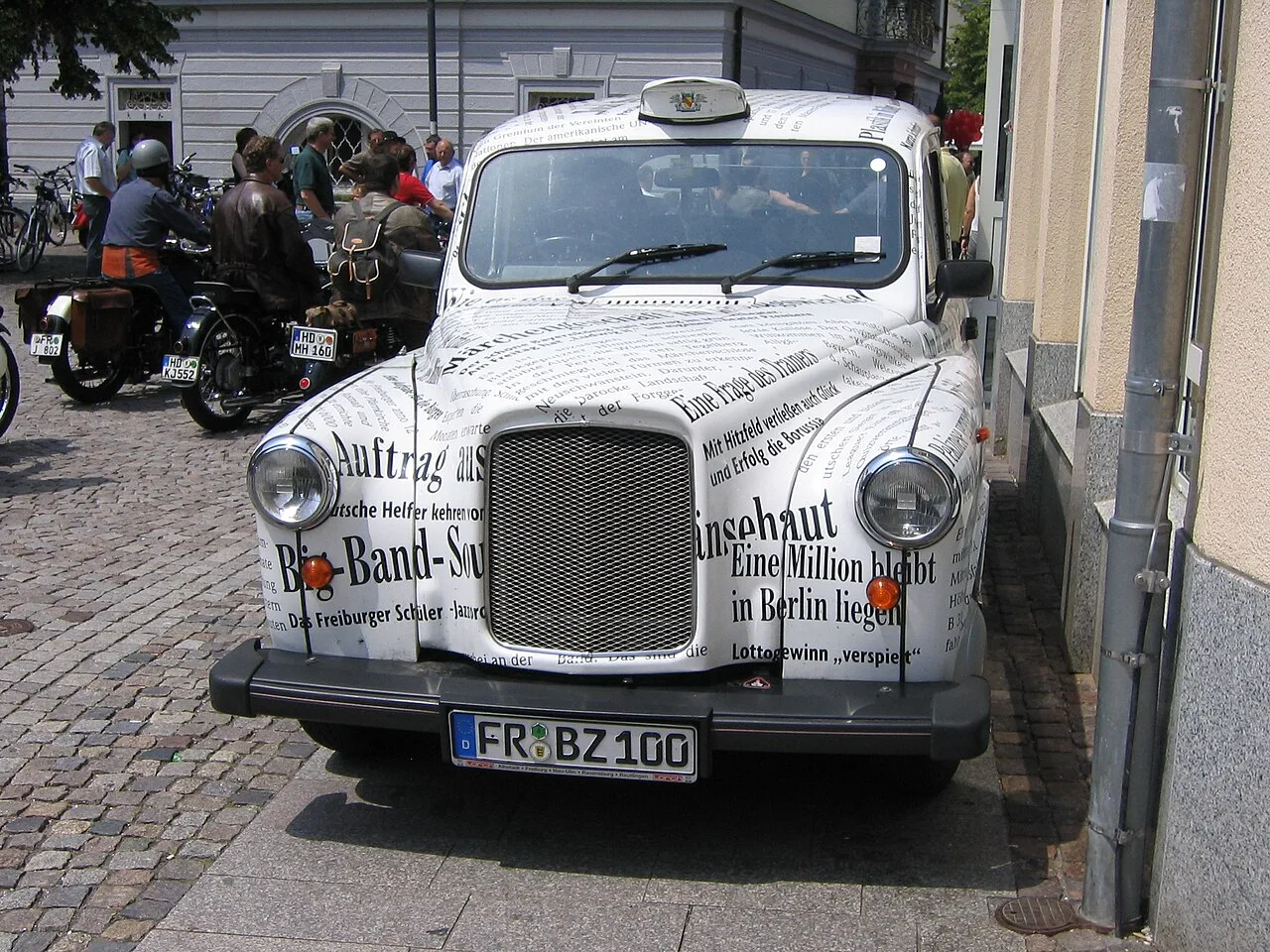
When the FX4R's successor flopped, Carbodies started rebuilding old taxi chassis instead of making new ones — and the law required these refurbished cabs to wear a special "Q" registration plate, not the current year's letter.
Median 103 hp across 377 similar cars
Lead trim: FX4Q 2.5 diesel (2520 cc) · up to 68 hp
Austin FX4R, FX4Q and FX4S1982–1989
- 0spots by members
- Unclaimednobody has spotted one yet
- 0sets it belongs to
Nobody in Burbles has spotted a Austin FX4R, FX4Q and FX4S yet. See one on the street, point the app at it, and the first card is yours — with your @handle permanently credited on this page.
FactWhen the FX4R's successor flopped, Carbodies started rebuilding old taxi chassis instead of making new ones — and the law required these refurbished cabs to wear a special "Q" registration plate, not the current year's letter.
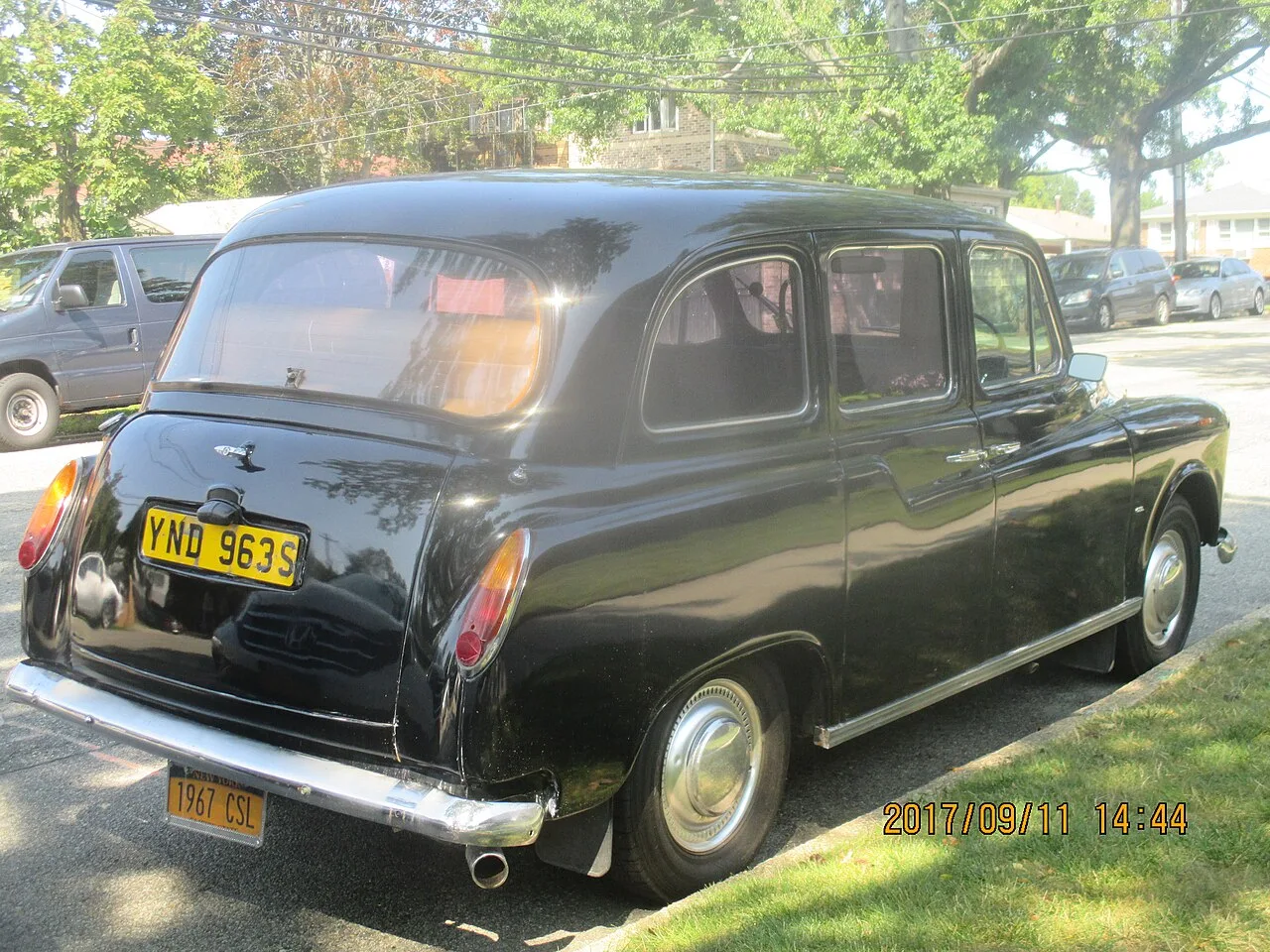
In 1982 Carbodies, who had been building the FX4 for Austin and Mann & Overton, took over the cab's intellectual property when British Leyland lost interest; with the old Austin engine unavailable after the closure of the Courthouse Green engine plant, they chose the Land Rover 2286 cc diesel (and offered the similar Land Rover petrol engine as an option) for the FX4R, "R" for Land Rover engined. It gained power steering, full servo brakes, an 85 mph top speed and lockable rear doors controlled by the driver, but its performance and reliability were poor and the cab gained a bad reputation; some proprietors fitted the Perkins/Mazda 2977 cc diesel, which improved performance dramatically but was noisy at idle. To regain lost sales Carbodies took old chassis and suspension components, refurbished them and fitted new bodywork and the original-type 2520 cc diesels re-imported from India: the FX4Q, registered with a Q prefix (the page dates it only by a 1985 photograph caption), all with automatic gearboxes but no power steering. In 1984 London Taxis International (LTI) was formed after Manganese Bronze Holdings bought Mann & Overton, and replaced the 2286 cc Land Rover diesel with a new 2495 cc version in the FX4S, with rocker switches, a stalk wiper control, draught-proofed doors and black rolled steel bumpers; a replacement, the CR6, was abandoned in 1985, so the FX4S was the stopgap. The FX4S-Plus of 1987 had a five-passenger rear compartment, grey trim and a Metro-derived dashboard, and the FX4W wheelchair conversion was available from early 1986.
Collectors Spotted in the Austin FX4 Lineage
No member has published a public street spot of the Austin FX4 yet — the First · Worldwide stamp is wide open.
Trims & Figures
3 published trims in the catalogue. A blank is a figure not recorded, not zero.
| Trim | Years | Engine | Power | Torque | 0–60 | Drive | Gearbox | MSRP |
|---|---|---|---|---|---|---|---|---|
| FX4Q 2.5 diesel (2520 cc) | 1985–1985 | 2.5 L | 57 hp | 109 lb-ft | — | — | — | — |
| FX4R 2.3 Land Rover diesel (2286 cc) | 1982–1984 | 2.3 L | — | — | — | — | — | — |
| FX4S 2.5 Land Rover diesel (2495 cc) | 1984–1987 | 2.5 L | 68 hp | 114 lb-ft | — | — | — | — |
Owning one
We don’t estimate running costs for a car like this. What it costs depends on its condition, its specialist and how it is driven, and an average would mislead.
Owners’ builds
Nobody has claimed one yet.
Photographs
The last Fairway wore the plate R1 PFX, read as RIP FX, and went straight to a museum instead of the road.
When the FX4R's successor flopped, Carbodies started rebuilding old taxi chassis instead of making new ones — and the law required these refurbished cabs to wear a special "Q" registration plate, not the current year's letter.
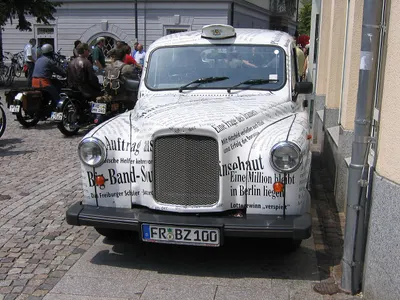
London's iconic black cab wasn't purely an Austin design — the taxi dealership that commissioned it, Mann & Overton, paid for half the development cost themselves.
Rivals
Same body, same money, other badges — tap any card to flip.

It briefly served as senior sibling to Marquette, a GM companion brand cancelled after just one year.

Nissan hired former BMW engineers to help develop the 510's suspension, which is why period reviewers frequently compared its handling to the BMW 1600/2002.

A Trabant 601 won its class at the 1970 Monte Carlo Rally, with a second 601 right behind it in second.

The 600 was a stopgap: the P50's body over the 601's mechanicals, and for a while its estate was built alongside the new 601 saloon.

The G80 Sport brought a 370 PS twin-turbo 3.3 V6, a mesh grille and copper-tinted chrome with copper stitching to match.

The Vigor was sold only with a five-cylinder engine, an unusual configuration Honda used to fit a longer engine transversely under a short hood.

The GS/E coupe earned the nickname "German Charger" for its long hood, short deck stance borrowed from Detroit muscle cars.

This DeVille/Fleetwood was the first production car anywhere to mount its V8 sideways, Cadillac's front-drive gamble on the new C-body.