

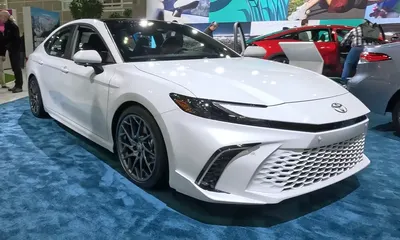

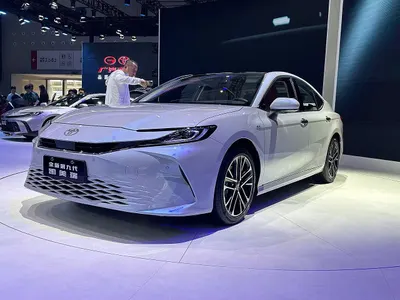
VerifiedFIRST PRINTPROThe XV70 Camry was the first Toyota of any kind to run Entune 3.0 — an infotainment system built on an open-source Linux OS, rather than Toyota's usual closed software.
Every Toyota Camry generation in the Burbles catalogue — complete specs, rarity tiers, interactive 3D cards, and the collectors who have spotted them on the street.
Spot a Toyota Camry on the street with the Burbles camera and keep its card in your binder — or claim your own build to your garage. Free on iOS and Android.
Each generation deals in its rarity tier’s alloy with its engine disc, lead specs, and first spotter record. Click into any generation for full trims and market figures.

After nine generations sold at home, Toyota finally built a Camry that Japan itself can't buy — the XV80 is assembled there purely for export.

The XV70 Camry was the first Toyota of any kind to run Entune 3.0 — an infotainment system built on an open-source Linux OS, rather than Toyota's usual closed software.

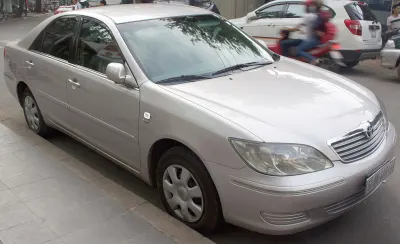
This Camry's shape was slippery enough to make it the most aerodynamic car built in Australia at the time — matching the record set by the Camry it replaced.

The XV40 Camry Hybrid's drag coefficient of 0.27 made it, at the time, the most aerodynamic car ever built in Australia.

This Camry had an unlikely second life as a Saudi drift car: enthusiasts there use it for "tafheet" (Arab drifting), a practice so hard on the chassis that rear suspension components have failed and thrown a wheel entirely.

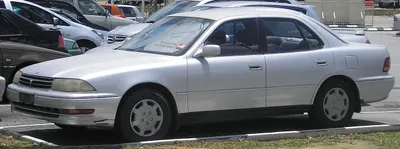
This Camry generation spawned a wagon twin sold as the Toyota Mark II Qualis — and in doing so broke a rule that had held for every Mark II before it: it's the only front-wheel-drive Mark II nameplate ever made.

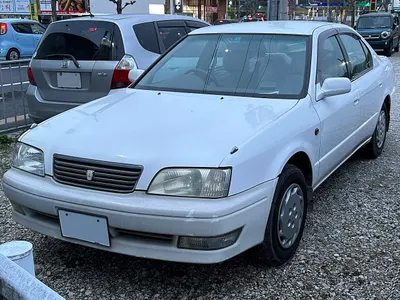
This Camry's exact footprint wasn't a styling call — Japanese-market V40 stuck to the legacy 4,700 x 1,700 mm bracket to stay inside the era's vehicle size tax law.

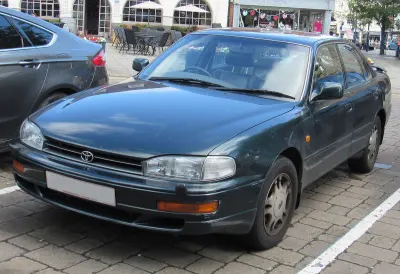
This Camry's rounded shape wasn't the Japanese design team's idea — American Toyota executives fought for it, arguing US roads and lawns demanded a different look.

This Camry stayed narrow on purpose: Japan's size-based car tax punished wide bodies, so while the rest of the world got the broader XV10 Camry, Japan kept the slim V30 just to dodge the bracket.

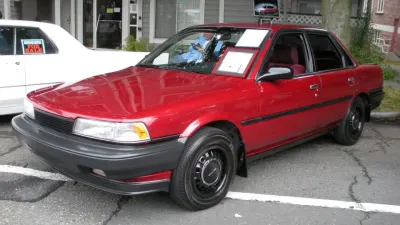
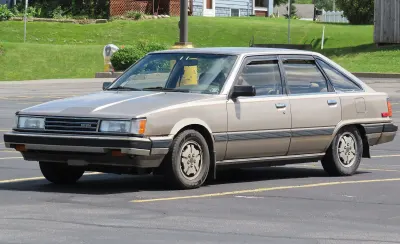
This V20 made history as the first Camry ever built outside Japan — and Toyota Australia got it on the line just six months after Japan started, the fastest localization yet.

"Camry" comes from the Japanese word for "crown" -- the same naming tradition behind the Toyota Crown, Corona, and Corolla.

The badge said Camry, but the face said something pricier — Toyota gave this Carina-based Celica Camry a front end styled after the Celica XX, sold abroad as the Celica Supra.
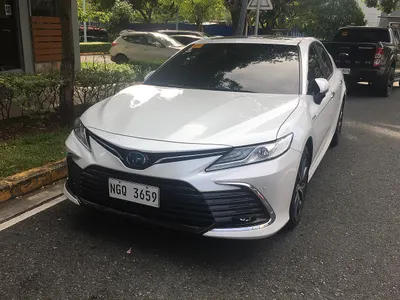
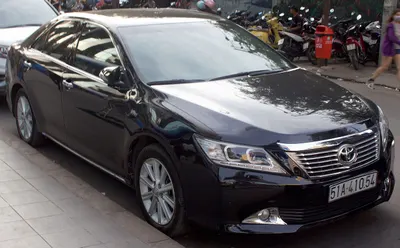
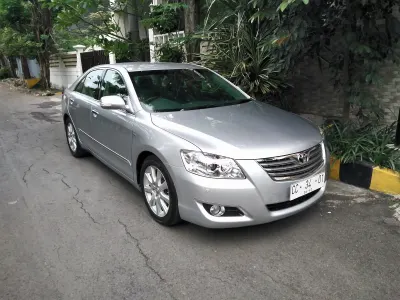
Real Toyota Camry cards spotted on the street by Burbles collectors. Tap any card to flip it over, inspect the collector’s binder, or follow them.
VerifiedFIRST PRINTPROThe XV70 Camry was the first Toyota of any kind to run Entune 3.0 — an infotainment system built on an open-source Linux OS, rather than Toyota's usual closed software.
VerifiedFIRST · WORLDWIDEFIRST PRINT×2This Camry generation spawned a wagon twin sold as the Toyota Mark II Qualis — and in doing so broke a rule that had held for every Mark II before it: it's the only front-wheel-drive Mark II nameplate ever made.
Lead figures across every published generation, newest to oldest. Select any generation to inspect all trims and engine options.
| Generation | Years | Tier & Rarity | Engine | Power & Torque | 0–60 mph | Weight | Trims | First Spotter |
|---|---|---|---|---|---|---|---|---|
| XV80 CamryXV80 | 2025–present | Uncommon | 2.5L I4 | 225 hp · 163 lb-ft | — | — | 6 trims → | Unclaimed |
| XV70 CamryXV70 | 2018–2024 | Common | 2.5L I4 | 202 hp · 182 lb-ft | — | — | 11 trims → | @matchateggy |
| XV50 CamryXV50 | 2012–2017 | Common | 2.5L I4 | 200 hp · 153 lb-ft | — | — | 3 trims → | Unclaimed |
| XV40 CamryXV40 | 2007–2011 | Common | 2.5L I4 | 169 hp · 167 lb-ft | — | — | 2 trims → | Unclaimed |
| XV30 CamryXV30 | 2002–2006 | Common | 2.4L I4 | 157 hp · 162 lb-ft | — | — | 5 trims → | Unclaimed |
| XV20 CamryXV20 | 1997–2001 | Rare | 2.2L I4 | 136 hp · 150 lb-ft | — | — | 4 trims → | @burbless |
| Camry V40 (Japan, 1994–1998)V40 | 1994–1998 | Epic | 1.8L I4 | 113 hp · 116 lb-ft | — | — | 3 trims → | Unclaimed |
| XV10 CamryXV10 | 1992–1996 | Rare | 2.2L I4 | 130 hp · 145 lb-ft | — | — | 2 trims → | Unclaimed |
| Camry V30 (Japan, 1990–1994)V30 | 1990–1994 | Epic | 1.8L I4 | 113 hp · 116 lb-ft | — | — | 6 trims → | Unclaimed |
| V20 CamryV20 | 1987–1991 | Epic | 2.0L I4 | 115 hp · 124 lb-ft | — | — | 7 trims → | Unclaimed |
| V10 CamryV10 | 1983–1986 | Epic | 2.0L I4 | 92 hp · 113 lb-ft | — | — | 5 trims → | Unclaimed |
| Celica Camry (A40/A50, 1979–1982)A40/A50 | 1979–1982 | Legendary | 1.6L I4 | 87 hp · 94 lb-ft | — | — | 5 trims → | Unclaimed |
See a Toyota Camry on the street, point Burbles at it, and that generation’s card goes in your binder with your own photo and serial number. Own one? Add it to your garage in the app.